Exploring Quantum Industry in Gyeongsangbuk-do
- Original source
- blog.naver.com



While browsing the press releases on the Gyeongsangbuk-do website,
the term 'quantum industry' caught my attention.
It's a technology frequently mentioned in recent news,
and I became curious about its relevance to our region.
Initially, I found the terminology somewhat challenging, but
upon researching further,
I discovered that Gyeongsangbuk-do is gradually laying the groundwork
to foster the quantum industry.
Let's take a look at the emerging quantum technology
and the preparation process in Gyeongsangbuk-do.
What differentiates quantum computers from traditional ones?
To understand the quantum industry,
I first explored quantum computers.
Traditional computers use bits as their fundamental unit,
representing information as 0 or 1.
In contrast, quantum computers utilize qubits,
which leverage quantum mechanical properties.
Qubits can exist in a state of superposition,
allowing quantum computers to perform calculations
using superposition, entanglement, and interference.
This means they may solve certain types of problems
more efficiently than traditional computers.
However, they do not process all calculations at once
or solve any problem instantaneously.
Specific algorithms and stable devices are required,
and reducing computational errors remains a significant research challenge.
How does Gyeongsangbuk-do connect with the quantum industry?
The province is promoting industrial growth by linking
its regional industrial base and research capabilities in semiconductors,
secondary batteries, and biotechnology to quantum technology.
Beyond researching quantum technology,
the goal is to establish a foundation for developing
related materials, components, and equipment.
Recently, collaborations with global companies have become more concrete.
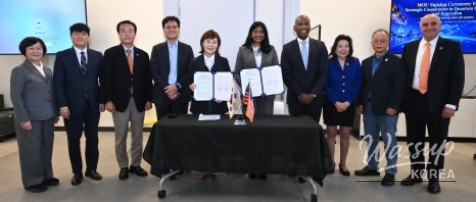
In September 2026, Gyeongsangbuk-do and Gumi City,
along with American quantum company IonQ
and domestic quantum company SDT,
signed a four-party agreement to establish a quantum foundry in Gumi Industrial Complex.
The quantum foundry can be understood as a manufacturing base for components
and systems necessary for quantum technology.
This agreement signifies cooperation aimed at connecting
the region's manufacturing capabilities with the global quantum industry.
However, signing the agreement does not immediately imply
the completion of production facilities or realization of investments.
It will be crucial to develop the cooperation into specific projects
and involve local businesses in the process.
In June 2024, Gyeongsangbuk-do announced the
"Gyeongsangbuk-do Quantum Technology Industry Promotion Strategy"
with the vision of becoming a leading hub for K-Quantum Industry.
The strategy includes three main pillars:
human resource development, infrastructure construction, and ecosystem creation.
By 2035, the goal is to train 600 professionals
and support 120 startups and related companies.
This is not merely an immediate achievement but a long-term policy goal.
The key is to nurture professionals and expand research foundations
while supporting research outcomes to lead to technological development and commercialization.
In 2025, a research team centered at POSTECH was selected
for the Ministry of Science and ICT's "Global Partnership Support Project for Quantum Science and Technology,"
laying the groundwork for international collaborative research.
On June 9, 2026, the opening ceremony for the "Quantum Global Partnership Leading Center"
and the "Global Quantum Science and Technology Research Hub Agreement"
took place at POSTECH.
Gyeongsangbuk-do, Pohang City, and POSTECH formalized their cooperation
to establish a global quantum research hub.
The leading center will build an international collaborative research platform
involving domestic researchers from POSTECH, DGIST, UNIST, and GIST,
as well as international institutions such as Harvard University, MIT,
and the Singapore Quantum Technology Center (CQT).
Research will focus on core technologies that connect different quantum platforms
and plans to train professionals through researcher exchanges and overseas dispatches.
This process connects local research capabilities with global research institutions
and broadens the growth foundation for future talents.
Quantum computers are often introduced with the example:
"Can calculations that take a long time on a supercomputer be done in under 5 minutes?"
This was highlighted by Google's quantum chip 'Willow,'
which was announced in December 2024.
Google stated that Willow performed a specific performance evaluation test,
'Random Circuit Sampling (RCS),' in under 5 minutes.
It was estimated that the same calculation would take about 10²⁵ years
on the high-performance supercomputers of the time.
It's important to note that this refers to the results of a specific performance evaluation test.
It does not imply that everyday tasks or calculations in all industrial settings
can be processed this quickly.
While this illustrates the technological potential of quantum computers,
further research is needed for practical problem-solving and broader industrial applications.
The future of Gyeongsangbuk-do lies in connecting research, talent, and businesses.
As we examined the policies for the quantum industry in Gyeongsangbuk-do,
we could see the expansion of its scope from strategy formulation
to international collaborative research, research hub establishment,
and manufacturing cooperation with global companies.
Moving forward, it will be important to observe how these preparations
translate into concrete joint projects,
business participation, investments, and production activities.
A thriving industrial ecosystem where quantum technology is researched locally,
professionals grow, and businesses seek new opportunities.
This is a piece written by Seongwoo Kwon, a 2026 Gyeongsangbuk-do SNS supporter.
* This post was directly reported and written by the Gyeongsangbuk-do SNS supporters,
and it has been published after verification by Gyeongsangbuk-do.






Source :https://blog.naver.com/gyeongbuk_official/224447563442
More from Place


No comments yet.