The Most Perfect Illusion: An Exploration of Hyperrealism
- Original source
- blog.naver.com


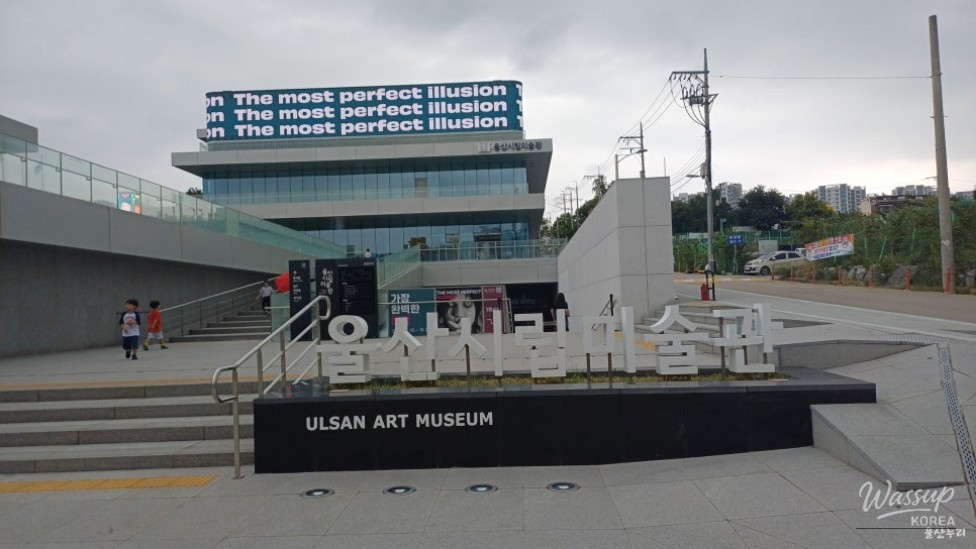
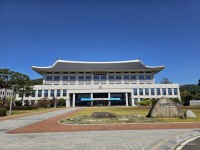
I had the opportunity to experience the international hyperrealism exhibition titled 'The Most Perfect Illusion' at the Ulsan Museum of Art.
The term illusion refers to something that appears to exist through imagination or hallucination, though it is not actually there.
While hyperrealism presents art that looks real, it paradoxically highlights that the artwork itself is not reality.
This exhibition showcased the works of 13 hyperrealist artists from the United States, Australia, Spain, Italy, Japan, and Korea, featuring a total of 100 pieces, including 90 paintings, 9 sculptures, and 1 large sculpture.
The exhibition title, 'The Most Perfect Illusion,' immediately captivated visitors from the entrance.
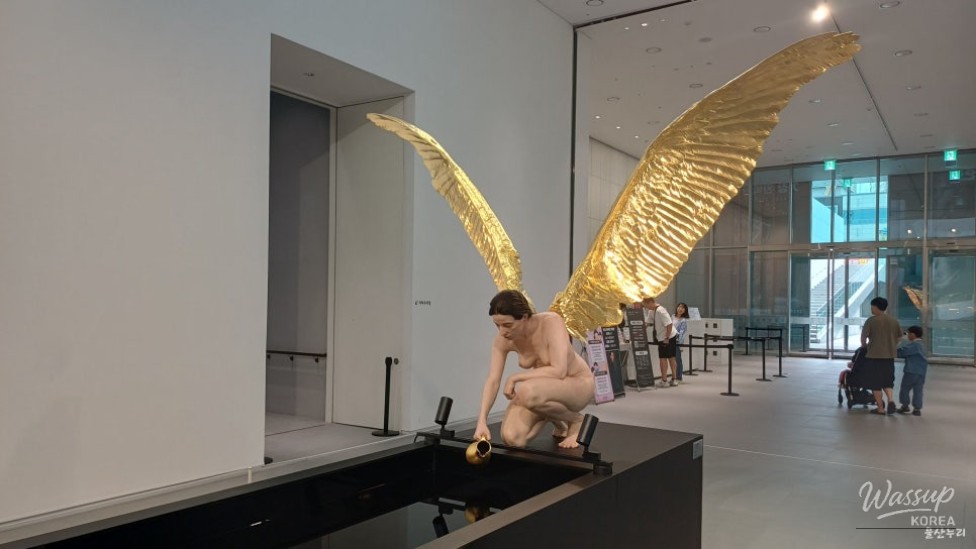
In the lobby, Australian artist Sam Jinks displayed a large piece titled 'Messenger.' This intricately crafted figure with wings created an illusion of being a real person.
The detailed representation of skin texture and body contours demonstrated how hyperrealist sculpture can approach reality. The wings, in particular, showcased the aesthetic beauty of the piece.
In the first section, titled 'The Thrill of Reality, the Abyss Beyond the Skin,' we encountered the perfect illusion of life through the meticulous depiction of physical features, even down to the finest details like hair and sweat pores.
American musician Jimi Hendrix and Mexican painter Frida Kahlo were depicted in a way that blurred the line between viewer and artwork, making it feel as if the piece was observing me as much as I was observing it.
Sam Jinks also explored human fragility by portraying figures smaller than life, revealing delicate skin textures and wrinkles that evoked a desire to reach out and touch them.
In another piece, a grandmother holding a baby symbolized the cycle of life, showcasing the beginning and end of existence.
Spanish artist Pablo Jurado Ruiz utilized a unique pointillism technique to create portraits that transformed from a collection of dots into a coherent face when viewed from a distance.
Italian artist Diego Coï conveyed his personal stories of love through pencil drawings, capturing the expressions and details of his girlfriend and wife's faces, while his self-portrait stood out as the only male representation.
American artist Mark Dennis's work 'Once Upon a Time' featured a green plant surrounded by birds, symbolizing a narrative that felt like it was on the brink of unfolding.
In the second section, 'The Gaze of Existence, the Aura of Still Objects,' the exhibition prompted viewers to experience familiar objects in unfamiliar ways, revealing their essence.
Korean artist Gu Ja-seung presented ordinary objects with such precision that they appeared photographic, prompting reflections on time and existence beyond their surfaces.
Ko Young-hoon's moon jar was notable for its slight asymmetry and fine cracks, enhancing its beauty through imperfection.
Kim Young-sung's work contrasted objects with living beings, creating a strange tension that invited viewers to seek hidden meanings beyond the visible.
In the third section, 'The Expansion of Boundaries, the Territory of Distorted Truth,' artists like Hashimoto Daisuke and Sam Leach explored new worlds beyond realism, showcasing the relationships between humans, animals, nature, and technology.
Leach's works featured unexpected combinations, such as a cat on a spacesuit, challenging conventional connections.
Robin Illy's transparent vinyl pieces expressed human perception and bias, symbolizing our struggles to fully understand the world around us.
In conclusion, hyperrealism has the power to transcend mere visual impressions, leading viewers to deeper contemplations of reality. The exhibition 'The Most Perfect Illusion' at the Ulsan Museum of Art provided a fascinating experience that encouraged us to reconsider our perspectives on reality.

Source :https://blog.naver.com/ulsan_nuri/224433827294
More from Place



No comments yet.