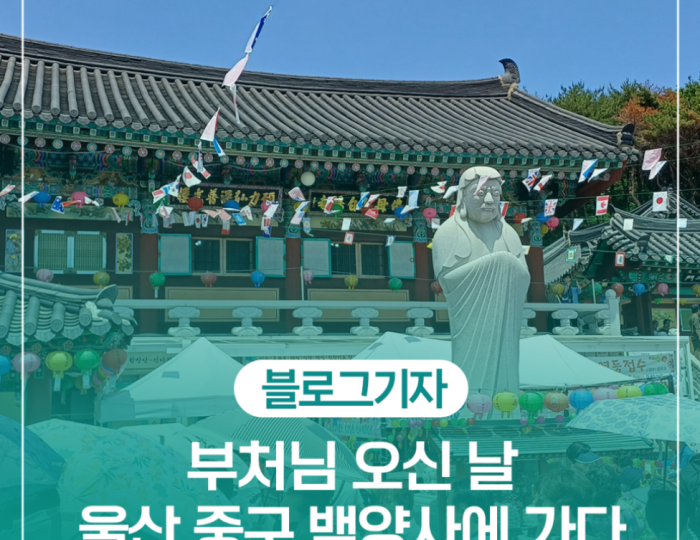
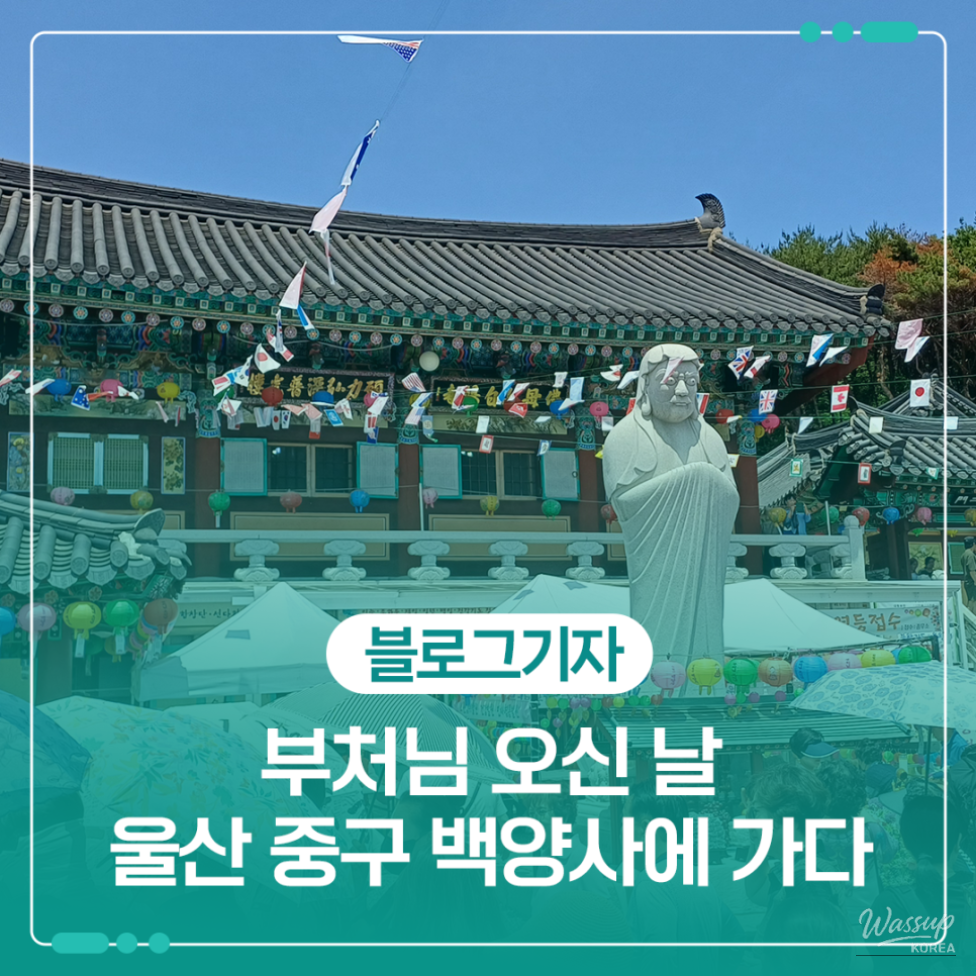
Exploring the Historic Baekyangsa Temple on Buddha's Birthday



On a breezy early summer day, I climbed Hamwol Mountain (200.6m), which embraces Baekyangsa Temple in Jung-gu, Seongan-dong.
It was the celebration of Buddha's Birthday in the year 2570, and I wanted to walk through the rich history of this millennium-old temple.
The path to Hamwol Mountain (also known as Bulmosan) is a blend of the old Seongdong 'Seong (城)' and the new Sang-an-dong 'An (安)'.
Hamwol, meaning 'embracing the moon', has been revered as a sacred mountain in Ulsan since ancient times.
Starting from the Korea National Open University athletic field, I slowly ascended the gentle slopes of Hamwol Mountain. Despite its modest height of 200.6m, it is considered one of Ulsan's main mountains alongside Muryongsan and Munsusan.
As I climbed the narrow paths, I quickly became drenched in sweat from the early summer heat. I took my time, soothing my body and mind along the gentle mountain trail.
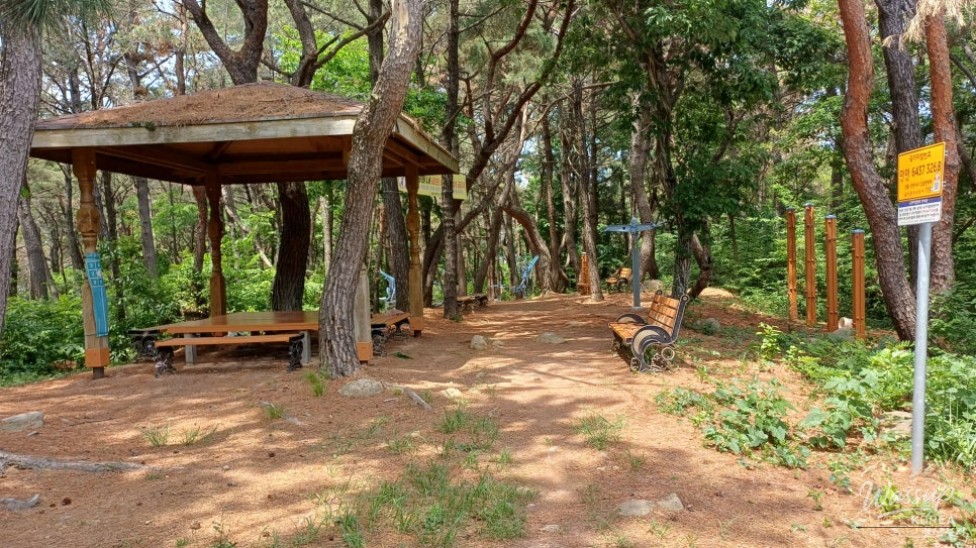
Upon reaching the ridge, a moss-covered pavilion beckoned me to take a rest.
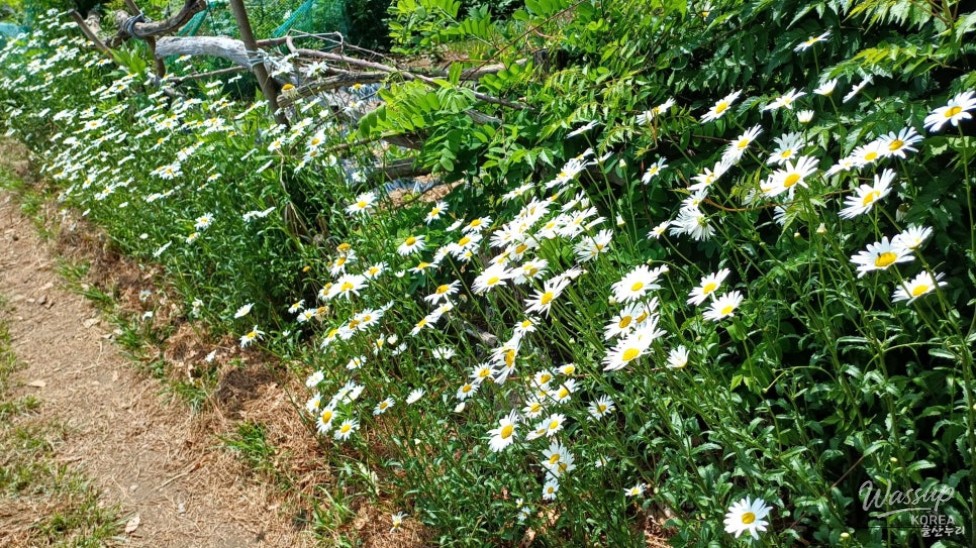
White marguerites bloomed by the roadside, confessing their love like the flowers they represent.
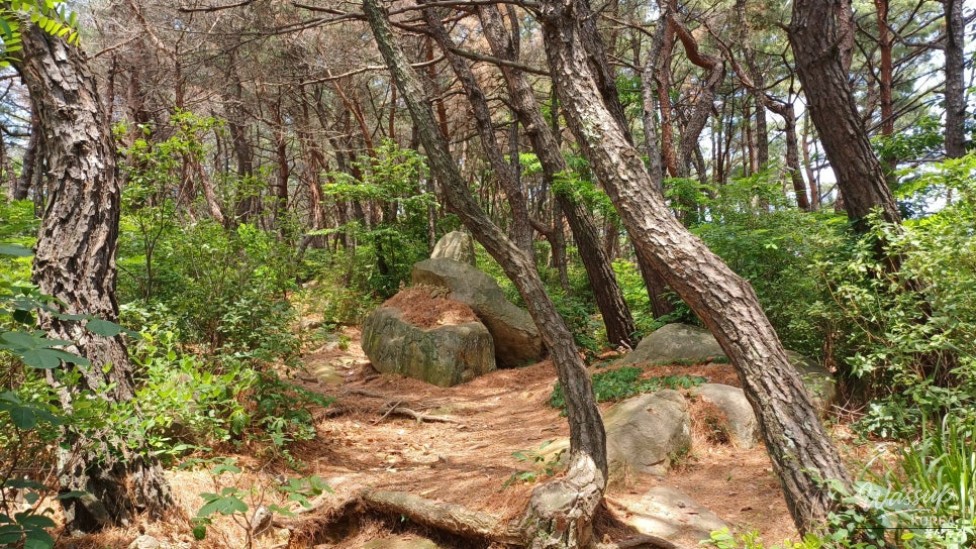
The rocks, standing shoulder to shoulder, exuded an almost primordial energy that felt hard to approach. It reminded me that humanity has learned to revere nature since ancient times.
The gnarled pine trees resembled practitioners holding onto an ancient devotion, having grown up listening to the sutras from nearby Baekyangsa Temple.
The vibrant greens and phytoncides offered by the forest cleared my mind as I descended past a bamboo grove, leading me back to the parking lot.
At the 'Taehwa Complex Cultural Space Mandi' tea house, I looked out over Ulsan city. The energy of the Yeongnam Alps seemed to surge towards me, as if I could reach out and touch it.
Turning my gaze, I saw Ulsan Port, the gateway of Gyeongju during the Silla dynasty, a site marked by frequent invasions.
Suddenly, the saying 'A generation that does not reflect on history repeats the same tragedies' crossed my mind. The view of mountains, sea, and industrial complexes merging into the coastline was a majestic sight.
The coexistence of nature, industry, and human life within one frame resembled a grand landscape painting, showcasing Ulsan's unique beauty.
As I strolled through the historic Baekyangsa Temple on Buddha's Birthday, it was bustling with crowds, a hub of Buddhist culture.
Founded by the great monk Baekyang during the Silla period, Baekyangsa means 'white poplar'.
According to the 'Annals of King Sejong', the sound of the pine winds at Baekyangsa is listed among Ulsan's eight scenic views.
In the Joseon era, Ulsan's governor Sim Won-yeol wrote in his poetry collection that the evening bell of Baekyangsa should be 'heard not with the ears, but with the heart.'
Baekyangsa is a traditional temple characterized by intricate dancheong (traditional Korean decorative painting) and tranquil wooden architecture, covering an area of approximately 78,000㎡, including about 18,000㎡ of temple grounds.
Once, most of the slopes of Hamwol Mountain belonged to Baekyangsa. Up until about 30 years ago, this area was a popular picnic spot for Ulsan citizens.
Since the 1970s, urban development transformed fields into residential areas. The temple, once nestled within the embrace of Hamwol Mountain for a millennium, has now become a temple in the city, surrounded by ten public enterprises and 30,000 residents.
The Unification Gate signifies the passage from the mundane world to the world of enlightenment. Next to it, the True Nature Gate represents the unchanging truth of things.
Crossing the temple's gates is also a step closer to the truth within oneself.
Upon entering the temple grounds through the Unification Gate, it was bustling with visitors celebrating Buddha's Birthday.
In front of the main hall, a large statue of Bodhidharma greeted me with its heavy presence.
The founder of Chinese Zen, Bodhidharma emphasized the practice of awakening one's pure nature. He conveyed truths in simple language, attracting many followers.
In front of the statue, a ceremony was taking place where water was poured over the baby Buddha, symbolizing the cleansing of afflictions and returning to one's original state.
The incense hall, a resting place for Buddhists, showcased elegant beauty with gold dancheong and seven treasures.
The bell tower housed various ceremonial instruments for the benefit of all sentient beings, reflecting a heart of compassion for all life.
In the lecture space of the main hall, the compassionate Avalokiteshvara was enshrined, offering a gentle smile that seemed to soothe wounded hearts in the secular world.
Gazing at her felt like standing before a blooming flower, naturally clearing my mind.
Beside Avalokiteshvara, the youthful deity Namsoon and the Dragon King of the East added depth to the faith.
The main hall, elevated in status, is referred to as the Great Hero Hall. Its splendid dancheong and traditional architectural style were magnificent.
Inside, statues of Shakyamuni Buddha, Ksitigarbha, Manjushri, Samantabhadra, and Avalokiteshvara were enshrined.
Behind them, an Amitabha triad painting outlined in white on a red background was displayed.
In front of the Great Hero Hall, the 'Law of Nature' composed by the monk Uisang and interpreted by the abbot Mukam Jiseon conveyed the words of the Buddha.
✔️ The Seven Stars Hall, the oldest building in Baekyangsa, enshrines the Seven Stars that govern human lifespan and fortune.
✔️ The Hall of the Underworld enshrines Ksitigarbha, who saves beings in hell.
✔️ The Yushim Hall is the residence of the abbot, while the Heeja Hall is where monks live.
Ascending the 108 steps leads to the Mountain Spirit Hall. Buddhism incorporates folk beliefs, accepting mountain spirits as protectors of the Buddha.
Behind the Mountain Spirit Hall, the pagoda is constructed in an oval shape topped with an octagonal roof. Various treasures, including the founder's pagoda and the Amitabha triad, have been designated as local cultural heritage.
As I exited the temple, the phrase 'A temple to find the true self' seemed to encapsulate my day.
Visiting Baekyangsa on Buddha's Birthday offered a moment to reflect on my true self. On my way down the mountain, summer had already drawn near.
Source :https://blog.naver.com/ulsan_nuri/224303881691
No comments yet.