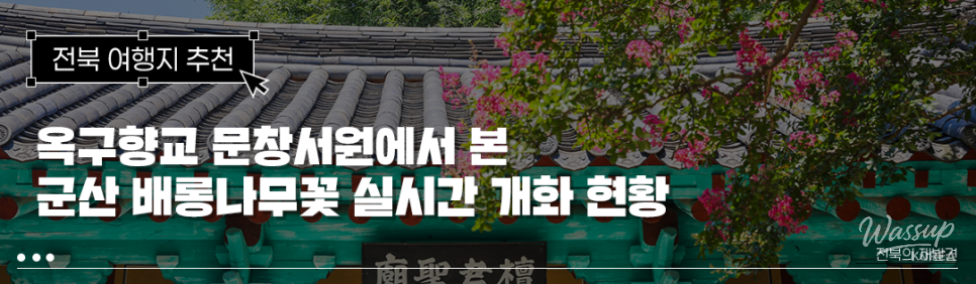
Exploring Gyeongju in August: The Beauty of Lagerstroemia



As the summer heat intensifies, the Lagerstroemia flowers begin to bloom. These flowers start blooming in mid-July and continue to blossom for about 100 days, which is why they are also known as 'Mokbaekilhong' or 'the flower that blooms for a hundred days.'
Due to their sensitivity to cold, these trees are primarily planted in southern regions, and during this time, you can see Lagerstroemia flowers blooming everywhere. Let me introduce you to the beautiful sights of the blooming Lagerstroemia at Okgu Hyanggyo and Munchang Seowon.
As of August 3, the Lagerstroemia flowers are in full bloom. Okgu Hyanggyo is located right next to Munchang Seowon. The red gate at the entrance symbolizes the sacred space, warding off evil spirits and misfortune. Underneath it, there is a 'Hama-bi' stone, indicating that visitors should dismount their horses and walk from that point.
Okgu Hyanggyo was established in 1403 in Iggok-ri and moved to Sangpyeong-ri in 1484. It was destroyed during the Imjin War and rebuilt in its current location in 1646. Recently, several new facilities have been constructed or relocated to this site.
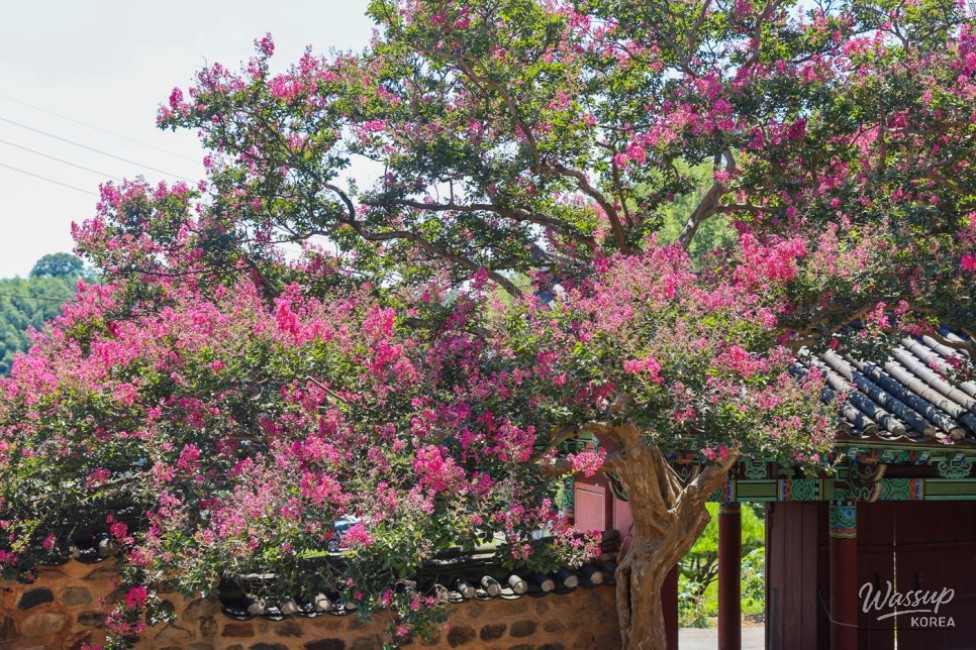
Upon entering Okgu Hyanggyo, you can see the Lagerstroemia flowers in full bloom. Even just standing there makes you sweat in the heat, but the flowers look stunning under the bright sun.
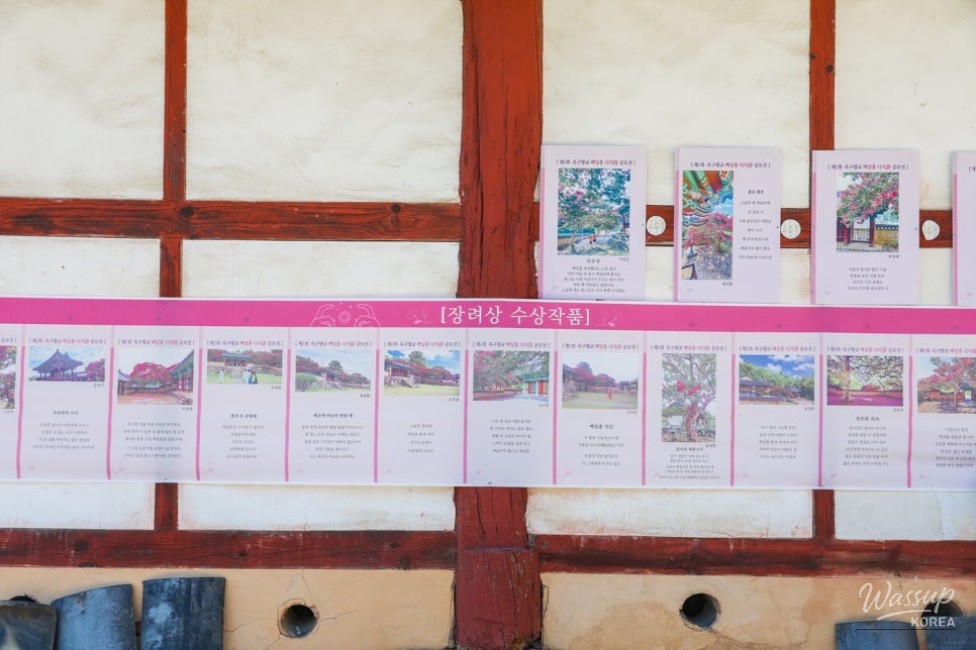
The first Okgu Hyanggyo Lagerstroemia Digital Photo Contest award-winning works are displayed inside the building, capturing various perspectives from travelers and evoking memories of their time at Okgu Hyanggyo.
There are also props for photography, including colorful umbrellas and summer hats. This year, a contest is being held again, so feel free to create memories here while participating in the competition.
Hyanggyo was an educational institution established during the Goryeo and Joseon dynasties, where Confucian rituals were held for the sages and teachings were provided to local students. Climbing the stairs, you will face the Daeseongjeon hall, where the spirit tablets of Confucian sages are enshrined, including Confucius.
Beyond the walls of Daeseongjeon, you can see the Lagerstroemia flowers. There are many Lagerstroemia trees at Okgu Hyanggyo, so as you stroll around, you can find the flowers beautifully integrated with the buildings.
Petals have fallen onto the walls, and while many dried flowers are visible, the blooms are gradually falling as of August 3. If you want to see the Lagerstroemia flowers, you should hurry.
Next to Daeseongjeon is the Dan-gun shrine, built in 1976 by local Confucian scholars to commemorate the noble founding ideology of Dan-gun, which is 'Hongik Ingan.' Rituals are held on the 15th day of the 3rd lunar month and October 3rd to honor this.
The scenery of the Dan-gun shrine signboard with Lagerstroemia flowers is a healing sight, even in the hot weather.
Under the summer sun, the Lagerstroemia flowers shine even more brightly, and the green leaves sparkle.
Next to Okgu Hyanggyo is Munchang Seowon, where red Lagerstroemia flowers bloom beyond the separating walls.
Passing through the gate leads you to Munchang Seowon, where a monument stands in front, and you can check its details through an information guide.
Munhang Seowon was established by the scholars of Okgu, named after the title of Choi Chi-won, 'Mun Chang-hu.' Inside the shrine, the spirit tablet and portrait of Choi Chi-won are enshrined, and the plaque was handwritten by the then-president Park Chung-hee.
There are also several older Lagerstroemia trees growing at Munchang Seowon. The Lagerstroemia is known for its smooth trunk, which is said to be ticklish when touched, earning it the nickname 'Ganjireom-namu.'
Although the abundant Lagerstroemia flowers are starting to wilt, they are still worth seeing.
There is a 'Jacheondae' at Munchang Seowon, said to be the pavilion where Choi Chi-won read and relaxed after returning from the Tang Dynasty. The name 'Jacheondae' comes from a nearby pond that is always red. Originally located on a small rocky mountain in Haje Port, Okgu County, the current building was reconstructed in 1967.
From the top of Jacheondae, you can overlook the surrounding scenery and feel the breeze.
Next to Munchang Seowon is Oksan Seowon, which can also be seen from Jacheondae.
The scenery of Lagerstroemia flowers and hibiscus flowers is one of the sights of summer. As I explored the area from Okgu Hyanggyo to Munchang Seowon, the beautiful integration of traditional buildings with Lagerstroemia flowers was truly captivating.
Everything is conveniently located in one area, making it easy to explore, and there are shaded spots to escape the scorching sun. Despite the ongoing heatwave, travelers are drawn here to witness the blooming Lagerstroemia flowers.
Given the weather, the flowers are starting to drop, so if you wish to see the lush Lagerstroemia blooms, please visit soon.


Source :https://blog.naver.com/jbgokr/224367567218
No comments yet.