A Journey to Gunbuk Station: Memories and Discoveries
- Original source
- blog.naver.com


By Jo Yoon-hee, 15th Blog Reporter
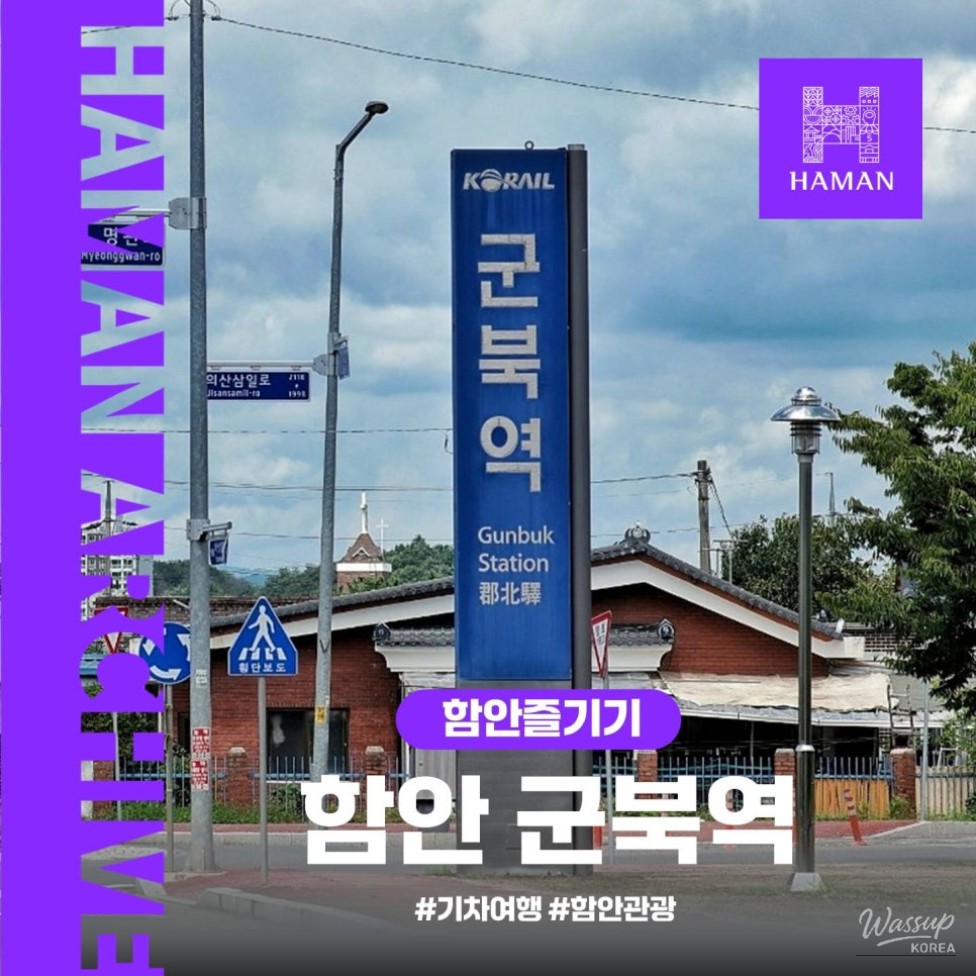
Gunbuk Station in Hamann
Located at 1992 Uisan Samil-ro, Gunbuk-myeon, Hamann-gun, Gyeongsangnam-do
With Chuseok approaching and having received good news after a long battle with illness, I wanted to share my joy with my parents, so we visited my great-aunt's house in Hamann. The neighborhood where she lives is near Gunbuk Station, which is also the birthplace of the founder of Hyosung Group, Manwoo Cho Hong-je. We saw her off as she headed to the village hall and then made our way to Gunbuk Station.
Thinking of Gunbuk Station, one of the places that left a strong impression on me as a child when I visited my great-aunt, I suggested we go there. However, since it has relocated, the train station from my childhood memories is no longer there. As we explored the new building, I tried to connect it with my past memories.
In front of Gunbuk Station, I noticed a sign for the Gunbuk Dolmen Site, indicating that dolmens might be nearby. Dolmens are representative tombs from the Bronze Age, also known as goindol, and they are large stone structures placed over graves. The Gunbuk Dolmen Site is said to have one of the highest numbers of dolmens in the Gyeongnam region, and since I had no prior information about it, I plan to explore the dolmens next time.
Initially, I thought the monument in front of Gunbuk Station was a commemorative stone for its relocation, but I found a stone inscribed with 'National Mother Yook Young-soo's Unforgettable Monument' behind it. There were small pillars surrounding the main stone, and I searched for information about them but couldn't find anything definitive. If anyone knows about this, I would appreciate any insights.
There are also other places to explore near the newly relocated Gunbuk Station. I saw a sign for the entrance to Baekisan Hiking Trail and an ice cave. The ice cave is in a former copper mine area with four exposed shafts, where cool air and water flow from the abandoned mine, leading to its name. The landowner runs a restaurant there, and my parents mentioned they visited a few years ago.
As I walked around outside the station, capturing the surrounding scenery, I followed some people who had just exited the train station. Under the railway bridge, there were several benches placed there by someone, and I understood why so many people came to relax in that shaded area with a refreshing breeze. If camping were allowed, it would make a great camping spot.
Leaving the refreshing natural breeze behind, I stepped inside the station. Although the new Gunbuk Station didn't hold my childhood memories, the essence of the place still resonated with me.
The old Gunbuk Station was located near Jungam-ri in Gunbuk-myeon, right next to the Gunbuk traditional market, and the station square was connected to the market. The old station was closed on October 23, 2012, and relocated about 1 km south to its current position due to improvements to the Gyeongjeon Line.
With the unified high-speed rail operation plan confirmed, the history of Gunbuk Station is quite similar to that of any other train station, with announcements regarding ticket sales and service changes. Its rural location makes it smaller in scale, but it still serves its purpose.
The main reason for relocating Gunbuk Station was not just to move it, but to improve the entire Gyeongjeon Line by straightening the railway line itself. Remembering how winding the old Gyeongjeon Line was, I made my way to the boarding gate.
Gunbuk Station, located in Dongchon-ri, Gunbuk-myeon, Hamann-gun, Gyeongsangnam-do, was built in 1923 with the construction of the Gyeongjeon Line, starting operations on December 1, 1923. It served as a gateway to the northwest of Gyeongnam during the Japanese colonial period and was the terminus of the Masan-Gunbuk line, playing a role in transporting rice harvested from the Hamann fields to Masan Port.
After nearly a century of use, the old railway's winding sections made it difficult to increase speed, leading to the construction of a new line for the double-track electrification project. The new Gunbuk Station, relocated about 1 km south, now features a straightened railway line.
As I was about to leave, I noticed the Mugunghwa train from Busan to Mokpo had just stopped on the tracks. There were many passengers on board, and I took care to capture photos without showing their faces.
In my childhood, traveling from the old Jin-Young Station in Gimhae to the old Gunbuk Station took quite a while. Looking at the Mugunghwa train brought back memories of my grandmother sharing boiled eggs from home and cider sold on the train, filling my mind with nostalgia.
Perhaps it’s time for me to take that nostalgic train journey again. Currently, Gunbuk Station serves a total of 14 passenger trains daily, handling passenger services and ticket sales. While KTX does not stop here, the Mugunghwa trains stop seven times in each direction. As of 2014, the number of passengers using Gunbuk Station was significant, and I believe it still sees many visitors today.
Gunbuk Station, which began operations in 1923, was relocated on October 23, 2012, and now operates with a double island platform with four tracks. The old Gunbuk Station has been repurposed as the Daeam Lee Tae-joon Memorial Hall.
Train travel continues to evoke nostalgia and memories for many. While it was once a means of survival, it has become a way to heal and connect with the past. Gunbuk is a place where history and the present coexist, and sharing these memories with my parents at Gunbuk Station was truly special.
Source :https://blog.naver.com/arahaman/224400984813
More from Place


No comments yet.