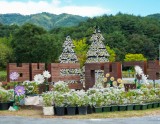
Exploring the Tranquil Beauty of Yeongtap Temple in Autumn
- Original source
- blog.naver.com



As autumn deepens, it's a great time for travel.
In our country, you can find temples in any region,
and in Dangjin, there are many temples and Buddhist relics.
The largest is Yeongtap Temple of the Jogye Order of Korean Buddhism,
along with smaller temples like Bodeoksa, Yeongnangsa, Sinamsa, and Seowonsa.
Yeongtap Temple is located about 1.8 km from the center of Myeoncheon-myeon,
which takes about 5 minutes by car.
The golden fields along the way are beautiful.
As you enter along the village road,
to the left of the entrance to Yeongtap Temple is the Jeolgol Reservoir.
Although it's not large,
it harmonizes well with the scenery of Yeongtap Temple.
Inside, there are parking lots on the left and right,
where you can park your car and walk slowly inside.
At the entrance, there's a sign indicating Yeongtap Temple,
making it a great spot for photos.
Along the roadside, there are six zelkova trees designated as 'Beautiful Trees' by Dangjin City.
These trees are over 110 to 200 years old,
with lush leaves in summer and beautiful autumn foliage.
The presence of these large trees adds to the historical atmosphere of the temple.
Yeongtap Temple is part of the 7th course of the Wonhyo Enlightenment Path,
leading to Anguksa from here.
At the foot of the mountain, there are signs indicating walking paths.
After exploring Yeongtap Temple,
it's enjoyable to walk along the mountain trails.
Yeongtap Temple is a traditional temple surrounded by majestic ancient trees and a pine forest,
located at the foot of Sangwangsan Mountain in Seonghari, Myeoncheon-myeon, Dangjin City.
The area around the temple has a cozy and serene atmosphere,
making it a peaceful place to visit at any time.
Today, we introduce Yeongtap Temple,
a branch temple belonging to the 7th district of Sudoksa.
Yeongtap Temple, affiliated with the Jogye Order of Korean Buddhism,
is located on Yeonhwabong in Seonghari, Myeoncheon-myeon, Dangjin City.
Although the exact year of its establishment is unknown,
it is said to have been founded by National Master Doseon during the late Unified Silla period.
In 1798, it was rebuilt by monk Ji-yun of Yeonamdang,
and in 1911, devotees renovated it.
In 1928, Lee Min-dong reconstructed the main hall.
In 1985, the construction of the 30-pyeong Daeungjeon began,
which was completed in 1990.
Although the main hall was lost to a fire in 1992,
it has recently been restored.
In 2010, the San Shin Gak was newly constructed by monk Cho-un.
Recently, a new guesthouse was built,
and the Birojeon was also established, attracting many devotees and tourists.
Yeongtap Temple has about 800 devotees,
who are working hard to spread Buddhism in the Myeoncheon area.
To the southwest of the temple, there is the Daeungbojeon,
and to the northeast, the guesthouse, San Shin Gak, and the Birojeon are arranged.
To the left of the temple courtyard is the Birojeon,
which houses the seated statue of the golden Biro Buddha.
The statue, flanked by the Bodhisattvas Manjusri and Samantabhadra,
follows the typical composition of the Goryeo period.
As you enter the courtyard, the Daeungjeon is directly ahead.
On the stairs leading to the Daeungjeon,
there are pots of chrysanthemums,
symbolizing the fragrant season of autumn.
The Daeungjeon was built in 1988,
with five rooms in the front and three on the side,
housing the statue of Sakyamuni Buddha in the center.
Inside the Daeungjeon, there is a bronze bell created in 1760,
which is 60 cm tall and 46 cm in diameter.
Although small, this bell is noted for its delicate craftsmanship.
In the glass shrine, there is a statue of the Medicine Buddha.
The main altar features Amitabha Buddha,
with Avalokiteshvara and Ksitigarbha Bodhisattvas on either side.
This statue, made during the Goryeo period, is believed to heal human diseases and ignorance.
It is said that during the late Goryeo period, monk Muhak visited the temple and noticed a strange rock emitting light,
leading him to carve the Medicine Buddha statue to pray for the peace of the country and its people.
The image of the Buddha carved into the rock is gentle and approachable.
To the left of the glass shrine is the San Shin Gak,
which was newly constructed in 2010 by monk Cho-un on a natural stone base.
The San Shin Gak reflects the result of the integration of mountain worship beliefs into Buddhism,
with Buddhism absorbing the faith to enshrine local deities.
Behind the glass shrine, there is a large rock with a seven-story stone pagoda.
This pagoda was built by National Master Bojo during the mid-Goryeo period in front of the temple courtyard.
It is said that monk Muhak moved it to its current location while creating the stone Buddha.
In 1798, monk Ji-yun of Yeonamdang left a record of building a five-story pagoda behind the glass shrine while restoring it,
and the temple was named 'Yeongtap Temple.' Originally a seven-story pagoda,
it was later damaged, leaving only five stories,
but it was restored to its seven-story form by devotees in the 1920s.
If you walk about 200 meters along the mountain path,
you will find a rock with the inscription '依斗岩' carved in a cursive style,
and below it is inscribed '人道正一,'
which was carved by Kim Yun-sik in 1887.
Source :https://blog.naver.com/dangjin2030/224451298823
More from Travel





No comments yet.