Ulsan: Pioneering the AI Transformation Era


The industrial capital of Ulsan stands at a new turning point.
Ulsan has driven the South Korean economy through shipbuilding, automotive, and petrochemicals.
Now, it is redrawing the map of future industries with artificial intelligence (AI) as its growth engine.
This marks the beginning of the AX (AI Transformation) era.
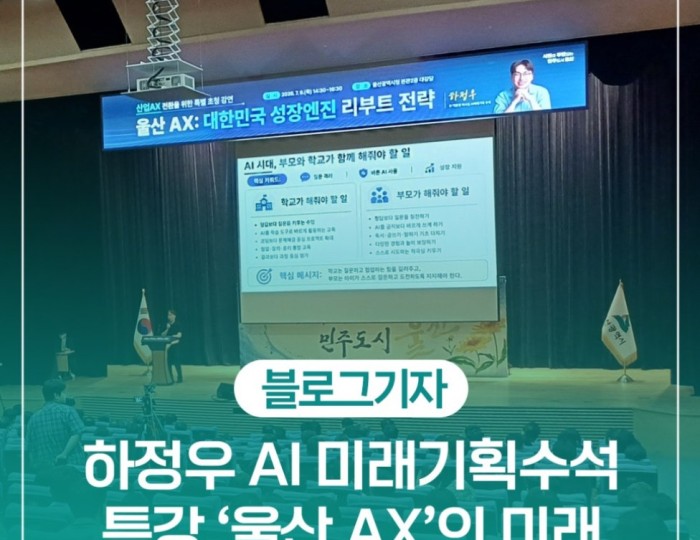
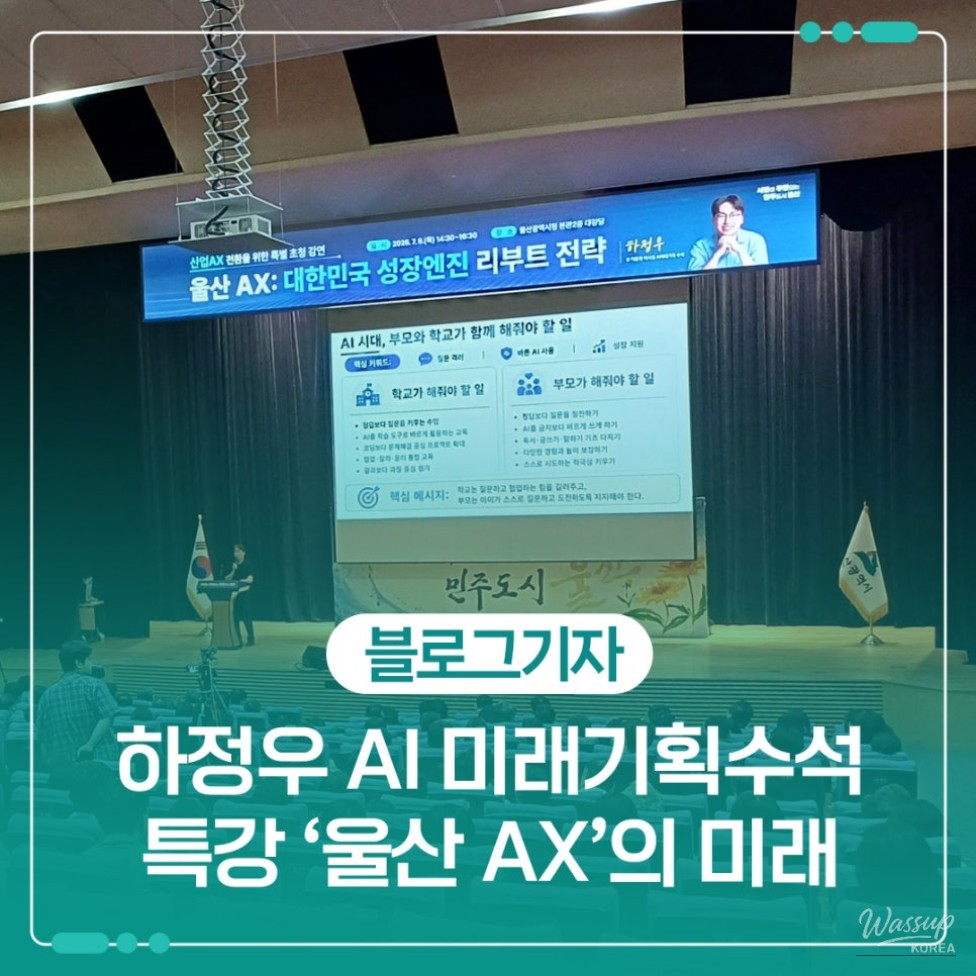
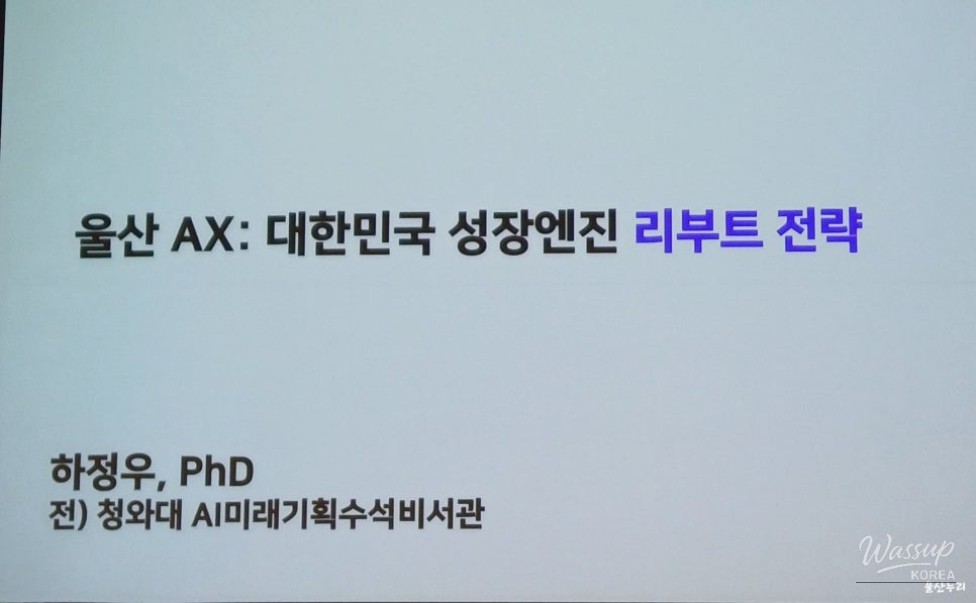
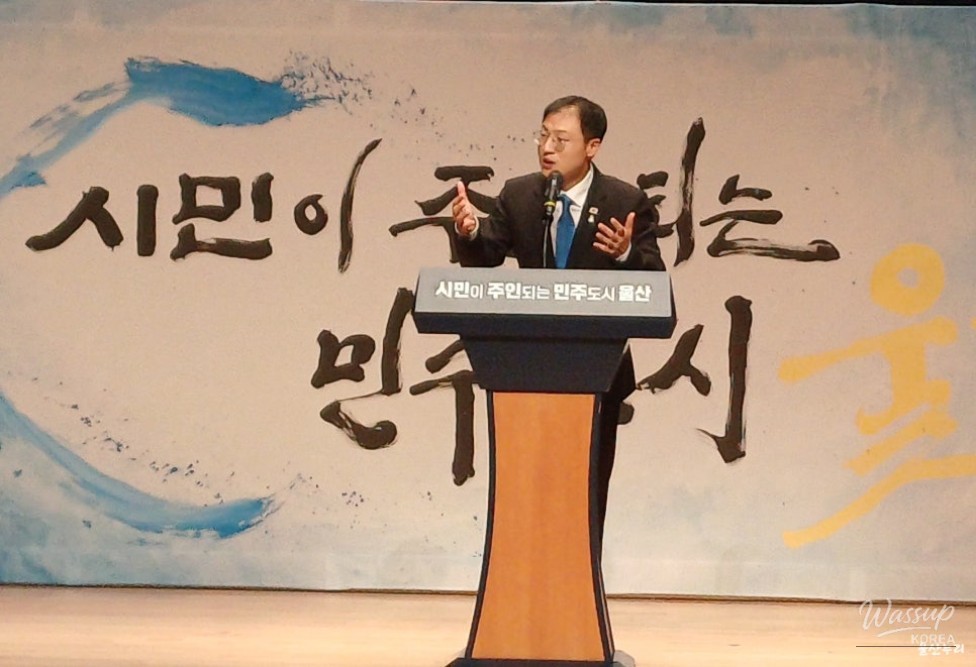
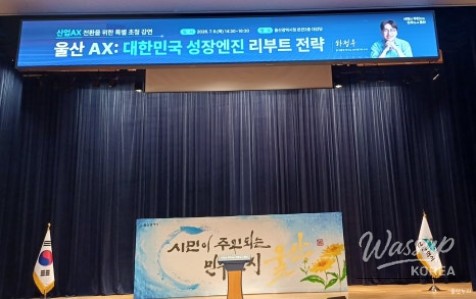
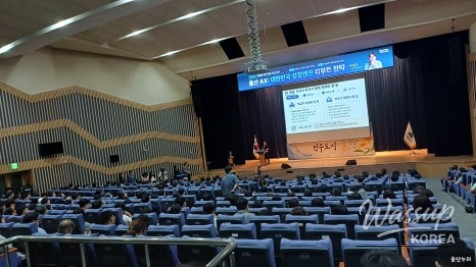
Last month, a special lecture titled "Ulsan AI Transformation (AX), Reboot Strategy for South Korea's Growth Engine" was held in the auditorium on the second floor of the city hall.
More than 500 attendees, including public officials, local business leaders, university students, and representatives from relevant organizations, participated.
The guest speaker was Ha Jung-woo, former Chief of AI Future Planning at the Presidential Office.
Before the lecture, Ulsan Mayor Kim Sang-wook emphasized the future of Ulsan based on AI, stating that he would support Ulsan becoming a hub for industrial AX.
The lecture began with an introduction to the latest AI technologies, presenting a meaningful vision of how Ulsan, as the center of South Korea's manufacturing, will lead the global industry based on AI.
Why has AI developed so rapidly?
A few years ago, AI often gave nonsensical answers to simple questions. Now, generative AI can converse, write reports, and even create images and videos.
Ha attributed this change to three factors: the explosive increase in data, enhanced GPU-based computing performance that allows for massive data learning, and innovations in deep learning algorithms that enable generative AI.
These three elements have combined to evolve AI into a stage where it can understand goals, devise action plans, and collaborate with humans to solve problems.
The core of the AI era is 'tokens'.
The most frequently mentioned term during the lecture was 'token'. A token is the smallest unit through which AI understands the world.
For instance, an image is analyzed in thousands of small pieces, sound is broken down into short time intervals for understanding, and sentences are learned through words and sentence fragments.
AI understands the world in token units and produces new results in token units.
Ha emphasized that the competitiveness of nations will depend on how many 'factories that produce intelligence' they possess.
He likened AI data centers to 'token factories', where various industrial AIs are created using data and GPUs as raw materials.
From shipyard precision welding AI to automotive self-driving AI, and robots for rescue in hazardous areas, all represent different forms of 'intelligence tokens'.
The lecture predicted that the world would soon enter an era where such intelligence is bought and sold, with countries producing many tokens becoming new industrial powers.
Why is Ulsan the protagonist of the AI era? The answer lies in its data.
Ulsan is a city with a global manufacturing base in shipbuilding, automotive, and petrochemicals.
The accumulated production processes, quality control, and equipment operation data are industrial assets that other cities cannot easily replicate.
Once AI fully learns from this data, it can produce world-class industrial AI for export.
Ulsan can generate high-value AI across various fields, from precision welding in shipyards to smart factory process control, autonomous driving, and industrial safety.
The future of AI is not confined to computer screens. The era of physical AI, which collaborates with humans in industrial settings, is dawning.
With AI working alongside people in dangerous welding tasks, repetitive automotive manufacturing, and rescue operations in disaster areas, the era of increased productivity and safety is approaching.
Intelligent manufacturing systems that can autonomously judge and respond in power outages or unexpected situations will become key technologies that determine manufacturing competitiveness.
Public administration must also shift to an AI-centric model.
The lecture pointed out that many administrative procedures could be improved with current technologies.
Public AX should boldly eliminate procedures that inconvenience citizens, aiming for an administrative environment where AI assistants provide necessary services.
On that day, Ulsan City signed a business agreement for the verification and training of talent to spread industrial AX and officially launched the Ulsan Industrial AX Council, a public-private partnership organization.
This is the first step toward Ulsan actively pursuing AI-based manufacturing innovation.
By adding AI to its solid industrial foundation in shipbuilding, automotive, and petrochemicals, Ulsan has the potential to leap from being South Korea's industrial capital to a global city of AI manufacturing innovation.
As the heart of South Korean industry, Ulsan is now leading the AX era with AI, writing a new chapter in its history. The AI transformation is starting now in Ulsan.
Source :https://blog.naver.com/ulsan_nuri/224367728299
No comments yet.