Spring Awakening at Gangji Valley



By Jo Yoon-hee, 14th SNS Reporter
Gangji Valley
Location: Starting from 43-2, Gangji 1-gil, Haman-myeon, Haman-gun, Gyeongnam (Gangji Village Hall)
This year, we welcome spring in Haman at Gangji Valley once again. The first encounter with wildflowers feels like first love, making us eagerly await a whole year. Now that March has begun, shall we go meet the wildflowers of Gangji Valley together?
There is a small open space in front of the valley where a few cars can park. Since several cars were already parked, I carefully squeezed mine next to them and headed up the mountain. Gangmyung-ri, where Gangji Valley is located, got its name from the combination of Gangji-ri and Jangmyeong-ri. This area was part of Arakaya, one of the six Gaya confederacies.
In 757 AD, it was renamed Haman-gun and later became Hamju in 995 AD. Originally part of Sang-ri, it was merged into Haman-gun's Eonnae-myeon on March 1, 1914, and has since been known as Gangmyung-ri in Haman-myeon.
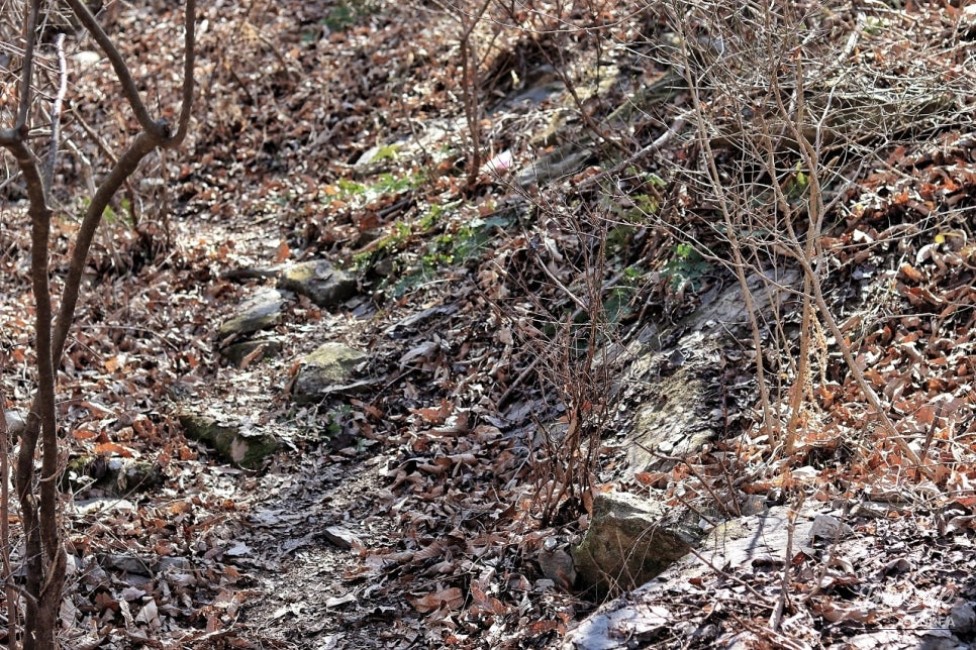
As I climbed up, I expected to see wildflowers, but to my surprise, not a single one was in sight. Just as I was about to lose hope, some hikers coming down encouraged me, saying that I would see them if I went a bit further. With renewed determination, I began to search as if I had radar in my eyes.
Finally, I spotted a bloom! How delightful it was! However, the flower seemed to be crawling towards the ground, as if searching for a warm spot to escape the cold. Unlike the usual warm days, the sudden drop in temperature had left it tightly closed, basking in the spring sunlight. I believe that if the temperature rises normally, we will soon see its beautiful form.
The wildflower I found is a perennial herb that grows in the mountains across the country, primarily under trees in forests, often seen in sunny or semi-shaded areas. The flower, known as the Korean Hepatica, grows to about 10-15 cm tall, has leaves that divide into three lobes, and typically blooms a single white flower on a long stem.
The leaves initially emerge curled and gradually unfurl, displaying a reddish or purplish hue that deepens to green. The roots spread sideways, forming clusters. The name Hepatica is derived from the fact that you can often hear pheasant calls when you see these flowers in early spring.
In addition to the Hepatica, I also encountered other flowers like Corydalis and Anemone. While scanning the ground, I was delighted to discover a mushroom with patterns resembling clouds. I pondered whether it was edible, but I continued my walk through the valley, reminding myself to be cautious with mushrooms unless you're an expert.
As I continued, I noticed a familiar flower, the Hepatica, peeking out from between the rocks. Its roots were nestled below, stretching towards an open space, showcasing its resilience.
The valley, now infused with spring, felt as if the earth itself was awakening. The sounds of crunching soil beneath my feet and the soft cushion of dirt brought me a small happiness. Even though I didn't see a landscape filled with wildflowers, I still felt grateful.
As I wandered, I spotted a unique phenomenon called a twin tree, where two different trees grow closely together, sharing resources. This reminded me to look up from the ground and appreciate the extraordinary sights around me.
The valley is preparing to burst forth with new life as the ice melts and spring arrives. Before April comes, or even before the end of March, I encourage you to experience spring alongside the wildflowers in Gangji Valley.

Source :https://blog.naver.com/arahaman/224211255448
No comments yet.