Exploring the Stories of Forest Guardians and Local Communities
- Original source
- blog.naver.com


[Reporter: Go Do-hye]
From science and history lectures to experiencing grass flutes,
Meeting the people who protect the forest and the stories of the local community.
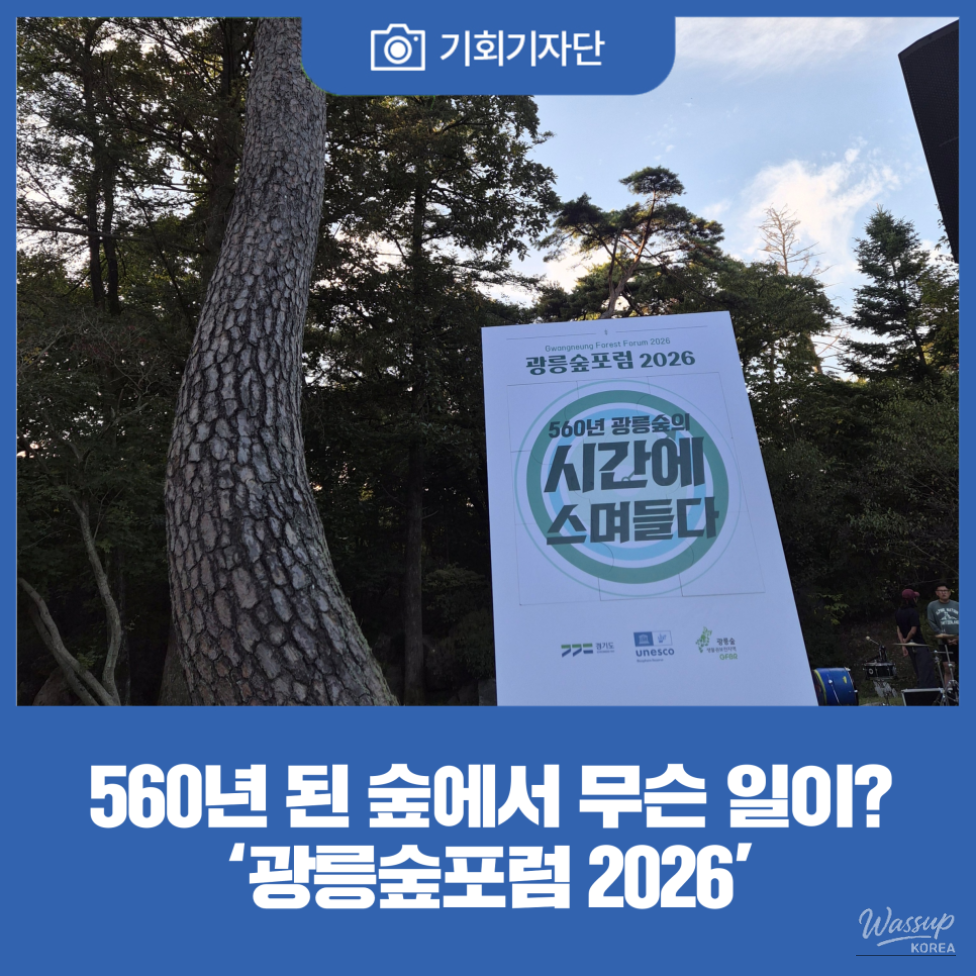
A banner announcing the 'Gwangneung Forest Forum 2026'
An event was held to learn about science and history in a forest that has embraced 560 years of time, where participants created small gardens using grass leaves to make sounds. On October 9, the 'Gwangneung Forest Forum 2026' took place at the Kyung Hee University Graduate School of Peace and Welfare in Namyangju, Gyeonggi Province, under the theme 'Soaking in the Time of 560 Years of Gwangneung Forest.' The forum included an opening ceremony, lectures, panel discussions, cultural performances, and experiential programs, allowing attendees to engage with the value of the forest in various ways.
The Gwangneung Forest Forum 2026 was held at the lawn of Kyung Hee University Graduate School of Peace and Welfare.
What stood out at this forum was the perspective that the forest should not only be viewed as a natural area to protect, but also as a space where history, ecology, and community life intersect. While knowledge was shared in lectures, citizens spent time creating and experiencing nature firsthand at the experiential sites.
Preserving the forest involves contemplating with the local community.
Gwangneung Forest is a historically preserved area and an ecological asset where diverse species thrive. However, safeguarding the forest cannot be achieved solely by protecting the nature within it. Collaboration with the local community, experts who study and manage the area, and the participation of future generations is essential.
After a ceremony where guests completed a signboard puzzle featuring the forum's theme, they took commemorative photos.
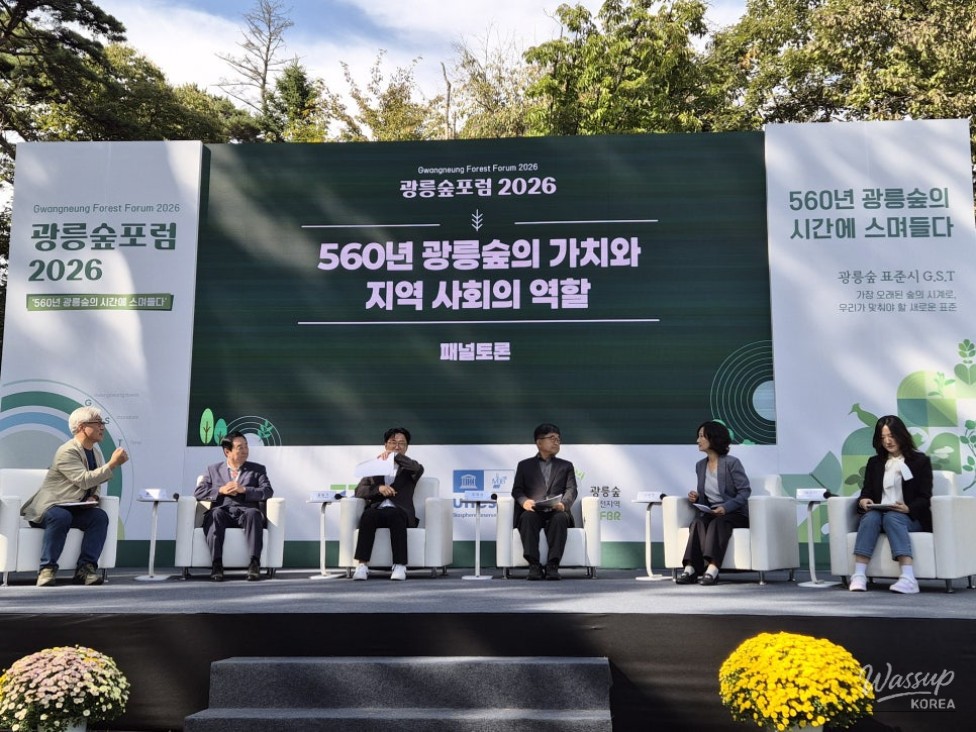
In the keynote speech, Professor Cho Do-soon, co-chair of the UNESCO MAB Korea Committee, explored the significance of Gwangneung Forest under the theme 'Learning New Coexistence Through the Oldest Forest's Clock.' The subsequent panel discussion included Kim Seong-nam, Vice Chair of the Gyeonggi Provincial Council's Agriculture and Marine Committee; Kim Seung-ki, a member of the Culture, Sports, and Tourism Committee; Shim Suk-gyeong, Chair of the International Advisory Committee for UNESCO Biosphere Reserves; Lee Young-seob, Director of Gwangneung Forest Management Center at the National Arboretum; Heo Su-min, a UNESCO MAB youth activist; and Lee Sang-woo, a director at the Namyangju Environmental Education Social Cooperative.
The discussion centered on how to connect forest conservation with the sustainable development of local communities. Topics included citizen participation in ecological monitoring, youth environmental education, promoting the value of local agricultural products, and eco-tourism and cultural programs, all of which suggested collaborative ways to protect the forest while benefiting the community.
The panel discussion focused on the cooperation between forest conservation and the local community.
Biosphere reserves serve as spaces for protecting nature and seeking sustainable development for human life. To pass on the value of the forest to future generations, opportunities for residents, youth, and local organizations to participate are crucial, alongside expert research and management.
Viewing Gwangneung Forest through the lens of climate crisis, history, and ecology.
Professor Kye Sung-beom gave a lecture on the historical significance of Gwangneung Forest under the theme 'From the King's Forest to the Citizens' Forest.'
The lecture program broadened perspectives on Gwangneung Forest. Science communicator and YouTuber 'Gwaedo' connected the forest's timeline with the current issue of climate crisis in his talk titled 'Gwangneung Forest: A Time Capsule in the Era of Climate Crisis.' He emphasized that reflecting on the accumulated value of the forest over time can help us understand and preserve our natural environment.
Professor Kye Sung-beom emphasized that Gwangneung Forest is not just an ancient forest, but a space whose significance has continued through changing times. He explained that examining past history serves as a starting point for considering how we view the forest today and what we will leave for future generations.
YouTuber 'Dahuk,' known for animal-related content, discussed 'The Hidden Heroes of the Forest's Clock' in his lecture, stating, "The forest is not completed by trees alone. Countless organisms living within interact to form a single ecosystem." This blend of science, history, and ecology provided multiple perspectives on Gwangneung Forest.
Experiential programs provided by non-profit organizations brought the forest into everyday life.
Experience booths and participants next to the forum venue.
Notably, all participating organizations in this forum were non-profit. Each organization operated programs allowing citizens to directly experience nature and the environment based on their activities and experiences. The way of introducing the forest and environment expanded beyond lectures and explanations to hands-on experiences where citizens could create and produce sounds themselves.
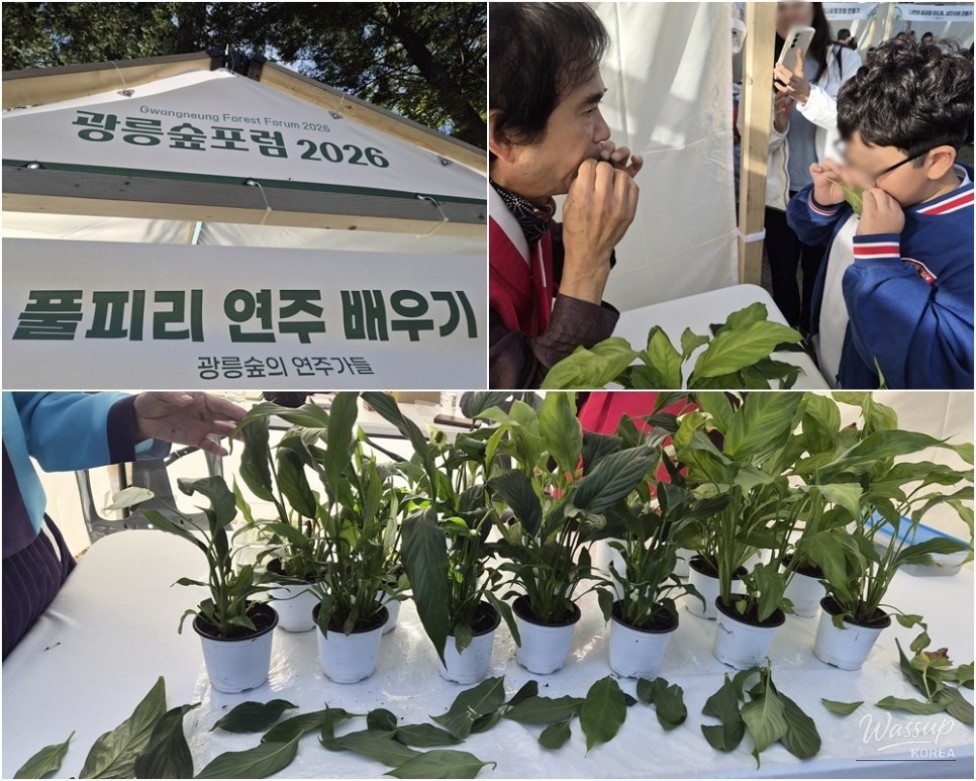
Participants created their own mini aerial gardens in the 'Ionanasa Mini Aerial Garden Making' experience led by the non-profit Green Stage.
In the 'Learning to Play the Grass Flute' session led by 'Gwangneung Forest Performers,' participants were intrigued. The grass flute is a traditional instrument that produces sound using leaves such as maple or acacia. The process of learning to play, where the thickness and elasticity of the leaves, lip position, and wind strength affect the sound, added to the experience's excitement.
Through these experiential programs organized by non-profits, the themes of environment and ecology were brought closer to citizens' daily lives. Rather than merely explaining the value of the forest, the programs helped narrow the distance to nature through hands-on creation and interaction.
Meeting a predecessor from 560 years ago.
The environmental performance by Eco Harmony concluded the Gwangneung Forest Forum as the sun set. Heo Su-min, a UNESCO MAB youth activist, shared, "Perhaps what is old is already ahead of us." The theme 'Soaking in the Time of 560 Years of Gwangneung Forest' went beyond merely viewing an ancient forest. It was about examining the life that the forest has nurtured and the efforts made to protect it, prompting a reconsideration of how to live in harmony with nature. The long passage of time poses a clear question to us today: What kind of forest will we pass on to the next generation?






Source :https://blog.naver.com/gyeonggi_gov/224440016991
More from Place




No comments yet.