Exploring the Oesol Memorial Hall: A Tribute to a Great Figure in Korean Language Preservation



Today, I visited the Oesol Memorial Hall located in Jung-gu, Ulsan, to explore the life of a great figure who dedicated his life to preserving our language and script during the dark era of Japanese colonial rule.
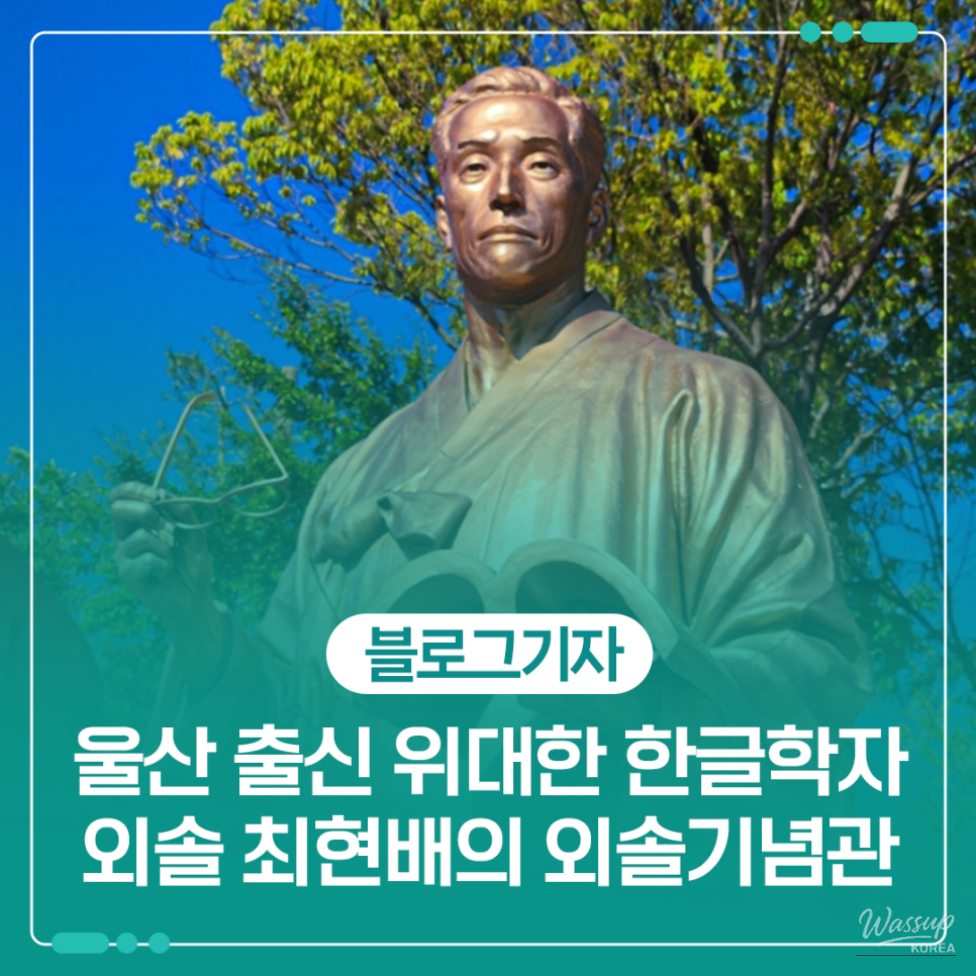
The Oesol Memorial Hall was established to honor the noble life and achievements of Oesol Choi Hyun-bae, an independence activist and a prominent scholar of the Korean language. It serves as a space for education, reminding us of the value of our language and script, especially Hangul.
As the value of this facility becomes widely recognized, the Oesol Memorial Hall has established itself as a significant historical and cultural asset in Jung-gu, Ulsan. Visitors can explore the life, spirit, and philosophy of Choi Hyun-bae, as well as exhibitions of related artifacts.
Before entering the Oesol Memorial Hall, I was excited to share some good news about the hall. Earlier this year, it passed the evaluation and certification conducted by the Ministry of Culture, Sports and Tourism, becoming the first public museum to receive official certification since its opening.
This certification system, established under the Museum and Art Gallery Promotion Act, assesses the operational appropriateness and professionalism of public museums across the country, granting certification based on their fulfillment of founding objectives and the management of collected materials.
With this certification, the Oesol Memorial Hall's status is valid from January 1, 2023, to December 31, 2028.
Now, let's take a look around the Oesol Memorial Hall.
Choi Hyun-bae firmly believed that the identity of our nation lies within our language and script. He made significant contributions to establishing a grammatical system and compiling a Korean dictionary. After liberation, he focused on textbook compilation, the establishment of horizontal writing systems, the promotion of Hangul, and nurturing future generations, ensuring the preservation and study of our language throughout his life.
After attending a local school and then entering Hansung High School, he later attended the Korean Language Institute operated by Yu Si-gyeong, where he encountered our language anew. The teachings of Yu Si-gyeong resonated deeply with him as a boy who had lost his country.
After graduating, he studied in Japan and returned to work as a teacher at Dongnae High School, where he began serious research on our language.
One of the significant events related to Choi Hyun-bae is the 'Byeongyeong March 1st Movement,' which he led in April 1919 after hearing about the March 1st Movement in Seoul.
Though the young activists were arrested, they organized a larger demonstration the following day, demanding the release of their peers, despite facing violence from the police.
To honor those who sacrificed during this movement, the Samilsa Shrine and the Samil Memorial Stone were erected in Jung-gu, Ulsan.
Choi Hyun-bae dedicated his time to teaching students about our language even on his days off. He created drafts for the Korean language book to teach students that societal change was necessary for national independence and continued his studies in Japan, majoring in education.
Returning home, he began his domestic activities in 1926 with the Korean Language Society, which aimed to preserve and study our language against the backdrop of Japanese colonial policies.
Despite facing severe oppression, Choi Hyun-bae never gave up on researching Hangul and continued his work, publishing significant studies and dictionaries, while also advocating for the unification of Hangul spelling and standard language dictionaries.
Choi Hyun-bae passed away in 1970 after a lifetime dedicated to our language and was posthumously awarded the Order of the National Flag by the government. His efforts to preserve our language and spirit during a dark historical period should always be remembered.
As I left the Oesol Memorial Hall, I reflected on the value of Hangul and the life of Choi Hyun-bae, who dedicated his life to preserving our language and culture.

Source :https://blog.naver.com/ulsan_nuri/224312949371
No comments yet.