Exploring Hwanggok Seowon and Chungsundang



SNS Reporter Jo Yoon-hee, 14th Term
Hwanggok Seowon and Chungsundang
- Address: 22-35 Sanggeom-gil, Gaya-eup, Haman-gun, Gyeongnam (Geonam-ri 103)
Some years ago, I was captivated by a grove of baekdong trees and happened to visit Dongsanjeong. Recently, I returned to the old house I had passed by during that visit.
While I was looking for a side entrance or other access to Hwanggok Seowon, I found the gate of Chungsundang right next to it was open, so I decided to go inside.
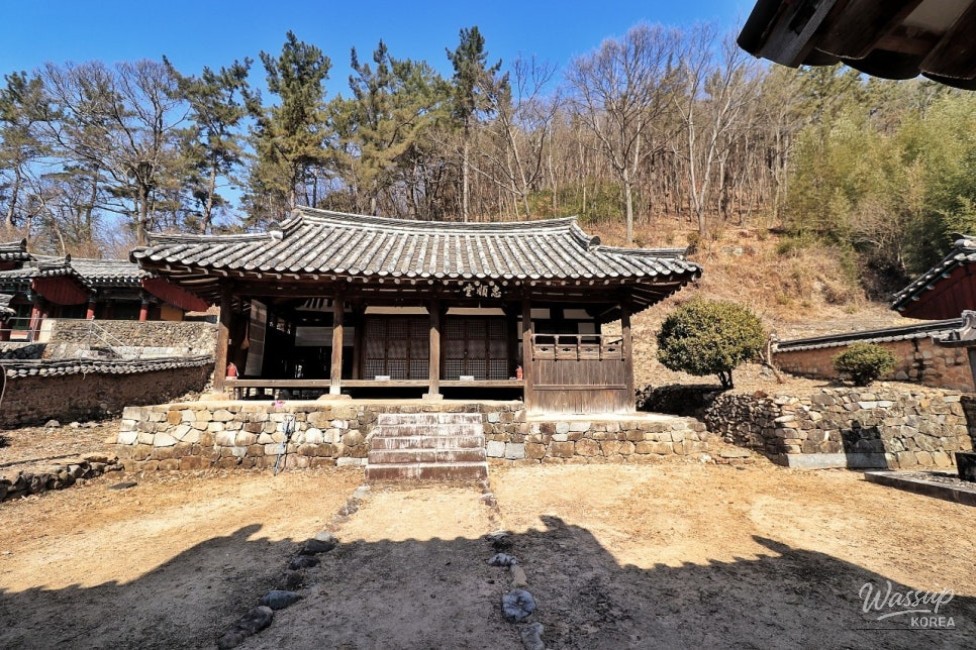
Chungsundang (忠順堂)
- Address: 103 Geonam-ri, Gaya-eup, Haman-gun, Gyeongnam
· Designated as Gyeongnam Cultural Heritage Material No. 530 on April 28, 2011
· A shrine dedicated to General Lee Ryeong (李伶), a leader of the righteous army during the late Joseon period
Chungsundang features a spacious courtyard and was built by Lee Ryeong's descendants to honor him, who led a righteous army of commoners during the Imjin War in 1592 and died in battle. It serves as a traditional building for the local gentry's rituals and clan activities.
As the name suggests, Chungsundang is a shrine, and the entrance resembles a traditional Joseon-era gate with flanking buildings for storage and living quarters.
Chungsundang, a cultural heritage site in Gyeongnam, has a tiled roof structure with a four-bay front and two-bay sides. The foundation is made of natural stone, with steps leading to the center, and the pillars are also set on natural stone.
The right three bays contain an ondol room with a floor, while the left bay is a raised floor, and the two side bays are connected by a wooden porch.
On a warm afternoon, as the sunlight warmed the floor, I felt drowsy and shared that moment with the place. Who was General Lee Ryeong, the first leader of the righteous army during the Imjin War?
Born in Geonam-ri, Gaya-eup, Haman-gun, Lee Ryeong (李伶) was known by his courtesy name Yeo-yun (汝允) and his pen name Chungsundang (忠順堂). His family lineage includes notable ancestors, such as his great-grandfather, Jeongmu-gong Lee Ho-seong (李好誠), and his grandfather, Lee Sun-jo (李順祖), who excelled in military service.
In April 1592, at the age of 52, when news arrived that the Japanese had invaded Dongnae, he gathered over 100 righteous soldiers and rushed to Gimhae, serving under Governor Seo Ye-won (徐禮元) and leading successful battles against many enemies.
He was entrusted with defending the fortified East Gate due to his character and loyalty. However, when Dongnae Fortress fell, he chose to fight to the end rather than retreat, famously stating, "How can I think only of myself when the nation's fate is at stake?" He encouraged his soldiers and fought bravely until he fell on April 20 of that year.
After the war, a soul-calling ceremony was held in his honor as his body was never recovered. The government soon exempted his family from military service, and in 1869, he was posthumously honored with a shrine.
Now, let’s take a look at Hwanggok Seowon.
Hwanggok Seowon (篁谷書院) is a Confucian academy established in 1633 during the Joseon Dynasty. Initially known as Geonamjeongsa (儉岩精舍), it served as a space for scholarly research.
The main entrance, called Gangdomun, symbolizes the reading of morality and ethics. The structure features a traditional layout, with classrooms on either side of a central hall.
Hwanggok Seowon played a crucial role in local scholarship and was restored in 1981, allowing it to continue as a space for traditional rituals and cultural heritage.
As I explored the area, I noticed how the river flowing in front of Hwanggok Seowon and Chungsundang was frozen, revealing the essence of the season. Despite the cold, I encourage everyone to venture out for a winter trip, especially to Haman's Geonam.


Source :https://blog.naver.com/arahaman/224184070190
No comments yet.