Choi Tae-seong's History Talk Concert Held Successfully at Gyeonggi Arts Center



[By Reporter Yoon Jae-yeol]
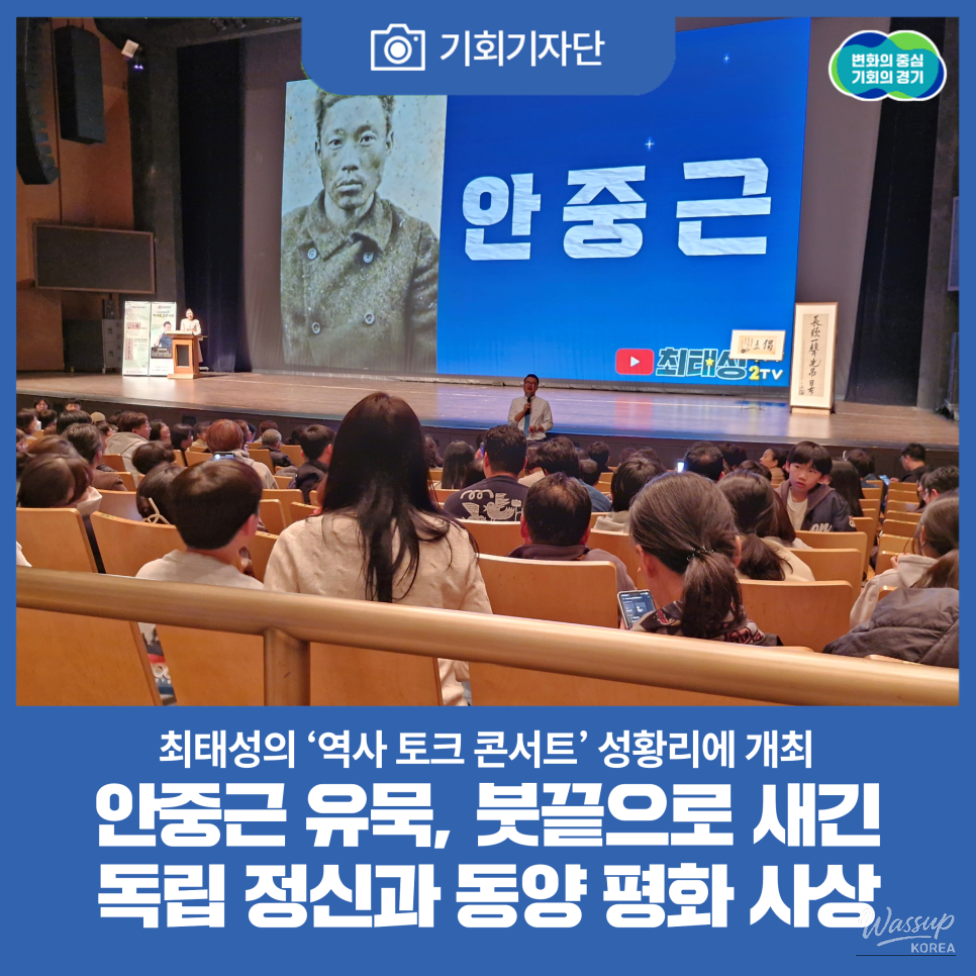
Choi Tae-seong's 'History Talk Concert' was successfully held at the Grand Theater of the Gyeonggi Arts Center.
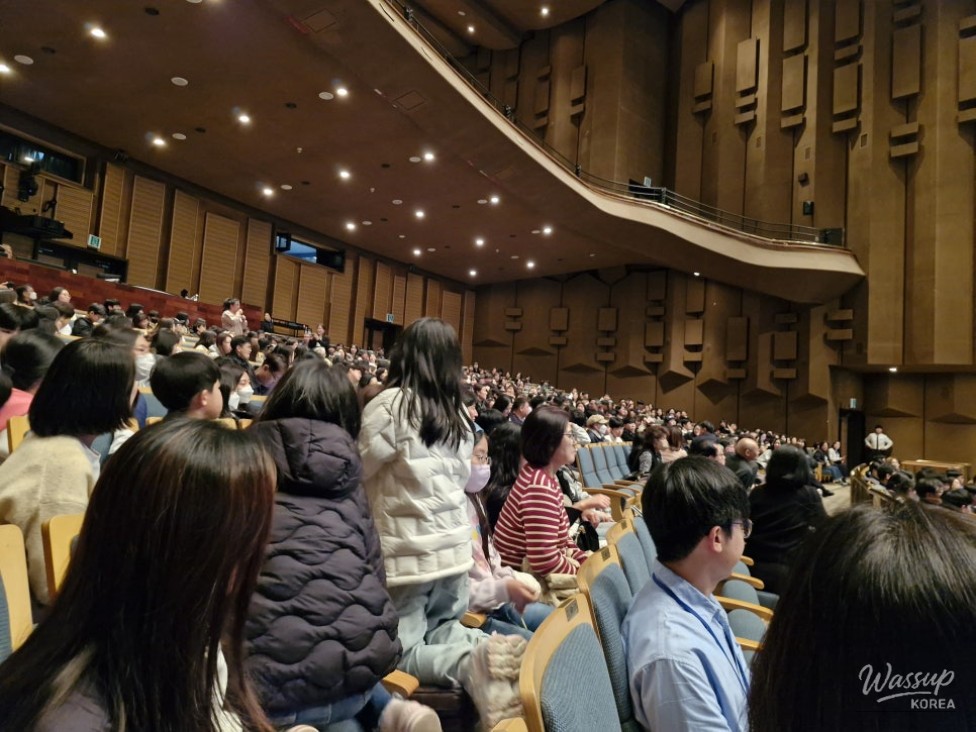
Choi Tae-seong's 'History Talk Concert' was held at the Gyeonggi Arts Center in Suwon. ⓒ Reporter Yoon Jae-yeol
November 11th, a deepening autumn evening.
Leaves fall on the streets in the chilly wind.
Despite the late hour and the cold,
Adults and children gathered at the Gyeonggi Arts Center in Ingye-dong, Suwon,
with excited hearts.
They were the crowds participating in Choi Tae-seong's 'History Talk Concert'.
The Gyeonggi Cultural Foundation and the Gwangbokhoe Gyeonggi Provincial Branch
held a special history lecture on Ahn Jung-geun
in commemoration of the 80th anniversary of Liberation.
The audience is immersed in the lecture at the Grand Theater. ⓒ Reporter Yoon Jae-yeol
In the Grand Theater, all 1,000 seats on the first floor
were occupied.
The audience's attention was focused on
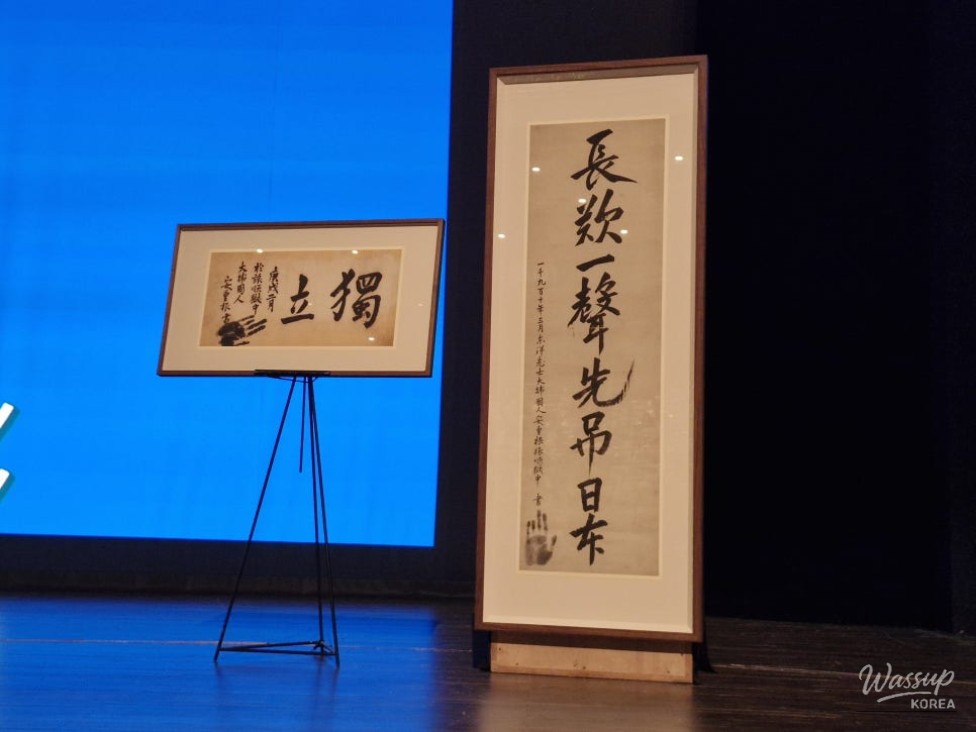
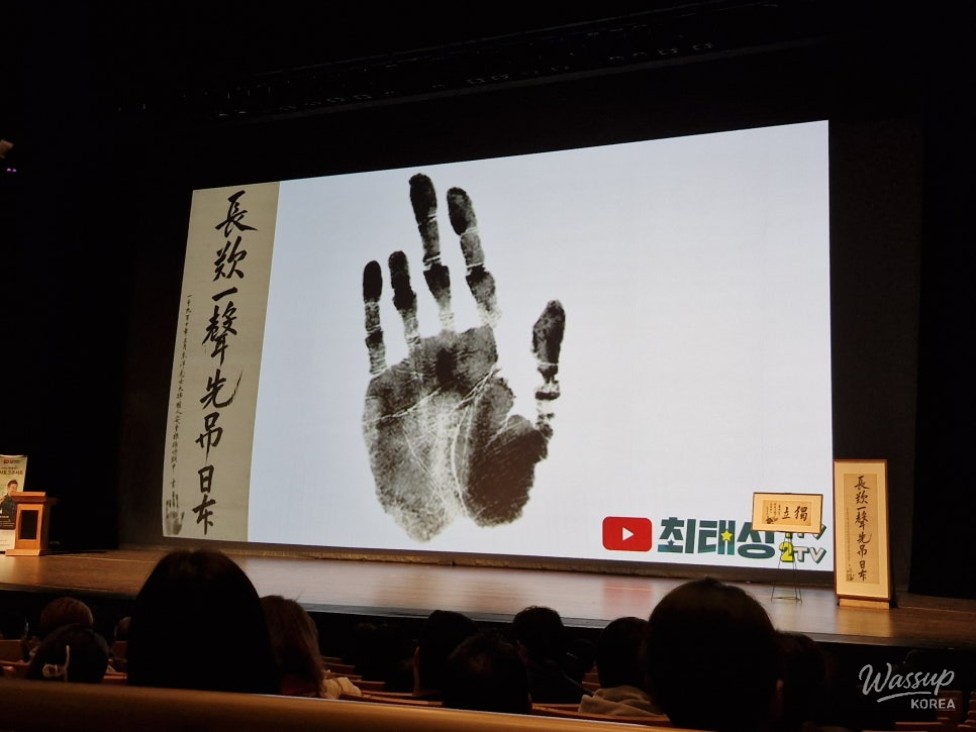
two pieces of Ahn Jung-geun's calligraphy on the stage.
The firm and solemn brushstrokes evoke a sense of tragedy.
Although the paper is faded,
the scent of ink still lingers with reverence.
The spirit contained in the two calligraphic works: Independence and Peace in the Orient.
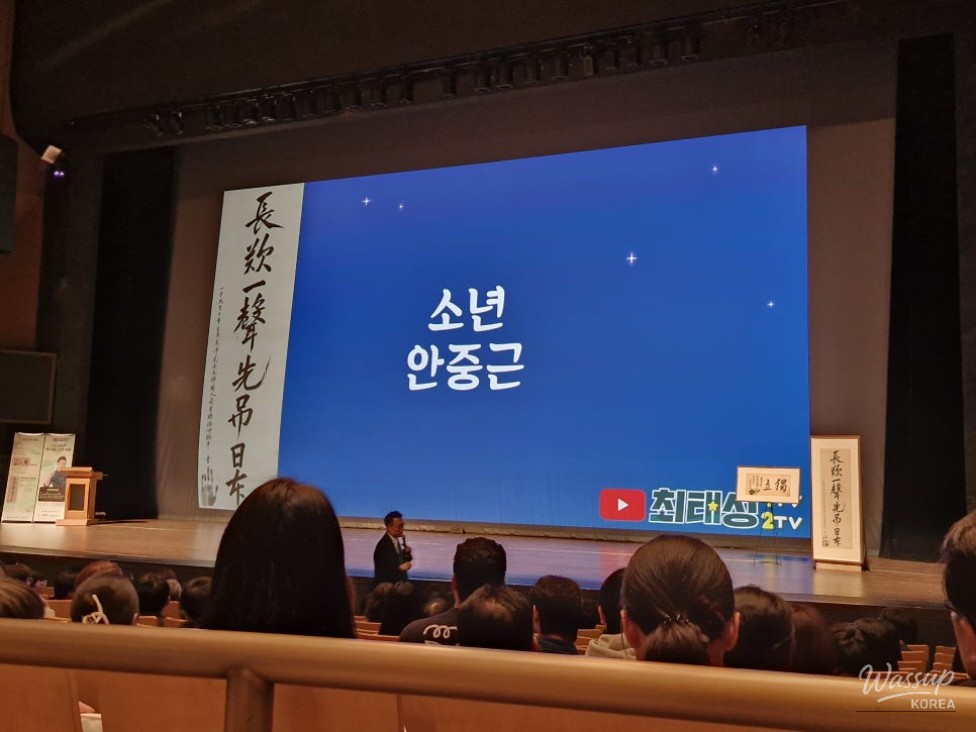
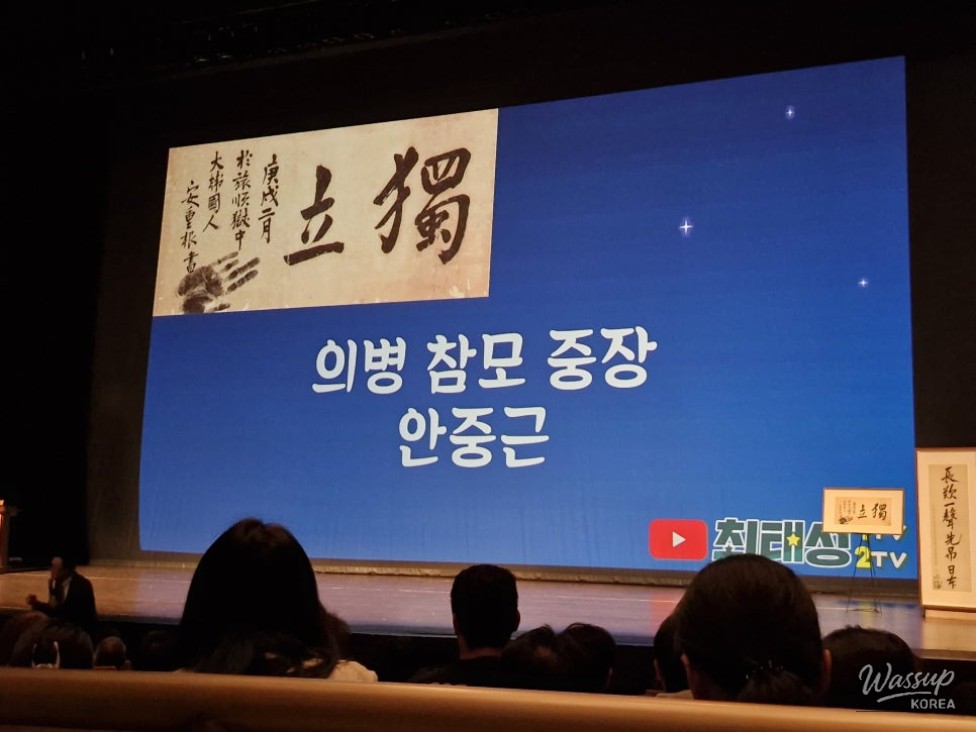
Ahn Jung-geun's calligraphy was displayed on the stage to match the theme of the lecture. ⓒ Reporter Yoon Jae-yeol
The lecture focused on two pieces of calligraphy left by Ahn Jung-geun:
'Independence (獨立)' and
'Lamenting Loudly, First I Mourn Japan (長嘆一聲 先弔日本)'.
Calligraphy refers to brush writing left behind
while alive or in prison.
Ahn Jung-geun wrote many while in prison.
Choi Tae-seong said that Ahn Jung-geun's writings
contain many instructive messages.
But these two pieces of calligraphy are different.
Beyond simple calligraphy,
they are considered cultural heritage embodying
the spirit of anti-Japanese movement, independence, and the ideal of peace in the Orient.
The two characters ‘Independence’ themselves
contain a desperate sense of responsibility and determination towards the nation.
'Lamenting Loudly, First I Mourn Japan'
is closely related to the theory of peace in the Orient.
The lecture also involved communication with the audience. ⓒ Reporter Yoon Jae-yeol
The lecture began with the story of young Ahn Jung-geun.
"Ahn Jung-geun enjoyed archery, especially hunting, from a young age.
He was very good at shooting in the process,"
saying, "Ahn Jung-geun is a person who designed his life
with what he liked."
He added that this aspect is also important
to our students living in this era.
He says let's look at what Ahn Jung-geun's life means to us. ⓒ Reporter Yoon Jae-yeol
He then suggests, "I hope you will consider what Ahn Jung-geun's image
means to me and to us.
No matter how famous and great an event is,
it doesn't resonate much if it's not related to my life.
Therefore, connect today's journey of Ahn Jung-geun
to what meaning it might have in your life."
Ahn Jung-geun, as a lieutenant general of the righteous army,
fought against the Japanese army and won every battle.
In the midst of this, he secures prisoners in battle.
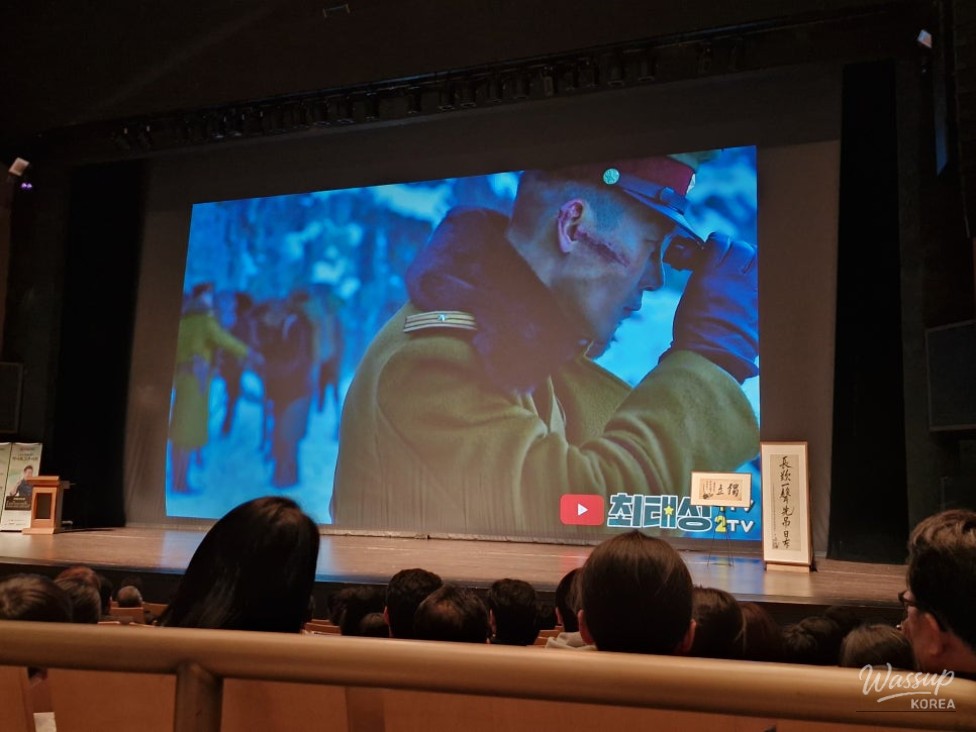
This scene is viewed as a movie.
Despite the opposition of his comrades,
Ahn Jung-geun spares the prisoners according to international law.
However, that becomes the cause,
and the army led by Ahn Jung-geun is annihilated.
Ahn Jung-geun, determined with severed fingers.
Ahn Jung-geun sacrificed his life for the independence of his country and peace in the Orient. ⓒ Reporter Yoon Jae-yeol
The emotional impact was amplified by connecting it with scenes from a movie about Ahn Jung-geun during the lecture. ⓒ Reporter Yoon Jae-yeol
The failure was devastating.
It was the same as killing his comrades
due to his own judgment.
The pain of the world collapsing pressed down on him.
He wanted to die.
No, he thinks he should die.
At this time, he sees his feelings through the movie.
"Because many comrades were sacrificed because of my belief,
I can no longer find a reason to live.
I tried to give up everything and die.
But at that moment, I realized.
That my life belongs to the dead comrades.
I am living in place of the lives of the dead comrades.
And I knew what I had to do," he recites.
Ahn Jung-geun's severed finger is an expression of firm will. ⓒ Reporter Yoon Jae-yeol
Even so, Ahn Jung-geun was afraid.
He was anxious at the thought that there might come a moment
when he would kneel in a desperate situation.
He had to strengthen his resolve in order not to waver.
He cut off his finger. By cutting off a part of his body,
he remembered the pain and moved forward.
And as a soldier,
he found a path he could take.
That was to strike the enemy's leader.
Ahn Jung-geun carried out the assassination in Harbin.
The assassination was not about aiming a bullet
at Ito Hirobumi's chest,
but an act for the independence of the country and peace in the Orient.
So Ahn Jung-geun was not afraid
even in prison before his death.
He had the belief that imperialist forces that harass the weak cannot last long.
He predicted the fall of Japan, saying 'Lamenting Loudly, First I Mourn Japan'.
At the end of the lecture, Choi Tae-seong said in a heavy voice.
"Ahn Jung-geun is a person who taught us how to love the country
through action.
The two calligraphic works are an outcry of that era
and a task left to humanity today," he concluded.
The applause did not stop for a long time.
A sense of reverence and emotion
spread across the faces of the residents who filled the audience.
History is the power to live today.
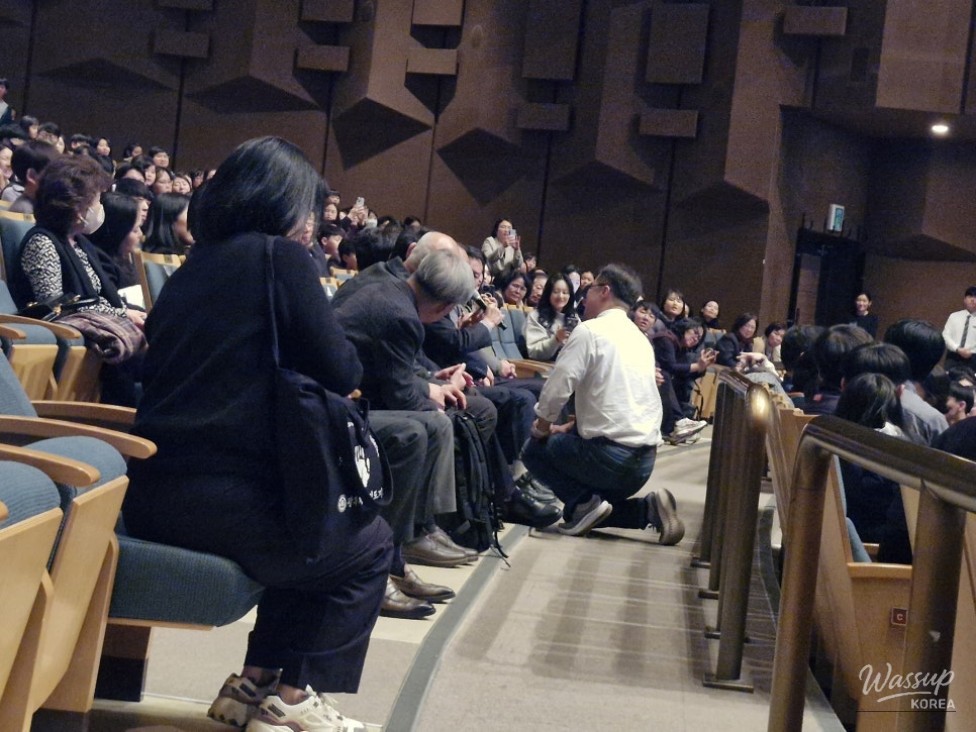
A descendant of Ahn Jung-geun is answering questions during the Q&A session. ⓒ Reporter Yoon Jae-yeol
Kim Ho-dong, head of the Gwangbokhoe Gyeonggi Provincial Branch,
said, "Gyeonggi Province will establish the 'Ahn Jung-geun Peace Center'
in Imjingak, Paju, in commemoration of the 80th anniversary of Liberation.
We plan to exhibit and store the two pieces of Ahn Jung-geun's calligraphy
in this space.
As a result of efforts to secure the calligraphy in Japan,
we have brought 'Lamenting Loudly, First I Mourn Japan' into the country.
We will soon return 'Independence' to the embrace of Korea,"
He said, "Although we have not been able to repatriate the remains of Ahn Jung-geun,
we must find even the calligraphy.
This is not just about finding a work,
but about firmly establishing the roots of our history
and finding the great spirit," he reveals.
History is not just a story of the past.
Through the life and calligraphy of Ahn Jung-geun,
we read the national spirit and the idea of peace.
That spirit becomes the power to live today
and a lighthouse for designing the future.
The history talk concert was a time to fill
with warm inspiration in the chilly weather.
It was a place where the warmth of life bloomed.
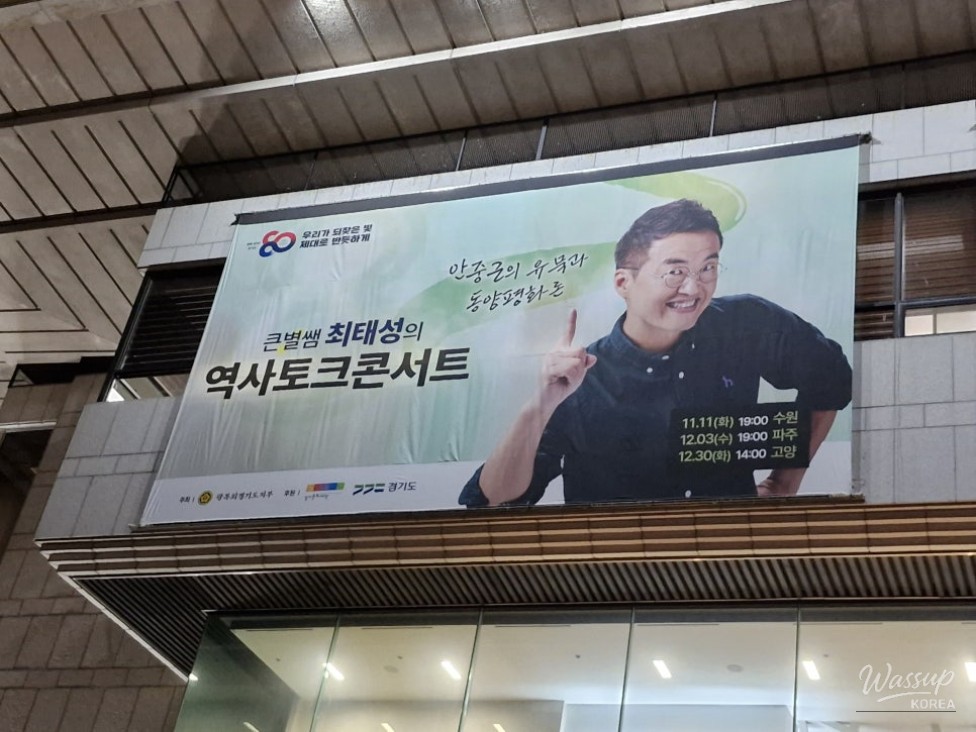
'History Talk Concert' continues to Paju and Goyang. ⓒ Reporter Yoon Jae-yeol
This special lecture is sponsored by the Gyeonggi Cultural Foundation.
Following the Suwon Gyeonggi Arts Center,
December 3rd, 7 PM
Paju Future Education Campus Paju Concert Hall,
December 30th, 2 PM
It will also be held at the Goyang Oullim Nuri Oullim Theater.
In commemoration of the 80th anniversary of Liberation, residents can enjoy
a time to reflect on Ahn Jung-geun's spirit of independence.
Residents who wish to participate can apply on the Gyeonggi-do Lifelong Learning Portal
'GSEEK' website.
The lecture will be given by history instructor Choi Tae-seong.
Inquiries can be made through the Gwangbokhoe Gyeonggi Provincial Branch
(Phone: 031-244-8150).










Source :https://blog.naver.com/gyeonggi_gov/224075740670
No comments yet.