A Stroll Through History: Discovering Haman Marisan Tumuli


By Jo Yun-hee, 14th SNS Reporter
Haman Marisan Tumuli
- Address: 153-31 Gobun-gil, Gaya-eup, Haman-gun, Gyeongnam Province (Land lot number: 581-1 Dohang-ri)
These days, autumn is painting our hearts with its deep colors. How about taking a walk together to see what dreams the tumuli, imbued with the season, are unfolding beside us?
Marisan Tumuli, the first of Haman's nine scenic views, is located along the ridge of Marisan in Dohang-ri, Gaya-eup, Haman-gun, making it a popular destination for Haman residents and tourists alike.
Currently, construction is underway to create a garden utilizing the green space (Gokgan area) in front of the Marisan Tumuli Exhibition Hall, which introduces the 600-year history and culture of the Ara Gaya. Once completed, it will be reborn as a wonderful promenade with stunning scenery.
The Marisan Tumuli Gokgan area project will be ongoing from March 10 to September 30, 2025. Although there may be some inconvenience, it will soon be transformed into a functional space for rest and enjoyment. I thought it would be great to return with my parents after the renovation. This place holds my mother's childhood memories, and she seemed to slow her pace as the tumuli were being prepared as if racing towards tomorrow.
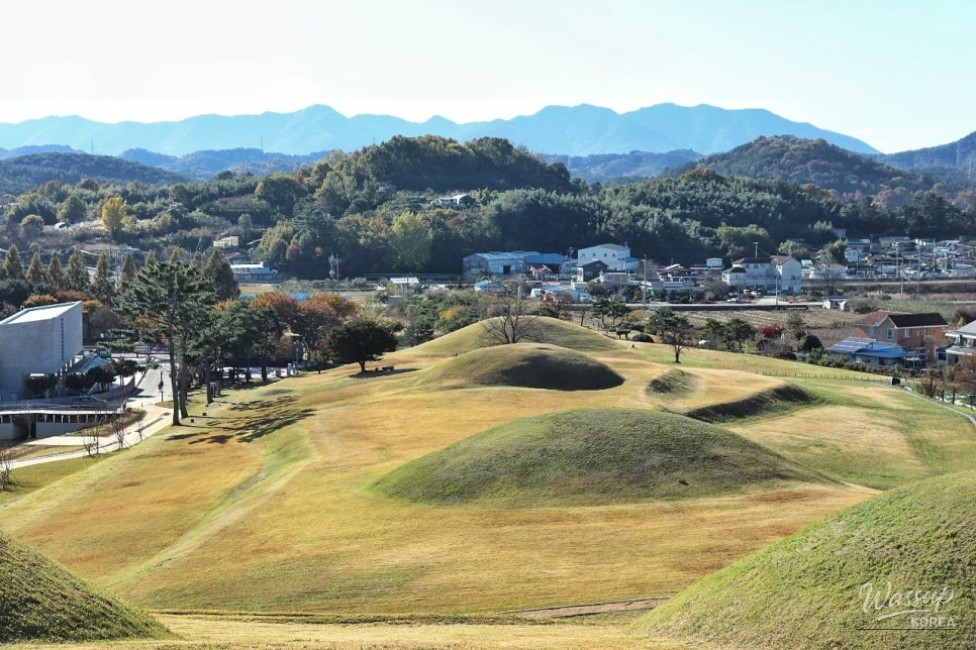
I captured the image of two trees, one with lush leaves and the other seemingly bare, standing like flagpole supports on the path to the tumuli, representing the passage of time between the deep autumn sky and the yellowing grass.
Haman Marisan Tumuli was managed as Dohang-ri Tumuli (Historic Site No. 84) and Malsan-ri Tumuli (Historic Site No. 85) based on administrative districts in 1964. However, based on the results of excavation surveys, it was integrated and redesignated as Historic Site No. 515 on July 28, 2011, as a single tumulus group where tombs of the same era and character were built.
The land designated as a historic site covers 562 plots, including 484 Dohang-ri, with an area of 525,221㎡, boasting the largest scale among Gaya-era tumulus sites. Every time I come, I am amazed and impressed by its size.
As of October 2013, Marisan is 78% nationally owned and 22% privately owned. It is managed by Haman-gun, designated by the Cultural Heritage Administration. In 1991, a detailed surface survey by the National Changwon University Museum confirmed a total of 113 mound tombs, including the existing 37. Furthermore, considering the results of past excavations, including those where the mound has been eroded and lost its original form, it is estimated that more than 1,000 Gaya-era tombs were built.
The mound tombs of Marisan were mainly built during the peak of Ara Gaya in the late 5th to early 6th century. Large mound tombs are located on the main ridge extending from south to north and on the top of the branch ridge gently leading to the west, while medium and small tombs are located on the slopes. In the northern area, wooden coffin tombs and wooden chamber tombs of Anya-guk, the predecessor of Ara Gaya during the Samhan period, are densely distributed. This shows that Marisan Tumuli was created over about 550 years, from before and after the beginning of the era to the fall of Ara Gaya, with tombs being built over generations.
Marisan Tumuli is a group of tombs in the hilly area of Marisan, Gaya-eup, Haman-gun, Gyeongsangnam-do, where pit-style stone chamber tombs and stone mound tombs of Gaya during the Three Kingdoms period have been excavated. It has been known since 1587, but in 1917, Ryuu Imanishi surveyed 45 tombs, and excavation surveys were conducted on Tomb No. 4 and Tomb No. 25 of Marisan in 1917.
As the burial grounds of Ara Gaya kings and nobles, it is a representative ancient site of Haman, preserving 600 years of history. The 'Mari' in Marisan originates from the pure Korean word 'Mori,' meaning 'leader,' so 'Marisan' means 'mountain with the king's tomb.'
About 2km of ridges stretching from north to south on Marisan in Haman-eup, Haman-gun, are densely populated with 127 mound tombs and over 1,000 medium and small tombs, making it an important site for estimating the transition of tombs and the development stage of the culture of the ruling class of Anra-guk Ara Gaya.
The Marisan Tumuli are characterized by large tombs being built along the top of the ridge, and medium and small tombs being placed on the slopes of the ridge, avoiding the areas where large tombs are located. In addition to armor and horse equipment that reveal the status of the tomb owner, ring-pommel swords, and recently, figurative earthenware such as deer-shaped and house-shaped earthenware have been found all at once, allowing us to estimate the diverse lifestyles of the Ara Gaya people.
In addition to the Marisan Tumuli, important sites in the Haman area include the Nammunoe Tumuli, as well as tumulus sites such as Ogok-ri, Hwangsa-ri, and Jangji-ri, Gaya-dong, presumed to be the royal palace site, and living sites such as the earthen fortress and wooden pillar rows built with large-scale civil engineering works confirmed in the surrounding area, the Gaya-ri embankment site, and the Chunguigong Park site. The Ugeori and Myosari kiln sites, which provide information on Ara Gaya pottery production, are also important. These sites can be good clues for restoring the lifestyle of Ara Gaya.
The ruling class of Ara Gaya, who built the Marisan Tumuli with large ancient tombs, must have established their own identity while integrating the interior and forming external relations with the surrounding areas. Looking around the bulging ridges of the Marisan Tumuli and looking down at the Haman Museum and the Gokgan area to be newly created, I look forward to the soaring tomorrow that will reveal all of Haman to the world.
Crossing one ridge, the autumn gestures of the trees that seem to welcome us and the desolate appearance of the crape myrtle trees that blazed red with flowers in the hot summer days remain. As I look around and come down from the Marisan Tumuli, the time at the tumuli, which was good because it was spring, summer, and autumn, seems to be ripening more and more with the seasons. The outing of the ginkgo tree standing across the rice paddies after the harvest is also a beautiful scene. The more I travel around Haman-gun, the more diverse and happy the memories I capture become.
I love Haman, my parents' hometown, where I traveled with them.




Source :https://blog.naver.com/arahaman/224079231410
No comments yet.