Back on the Road: Half Marathon After a Muscle Strain
Loop from Majang to Sewol Bridge, Seoul, Republic of Korea
청계천


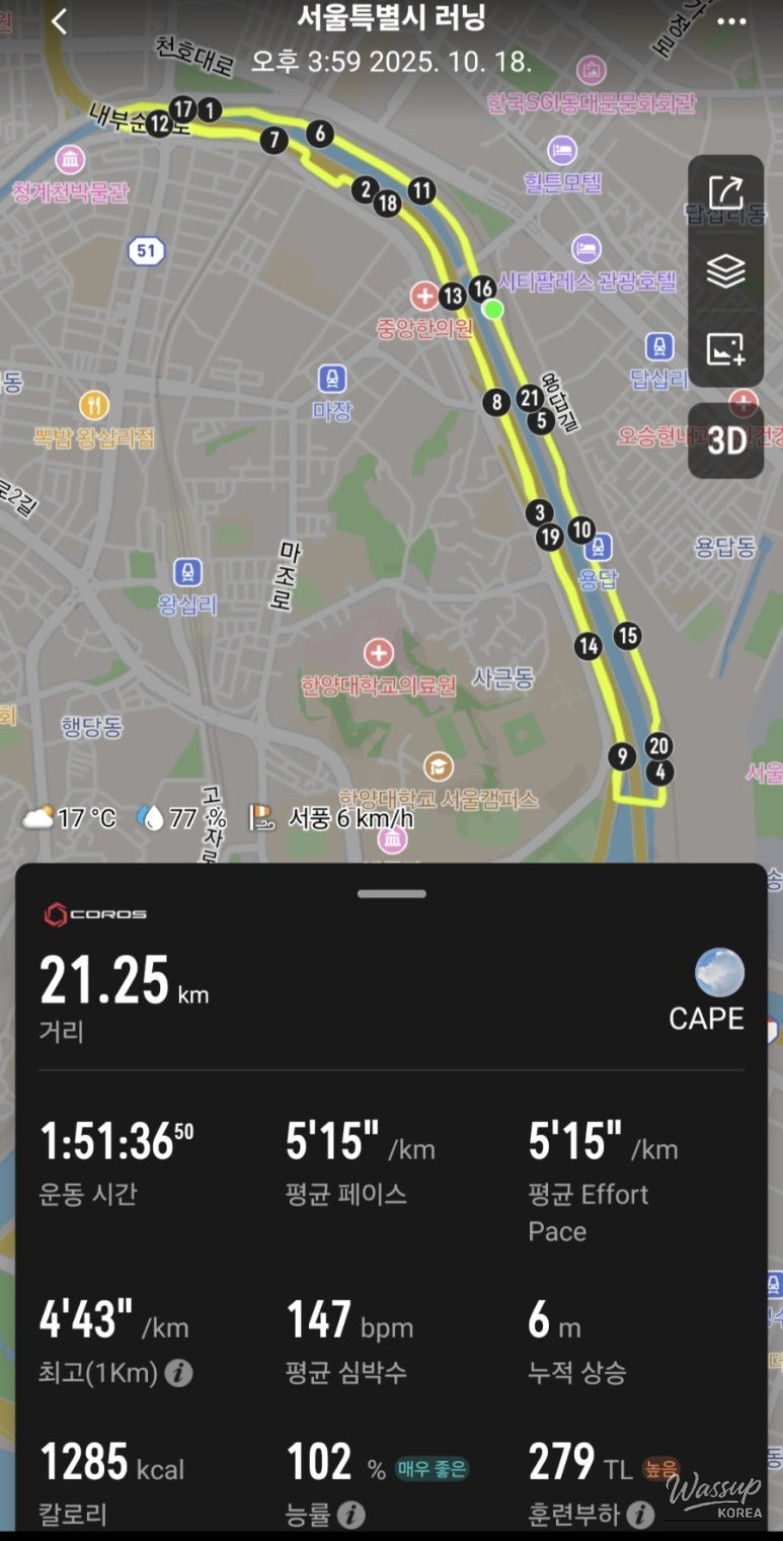
Recovering from an injury is often a mental battle as much as a physical one. After dealing with an intense muscle strain and subsequent lower back pain around the spine and iliac bones, I finally felt well enough to attempt a longer distance. This weekend, I completed a half marathon by circling the Cheonggyecheon Stream (청계천), focusing on a low-intensity tempo run to gauge my recovery progress.
While the run was successful in terms of distance, the experience highlighted the importance of road quality and proper equipment maintenance. From managing a "beaten-up" feeling in my lower back to discovering significant damage to my Adidas Adizero Adios Pro 3s, this run served as a reminder that consistency often requires compromise and careful adjustment of training intensity.
The Route: 4 Laps of Cheonggyecheon
To avoid steep inclines and keep the impact manageable, I opted for the flat terrain of Cheonggyecheon. One full lap from my starting point to Sewol Bridge and the Jeongneungcheon confluence measures exactly 5.3k. Completing four laps provides a perfect half-marathon distance. However, I noticed a stark difference in road conditions: the Majang-Sageun section is smooth, while the Yongdap-Sindap stretch is rough, putting unnecessary strain on my ankles and soles.
Equipment Check: Midsole Damage on Pro 3s
Rough surfaces are not just hard on the body; they are brutal on shoes. After the run, I noticed that both of my Adidas Pro 3s had torn medial midsoles. Even though the outsoles still look brand new with only 430k of mileage, the cushioning feels dead and the structural integrity is compromised. It seems that the bad road surface caused the shoes to clip each other more frequently, leading to this unexpected wear and tear.
The Physical Struggle: Post-Marathon Slump
My body hasn't quite snapped back to its pre-Dongdaemun Marathon form. Before that race, speed training was a regular part of my routine, but now my body feels heavy after just 3-5k of jogging. The lingering ankle discomfort and lower back pain make me cautious; I find myself holding back to prevent a more serious injury. The fluctuating weather has also been a significant drain on my energy levels.

Maintaining the Training Posture
The lack of speed training is making my strengthening exercises feel less effective. Without that high-intensity stimulus, it’s harder to maintain the "thinking posture" required for efficient running. I am currently debating whether to keep pushing through the heavy feeling to maintain my monthly mileage or to prioritize absolute rest until the back pain completely disappears.
Conclusion: Looking Toward 300k
Despite the setbacks and the equipment failure, I am grateful that I could resume running so quickly after the strain. By focusing on volume over speed for the time being, I am still on track to exceed 300k this month. The key moving forward will be avoiding the rougher sections of the stream path and perhaps rotating in a more durable daily trainer to save my remaining carbon plates for better road surfaces.
Would you like me to look up the most durable daily running shoes for high-mileage runners on rough terrain, or should I find some targeted stretches for iliac bone and lower back pain relief?
No comments yet.