Exploring the Historical Sites of Okcheon



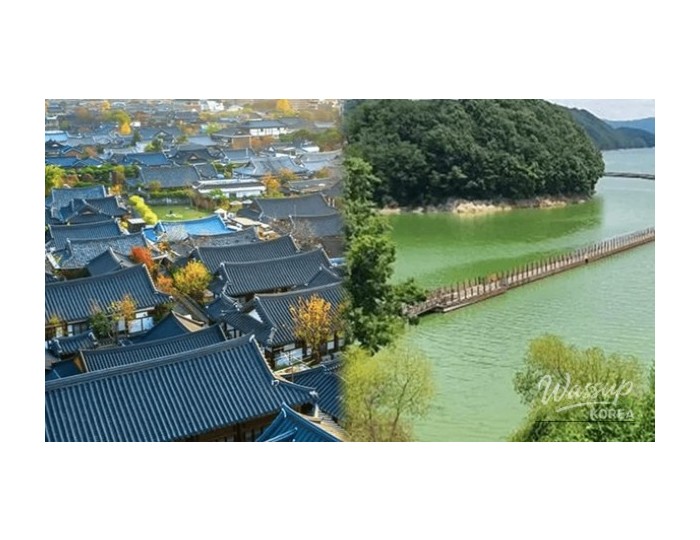
The calm waves of the Geumgang River flow gently through Okcheon, Chungbuk.
Before spring passes, we introduce two places where the breath of Confucian scholars from the Joseon dynasty still lingers: Gyeongyuldang, where knowledge and character were cultivated, and Dokrakjeong, where poetry was recited amidst nature.
The first place I visited was Okcheon Gyeongyuldang, a cultural heritage site in Chungbuk.
Address: 120 Jongmi 3-gil, Annam-myeon, Okcheon-gun, Chungbuk
Parking: No dedicated space, parking on agricultural roads.
Gyeongyuldang, which served as a village school for descendants, was named after the pen name of Jeon Hu-jeong, who admired the scholar Yulgok Lee I. Initially, only the children of noble families could attend such schools, but over time, commoners were also allowed. It functioned as a private educational institution similar to an elementary school.
The construction of Gyeongyuldang reflects the love and care of ancestors for their descendants' education, and it is currently used as a shrine for the Jeon clan.
Unfortunately, on the day I visited, a warning sign indicated a risk of collapse, preventing entry.
I took photos from a safe distance using a regular camera.
The year of construction can be identified from the decorative tile on the roof, inscribed with "Yongjeong 13th year, Eulyu" (1735). According to the information board, the builder was Jeon Hu-jeong, a scholar from the Yeongjo era.
The building features a typical layout of a village school, with four rooms at the front and two at the sides, covered by a hip roof.
Next to the door, there are elongated straw structures designed to prevent the door handle from hitting the wall when opened.
Gyeongyuldang, overlooking the gently flowing Geumgang, is situated in a typical location for drainage, with a view from behind the pine trees.
The low stone wall allows for clear visibility even from a distance.
As I couldn't enter Gyeongyuldang to explore its serene atmosphere surrounded by the pine forest and low walls, I referred to the Chungbuk Archive for more information.
"To install verandas on all sides, the northern side was made with three rooms. Verandas were added to the east, west, and south sides, with two ondol rooms in the center. A raised veranda was placed to the north of the rooms, and a small room was added to the east, with a half-sized attic to the north of it. Among the four rooms at the front, the two center rooms are wider, allowing for larger gatherings. The front features a veranda, while the sides and back have been diversified for various uses. The veranda above the side furnace is slightly elevated for fire prevention and aesthetic simplicity. The adjacent storage room and one room at the back do not have a veranda and are used for practical purposes in clan affairs."
As described, the furnace veranda appears slightly higher than the front veranda.
Though simple, it harmonizes well with the surrounding landscape, with the distant Geumgang flowing beautifully.
After enjoying the humble yet charming Gyeongyuldang, I drove to the final destination of my 20-kilometer drive through Okcheon, Dokrakjeong, located about 4.8 kilometers away.
Dokrakjeong, built in 1607 by General Jo Mung-deuk, served as a space for scholars to engage in discourse and study, and it is designated as Cultural Heritage No. 23 in Chungbuk.
Address: 170 Yeonju-ri, Annam-myeon, Okcheon-gun, Chungbuk
Parking is available along the roadside.
After climbing a short stone staircase, you will find the entrance on the left side of Dokrakjeong, which is uniquely positioned not at the front.
Looking back while climbing the stairs reveals a more beautiful view of the Geumgang, a popular fishing spot.
Upon entering, the side of the building and a low chimney can be seen.
Despite its name suggesting solitude, Dokrakjeong was a gathering place for scholars to share ideas and was later used as a village school.
The plaque for Dokrakjeong was written by Sim Hu in the 9th year of King Hyeonjong's reign, with subsequent renovations noted in 1772, 1888, and later by the clan.
Interestingly, the village surrounding this area is also named Dokrakjeong.
In front of the pavilion, there are copies of the construction documents, providing insights into its purpose and the surrounding landscape, allowing one to feel the rich emotions of the ancestors.
One excerpt states, "Following the traces of the past, surrounded by mountains and rivers, the auspicious site naturally opens up, and the old stone steps seem to be arranged like stars on the sky."
It is a precious spot, but unfortunately, a water pumping station obscures the beautiful scenery in front of the pavilion.
The views of the waves and Deungju Peak enhance the charm of Dokrakjeong, but the installation of the water treatment facility has regrettably marred the landscape.
While essential for local residents, it feels as if cultural heritage was overlooked.
Recently, a cruise ship named Janggyo is operating along the 21-kilometer stretch connecting the Janggyo tourist area with the nearby Gyeongyuldang and Dokrakjeong, as well as Deungju Peak, where one can view the map of the Korean Peninsula.
Source :https://blog.naver.com/cbkb21/224262719789
No comments yet.