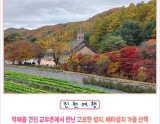
Exploring the Historic Baeti Shrine and the Life of Father Choi Yang-eop
- Original source
- blog.naver.com



Walking along the path lined with ginkgo leaves, I made my way towards the old cathedral inside the Baeti Shrine, following the yellow-hued ginkgo tree path. The fallen leaves made my steps naturally slower.
Scattered along the path are stones engraved with crosses and small sculptures. As I pass by them one by one, I soon find myself in front of the old cathedral.
Who was Father Choi Yang-eop?
Father Choi Yang-eop is the second person to become a priest in the Korean Catholic Church. After studying abroad at a young age, he returned to Korea and traveled to various villages with scattered believers to provide pastoral care.
Due to his life dedicated to caring for believers on the road, he is referred to as a good shepherd and a witness of sweat. This nickname reflects his tireless life spent walking while caring for his congregation.
A Small Thatched House with Two Rooms
The old cathedral is a two-room thatched house designated as a cultural heritage site in North Chungcheong Province.
It is the building of the first seminary established in Korea, and it was also Father Choi Yang-eop's first parish. A seminary is a school for those studying to become priests, while a parish refers to the church that serves as the center of a believer community. I was surprised to find it much smaller and more modest than I expected.
Here, Latin, theology, and Western studies were taught, marking the beginning of modern education in a small house deep in the mountains.
The Priest at the Desk
Inside the room, there is a statue of a priest sitting at a desk. The simple room, furnished with books and writing instruments, gives a glimpse into life at that time.
Father Choi Yang-eop celebrated Mass in this house and wrote prayers and catechisms in Korean. Later, other priests also used it as a combined church and rectory.
Back to the Yard
Three busts stand side by side along the edge of the yard. Next to the thatched house, a forest of autumn leaves accumulates.
The thatched roof, low eaves, earthen walls, and wooden windows are modest yet memorable.
While it may not be a grand building, it holds significance as a place where one can see the starting point of Korea's seminary up close. Visiting the nearby Father Choi Yang-eop Museum adds to the experience.
Source :https://blog.naver.com/jincheongun/224467118089
More from Travel

No comments yet.