Exploring the Gyeongsangnam-do Education Science Center in Jinju



Gyeongsangnam-do Education Science Center
A Great Place to Visit with Kids in Jinju
Jinju offers numerous travel destinations where history and nature meet, but one cannot overlook the space where science can be experienced easily and enjoyably: the Gyeongsangnam-do Education Science Center. This is not just a museum for observing exhibits; it is a cultural space for science where visitors of all ages can engage hands-on, moving and experiencing the principles of science.
Here, science, which often feels difficult, comes to life in a playful manner. Visitors can walk through various exhibits, from the birth of the Earth to dinosaurs and fossils, electricity and magnetism, the universe and stars, and the ecology of insects, encountering a new world along the way. This time, we will introduce the diverse exhibits and experience spaces at the Gyeongsangnam-do Education Science Center that are perfect for family visits in Jinju.
The center operates under the theme "Understanding Science Reveals a New World," focusing on experiential learning. It is designed to help visitors naturally understand science through various content that involves seeing, hearing, and participating, making it interesting for all ages. Rather than merely conveying knowledge, it fosters scientific thinking through exploration and experience, making it a beloved destination for both family outings and educational trips.
B1. Natural History Hall - Paleozoic Era
The first space in the Natural History Hall allows visitors to meet the world of the Paleozoic Era from hundreds of millions of years ago. Through illustrations of the Paleozoic environment and various fossils, one can understand the natural environment and life forms of that time. By examining traces of life that thrived in the sea, visitors can learn about the beginnings and evolution of life in an easy and engaging way.
B1. Natural History Hall - Mesozoic Era
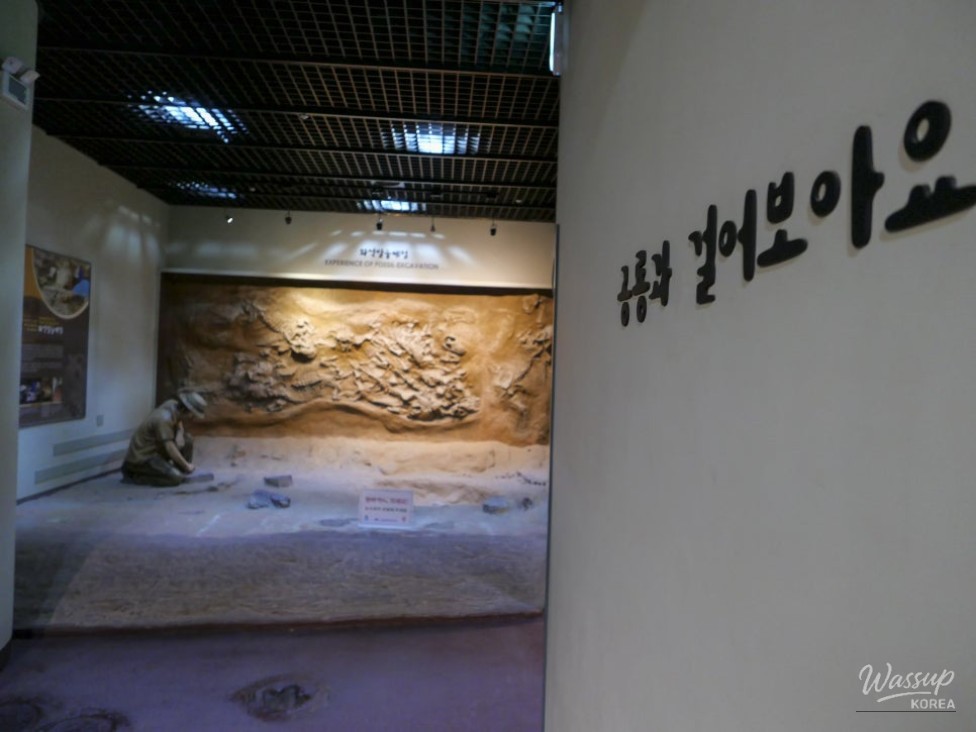
The Mesozoic exhibition showcases the world of dinosaurs, which captures the interest of many. The exhibition clearly presents the environment of the Mesozoic Era, types of dinosaurs, fossil formation processes, and causes of dinosaur extinction, including a fossil excavation experience that is especially popular among children.
B1. Natural History Hall - Cenozoic Era
The Cenozoic exhibition explores the process of mammals thriving after the dinosaurs disappeared. It is structured to help visitors understand changing natural environments alongside various fossils, naturally linking to the formation of the current ecosystem.
B1. Natural History Hall - Harmony with Humans
The final space in the Natural History Hall addresses human evolution and the beginnings of civilization. Through various exhibits, visitors can understand the process of human growth from the birth of primitive life forms to the evolution of skulls and the history of humanity living in harmony with nature.
1F. Fossil Exhibition Hall
In the Fossil Exhibition Hall, visitors can closely observe various fossils, including four types of bird footprints, two types of dinosaur footprints, pterosaur footprints, turtle footprints, and dinosaur skin fossils. Additionally, sedimentary structures like mud cracks and trace fossils are displayed to help visitors understand the fossilization process.
The highlight of the Fossil Exhibition Hall is the Timewalker immersive video media show, which captivates visitors for the longest time. Based on fossils discovered in Jinju, it vividly recreates the natural environment of the Mesozoic Era.
1F. Science Experience Hall 1 - Electricity and Magnetism
In Science Experience Hall 1, visitors can directly experience various principles of electricity and magnetism. By pressing buttons and moving devices, they can visually confirm changes in current and magnetic fields, making it easy to understand how the science in textbooks works in reality.
1F. Science Experience Hall 1 - Harmony of Matter and Energy
This space allows visitors to experience the relationship between matter and energy through various experimental devices, easily understanding scientific principles in daily life.
2F. Science Experience Hall 2 - Spectrum of Space
On the second floor, more advanced scientific experiences continue, allowing visitors to directly observe various physical phenomena and energy principles.
3F. Insect Specimen Hall
The Insect Specimen Hall features a variety of specimens, from common insects to rare ones, revealing the amazing survival strategies and beautiful forms hidden within even the smallest life forms.
4F. Astronomy Experience Hall
The Astronomy Experience Hall is the space where visitors can meet the universe up close, understanding the birth, evolution, and extinction of planets and stars through various exhibits and experiences.
4F. Planetarium
The planetarium offers a virtual starry sky that feels like the real night sky, allowing visitors to comfortably enjoy beautiful constellations regardless of weather or season.
The Gyeongsangnam-do Education Science Center is Jinju's representative experiential science museum, where science can be learned easily and enjoyably through various exhibitions and experiences. It is a perfect place to spend meaningful time with children or find a unique indoor travel destination, offering a special space to experience science like play and discover new joys.


Source :https://blog.naver.com/pearl286/224341524825
No comments yet.