Reflections on Memory and Region: A Review of the Sungbuk Archiving Project Screening


Lee Min-hye-min | Director of the Sungbuk Youth Civic Association.
I aspire to build a network for young people who learn, work, play, and live in Sungbuk.
As someone who has spent time in Sungbuk from 2015 to 2025 as a young citizen, an activist, and a mediator and enjoyer of culture, being able to witness the '2025 Sungbuk Archiving Project × Korea National University of Arts 〈Memories of the Region〉 Screening' was both a new pleasure and an experience of reflection.
Held on September 4, 2025, at Arirang Cine Center Hall 3, the screening featured a total of four works, followed by a conversation with critic Lee Do-hoon and director Ahn Gun-hyung. All four pieces meticulously considered which aspects of Sungbuk's complex and vast characteristics to focus on, which time periods to capture, and what stories to tell through metaphors and expressions. Therefore, I hope that they will be presented at more occasions in the future. (I can say that this hope is reasonably possible as there was one project from the 2024 screening of 'Memories of the Region' that had the chance to be shown again at the Jeonju International Film Festival and the Spark Documentary Festival.)
On my way to the screening, I repeatedly read the combination of the two words “region” and “memory.” The two words shared similar shapes and sounds, creating a peculiar rhythm. Region and memory, memory and region… In fact, for the past 10 years, I have been desperately trying to connect youth and the region, thinking that they could become each other's support. But it wasn't easy.
Most young people come to Seoul in search of education and employment, and while Seoul provides spaces like schools and workplaces, it doesn't become a place where they can truly settle. With already limited leisure time in their daily lives, it's not easy to dedicate enough time to learning about and enjoying the resources of the region. Moreover, without a kind guide! Thus, for the majority of the 130,000 young people living in Sungbuk-gu, the region is merely a place of residence. (According to 2024 Sungbuk-gu population statistics, approximately 123,000 young people aged 19-39 reside in Sungbuk-gu. The 'living population,' which includes young people living without registering their address, would be even larger.) From the perspective of local residents or administrative agencies, young people are often perceived as transient, staying only temporarily. They consume, utilize, and explore the region, but when it comes to 'settling down,' they go elsewhere. Consequently, the region and young people drift apart without properly encountering each other.
But if memory and recording intervene here, a slightly different scenario becomes possible. The decision to record is a declaration to listen to the stories of those who remember the past. It's a commitment to jointly contemplate the future of this place. This determination can become a bridge connecting the region and young people. Have I been diligently creating a foundation where these resolutions and declarations can be sustained? Have I been approaching memory and recording with this level of seriousness?
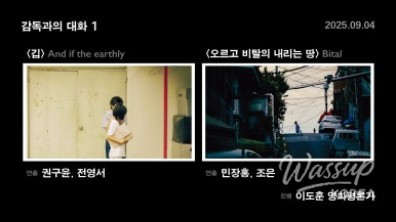
Let me introduce the screened works in order of presentation, starting with 〈Gip〉 (Directed by Kwon Gu-yoon and Jeon Young-seo). It is the only feature film screened that day, summoning characters and texts from Lee Tae-jun's novel 'Dalbam (Moonlit Night)' to the screen. The protagonist, a weather forecaster who observes and predicts meteorological phenomena, aimlessly wanders in search of 'Wolshik (Lunar Eclipse)' cigarettes, against the backdrop of actual convenience stores, alleys, and stairs in Jeongneung, Seongbuk-dong, and Seokgwan-dong. One night, the protagonist learns about an illustration and a character named 'Hwang Su-geon' from 'Dalbam' and chases after him. The 'Seongbuk Global Food Festival Nurimasil' in Seongbuk-dong is shown for a long time, and places related to literature (and literary figures) such as the Seoul Fortress Trail and the Seongbuk Modern Literature Museum also appear. As the film progresses, the protagonist and Hwang Su-geon meet and converse. Sentences from Lee Tae-jun's novel or newspaper articles replace parts of the dialogue or explain scenes, crossing between the world of literature and the world of visual media. Hwang Su-geon and the protagonist engage in increasingly intimate interactions, and like their precarious relationship filled with tranquility and unease, weather forecasting calculations also falter. While real events happening in present-day Seongbuk-dong and weather phenomena in the sky are shown alternately, I ponder how looking back at the past might be related to predicting the future. At the end of the film, the voice of prediction, 'It will rain in the future,' transforms into prophecies about the future society, but in the reality outside the film, most of those prophecies have already passed. In this way, the film slowly concludes, completing a long and intricate stitch that sews together the world within literature, the world within the film, and the world outside the film.
Critic Lee Do-hoon, who conducted the conversation that day, interpreted it as 'a modernist work experimenting with the spatial and temporal gaps, fictional gaps, linguistic gaps, and cinematic gaps between the protagonist and Hwang Su-geon, a character in Lee Tae-jun's novel.' It is a film that intentionally chose the 'slipping' ambiguity between the past and present, time and space, and the languages of literature and cinema, and this composition reflects the ambiguity that the directors themselves felt. In the conversation, director Jeon Young-seo explained how and why she made this film, saying, 'I found it interesting that 'Dalbam' referred to Seongbuk-dong as 'still a rural area.' You can't really call Seongbuk-dong rural these days.' She added, 'I lived in Seongbuk for a long time but didn't feel like it was a place where I could put down roots. (…) It was like a temporary mooring, a place I had to pass through but hadn't been able to leave yet, a somewhat abstract and ambiguous place, that was the feeling I had about 'Seongbuk.' I saw this irony in the novel.' It was interesting to see the region not just as a physical space, but as a fantastical space where irony and humor overlapped.

〈Climbing Up and Down the Sloping Land〉 (Directed by Min Jang-hong and Cho Eun) is set around the 'Dongbang Hill' area in Jangan-dong and can be described as a documentary that directly confronts how changes in Seoul's urban development policies have affected the region of Jangan-dong. In the conversation, when asked about the title, director Cho Eun explained, 'When I'm coming up with a title, I feel like I'm writing a poem,' and added that she wanted to create a title with a life force that moves horizontally and vertically when read. Regarding the phrase 'climbing up and down,' she said that it had multiple meanings, including 'the fluctuating history of Jangan-dong, which was a wealthy neighborhood in the 1970s, then remained stagnant as Gangnam was developed, and then was confirmed for redevelopment and then canceled, the rise and fall of real estate prices within that history, a place of interests and conflicts, and at the same time, people continuing to climb up and down this steep area, the movement of human and non-human existences.'
It was the most faithful current record of revisiting the redevelopment issues that Sungbuk has long endured from a youth perspective, and in particular, the directors' persistence and tenacity in not giving up on filming until the very last moment, even amidst the extremely harsh heavy rains and heat of this summer, were very striking. Is there anything that is only beautiful when looked at deeply and observed persistently? Looking into each person's position surrounding Jangan-dong is like zooming in and zooming in again on an alleyway landscape mixed with waste materials, garbage, plants, cats, and unfolded umbrellas. It's complex and messy, but something is always happening within it. In our society, the story of redevelopment policy has been steadily deepening and widening. Many people would agree that it is a topic that cannot be discussed only in terms of pros and cons. Wouldn't it be good to talk more about the lives of those who climb up and down the slopes, about the daily lives and labor they are managing? Before it's too late.

〈Beopryun Temple〉 (Directed by Kang Min-jeong and Lee Chae-bin) begins with a scene in a very quiet kitchen. A monk enters and slowly mixes something like paint, then brushes it onto a piece of paper, gradually drawing the shape of a lotus flower. Along with the cryptic saying that the lotus flower is a symbol of 'being dyed but not being stained.' In that way, it slowly immerses you, like paint seeping into paper. This documentary, with a definite protagonist named Venerable Heeun, calmly captures the monk's daily life, work, thoughts, and conversations with the production team, progresses in its own way toward the story it wants to tell, and even deals with the themes of meeting and parting in a simple way.
Meetings and partings come and go. Like an art school being established in a place that used to be a 'scary neighborhood,' or cats coming and going through the open yard gate, like a quiet Dharma hall being bustling with all sorts of people on event days and then becoming quiet again after time passes, like a Buddhist grandmother leaving behind a smile in her portrait and young grandchildren but being able to have audiences pray for her soul thanks to the young filmmakers staying at the temple. And until the end of the film, the lotus flower is slowly drawn and drawn again. In the conversation, director Ahn Gun-hyung pointed out that 'Korea National University of Arts was established in the place where the Agency for National Security Planning was located, someone who likes heavy metal became a monk, there's a daily space on the first floor and a Dharma hall on the second floor… the relationship between mud and lotus flower is now being formed in many analogies,' and director Lee Chae-bin added, 'When I wondered what would continue amidst those things that stay and leave, I thought that the painting that the monk has been doing for a long time and will continue to do could be the center, that the audience would feel that something is continuing and will continue to be done, rather than feeling emptiness.'
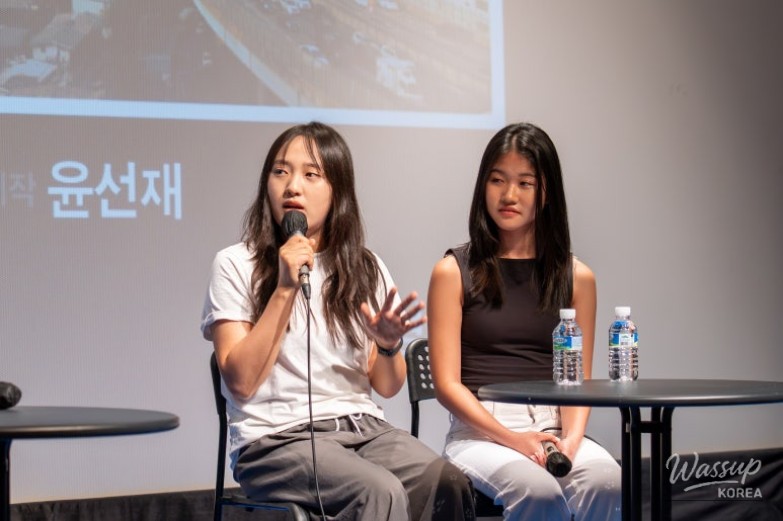
〈Miarigogae〉 (Directed by Kwon A-young and Produced by Yoon Seon-jae) was the last film screened and left the most lingering impression. It is a story about redevelopment, poverty, displacement, prostitution, and family, and fundamentally, it is a film that asks how we, who are different from each other, can understand each other. Or it may be asking whether we can stand in solidarity before understanding.
The Hawolgok-dong red-light district (area around 88 Hawolgok-dong, Seongbuk-gu), commonly called 'Miari Texas,' has been gradually shrinking due to several redevelopments, but in recent years, it has overcome several crises, even being driven to the point of forced eviction. If you are a young person interested in local issues, especially someone interested in the socioeconomic poverty of women working in the sex industry, you cannot help but be deeply interested in this topic, so I was glad to be able to see a work dealing with this topic at this screening. And of course, if you are someone who worries about and feels sorry for something that is disappearing, this topic will be one that you can have a long conversation about.
The directors said that they prepared for this work by going directly to press conferences and rallies attended by the parties involved and building relationships with them, which made it possible to include the voices of the parties involved in the film with significant weight, and to see even specific places inside the red-light district that are not well covered in other media on the screen. Personally, I had the opportunity to actually tour the inside of the red-light district a few years ago through the 'Women's Human Rights Center Boda' and hear explanations about activities supporting victims of prostitution, so I would say that it was a coincidence or good fortune that I was able to recognize familiar places. I could imagine how difficult the casting and filming would have been even more because I had background knowledge, but the power that ultimately made it possible to produce and screen it like this must have been due to the production team's desire to tell the stories of the women in the red-light district. Director Kwon A-young said that she has been constantly thinking about 'whether sex workers are the most vulnerable class who are evicted first in the process of redevelopment driven by the logic of capital.' Young people asked the question, and the region should respond together.

When asked to describe the Sungbuk area, I usually end up explaining it based on information that can be found through internet searches, as if I were a tourist guide. What cultural heritages there are, how many universities there are, how many people there are, what subway stations there are, and so on. But is that all we can say about the region, and is that all we want to hear? If the elements that make up a region were that simple, we would not be able to explain the love-hate relationship that we each feel towards our hometown or the region where we have lived for a long time.
We experience not only the geographical elements of the region, but also the people who live there, the events surrounding it, and the climate that passes through it. All of these elements work together in a complex way to create an impression, and many people contribute together to create the atmosphere of the region. The air and atmosphere sometimes cross legal and administrative boundaries, and sometimes cross the past and future. That's why recording the region is not easy. If it doesn't contain all the contexts that spring up, flow, and fade away, if this entire narrative of experience is not recorded, it becomes a taxidermied specimen that is no longer worth looking back on.
That's why the meeting with the medium of film is exquisite. When the people who were murmuring and filling the lobby enter on time and the lights go out, the only place to look is the screen. The audience intently gazes at the scenes that fill their field of vision, not knowing what will happen next, and tries to understand the speaker's situation and the director's intentions. His experience becomes like my own, we wander together, we feel regret together, and we concentrate and immerse ourselves until the lights are turned on again. In this field of intense indirect experience, recording gains life. I'm glad that we can leave Sungbuk at this point in time with this powerful medium that can revive the emotions of that moment whenever we see it again. We can start again from here. When individual records are gathered, they become a collective memory. We can remember Sungbuk more broadly.




No comments yet.