A Reunion in Sejong: Cherished Memories and Beautiful Landscapes
- Original source
- blog.naver.com



For over ten years, some friends have been nurturing their friendship.
Since I moved from the metropolitan area to Sejong City, we spent a decade merely exchanging greetings.
However, one late autumn day, they visited Sejong.
These are the people with whom I once roamed the fields and mountains, carrying cameras and getting close to small flowers.
They were my companions from a photography club, dedicated to capturing every flower and landscape we encountered.
Two decades have changed many things.
Some friends have passed away, while others now struggle with mobility.
Yet, our hearts remain anchored in the memories of those days.
As we planned our long-awaited reunion, I felt both excited and slightly anxious.
In the past, it would have been customary to invite them home and serve a heartfelt meal, but now, restaurants and cafes have become the preferred meeting spots.
We used to climb rugged mountains to find wildflowers and enjoy breathtaking views, but now, leisurely walks in arboretums or gardens suit us better.
We sought a place where we could enjoy nature without much walking and comfortably chat.
The choice was straightforward: the National Sejong Arboretum and the rooftop garden of the Government Sejong Complex.
I believed these locations would perfectly showcase Sejong's unique characteristics and beauty to our esteemed guests.
The National Sejong Arboretum is a representative space where one can encounter nature in the city.
It offers a wealth of sights throughout the year, featuring diverse plant exhibitions, seasonal special exhibitions, cultural events, and educational programs related to plant conservation and carbon neutrality.
Upon parking in the arboretum lot, I noticed a banner announcing changes to the entry route due to ongoing expansion work for a garden shop and garden center to support local farmers and small businesses.
Though we had to take a longer route, passing through a small tunnel added a bit of fun to our entrance.
The ticket booth and entrance remained in their original locations.
All six of us in the group qualified for senior discounts, allowing us to enter for free with just an ID check.
Three women and three men gathered in front of the arboretum logo.
We formed a heart shape with our hands and snapped a commemorative photo, capturing the joy of our reunion in a single frame.
Our first stop was the Four Seasons Exhibition Greenhouse.
This greenhouse is the largest exhibition space in the country for observing tropical and Mediterranean plants.
The building's exterior is eye-catching, designed to resemble the three petals of the iris, Sejong City's flower, in a beautiful, streamlined glass structure.
Reaching a height of 32 meters, it utilizes transparent special glass to ensure indoor plants receive ample sunlight.
We entered the Mediterranean greenhouse first.
The variety of trees created a lush, green environment inside.
The tree we commonly call acacia is actually called 'acacia tree,' while the tree we encountered here is the true acacia. We nodded in agreement as we compared leaves and learned something new.
The Mediterranean garden, with its flowing water, welcomed us with a vibrant display.
We took turns photographing each other and created memories against the stunning backdrop. Our photography skills seemed just as good now as they were back then.
Entering the tropical greenhouse, we felt the humid heat, but the cool water cascading down helped us forget the warmth for a moment.
Tropical fruits like bananas and various exotic plants and flowers caught our eyes.
In the special exhibition greenhouse, a unique display titled 'The Little Prince's Journey on Earth' was underway.
Perhaps the long-distance travel had tired us a bit.
The women decided to relax with a cup of tea at the lobby café, while the men hurried to explore the bonsai garden, palace garden, and rare plant exhibitions throughout the arboretum.
It seemed that even a whole day would not suffice to explore the vast arboretum.
We couldn't help but feel envious of the fact that such a beautiful and expansive arboretum exists right in the heart of the city.
Next, we headed to our second destination, the rooftop garden of the Government Sejong Complex.
This rooftop garden is a special place that I want to show to anyone visiting Sejong City.
Connecting 15 government buildings, the total length is about 3.6 km, covering an area of 88,279 square meters, equivalent to about 12 soccer fields. It is listed in the Guinness World Records as the world's largest rooftop garden.
There are approximately 310 species and about 1.44 million plants planted in the rooftop garden. It features various themed spaces, including herb gardens, medicinal plant gardens, fruit-bearing berry gardens, and vine tunnels, offering different scenic views each season.
However, access to the rooftop garden is not freely available, and prior reservations are required.
It operates in the first and second halves of the year and is closed during summer and winter.
There are three viewing courses, but currently, only Course 1, which moves from Building 6 to Building 1, is operational.
Visits are conducted at 10 AM, 1:30 PM, and 3:30 PM on both weekdays and weekends, lasting about 60 to 90 minutes.
Parking is available at the temporary parking lot near Building 9 or the outdoor parking lot near Building 2.
We barely managed to park in the temporary lot close to Building 6's reception.
Due to limited parking space, it is advisable to use public transportation if possible. The BRT northern stop is conveniently located right next to it.
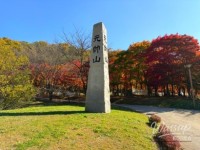
Our second photo op was in front of the Guinness World Record monument.
With the beautifully colored autumn leaves as our backdrop, we gathered in front of the monument, raising our arms high.
We expressed our pride in having the world's largest rooftop garden and our hopes for the development of Sejong City.
On that day, the rooftop garden tour was led by cultural interpreter Kim Young-im.
She shared stories about the various trees and flowers planted in the garden, including the crape myrtle and Cornelian cherry.
Everywhere in the rooftop garden, plants symbolizing autumn, such as silver grass, cosmos, and chrysanthemums, were present. The flowers and grasses swaying in the autumn breeze reminded us of the season's depth.
The bright red berries of the Cornelian cherry also caught our attention.
While the red berries are beautiful now, they will bloom yellow flowers again next spring to welcome us.
The unique decorations on the rooftop entrance wall also drew our attention.
These plant decorations are referred to as espalier and green wall systems.
Espalier involves guiding the branches of trees like apple trees flat against building walls, while green walls involve planting plants like stone maples in the crevices of walls.
The idea of harmoniously integrating nature with architecture was truly impressive.
Now, we ascend to the final course of the rooftop garden, the observation deck.
Around the observation deck, lanterns hang, and a large Taegeukgi (Korean flag) stands diagonally in the center.
From the observation deck, we could see the rooftop garden we had walked through and the landscape of Sejong City all at once.
As I looked at the rapidly developing Sejong City, I felt a sense of pride.
It was also a great honor to show such a wonderful city to our esteemed guests who had traveled from afar.
We concluded our rooftop garden tour at Building 1 of the Government Sejong Complex.
As we descended the stairs outside the building, the beautifully colored autumn leaves and colorful sculptures created another autumn scene.
Don't miss the autumn in Sejong; there are many more places worth visiting.
After exploring the arboretum and rooftop garden in half a day, I would recommend a few more spots for visitors to Sejong if they have extra time.
1. Sejong Lake Park – A picturesque blend of lake and city.
Sejong Lake Park is the largest artificial lake in the country, boasting an area about 62 times that of a soccer field and an average depth of 3 meters.
Five artificial islands have been created around the lake: Festival Island, Stage Island, Water Play Island, Water Flower Island, and Wetland Island.
The National Sejong Library, harmonizing with the lake, and the distant view of Jeonwolsan Mountain resemble a beautiful painting.
The walking and biking paths along the lake provide a relaxing space for citizens. It's especially nice to stroll slowly on autumn days while admiring the reflections in the lake.
2. Geumgang Pedestrian Bridge – A unique landmark in Sejong.
The bridge connects the central green space on the north side of the Geum River with the riverside park in the southern living area, symbolizing Sejong City's unique urban structure.
Designed to commemorate the year 1446 when King Sejong promulgated Hangul, its perimeter measures 1,446 meters.
It features a two-level structure, with the upper level designated for pedestrians and the lower level for bicycles.
The innovative design symbolizes Sejong City's fantastic urban structure and is recognized as the longest pedestrian-only bridge in the country.
3. Bear Tree Park – Experience the beautiful autumn foliage in Sejong.
Just outside the city, Bear Tree Park is renowned for its stunning autumn colors.
It is a botanical garden and zoo where you can meet over 100 moon bears and brown bears, more than 1,000 species of plants, and around 400,000 flowers and trees.
In various spaces like the Bear Tree Garden, plant garden, and bonsai garden, you can enjoy the changing nature each season, along with bear feeding experiences and various performances and exhibitions, making it a popular family outing spot.
In addition to seasonal flower festivals featuring cherry blossoms, azaleas, and roses, there is also an autumn foliage festival. Especially when strolling through the trees and gardens adorned with autumn colors, you can fully appreciate the beauty and tranquility that nature provides.
Our autumn outing in Sejong with friends after a long time was truly special.
We met charming flowers and trees at the National Sejong Arboretum and admired the beautiful scenery of Sejong City from the rooftop garden of the Government Sejong Complex.
However, the places we visited that day were not just beautiful tourist spots.
Simply reuniting with friends, who once roamed the mountains and fields with cameras in hand, made the day special.
Time flies so fast. Climbing high mountains like before has become difficult, and wandering around taking photos all day is no longer easy. The absence of friends who have passed away is felt even more profoundly now.
Yet, the memories we shared are still alive in our hearts, and the faces we encountered after a long time still hold the laughter from those days.
There are many places in Sejong that I want to show. I will save the beautiful autumn scenes of Sejong Lake Park, Geumgang Bridge, and Bear Tree Park for our next meeting.
Walking paths with good people are enjoyable, even if they are long, and beautiful landscapes shine even brighter when shared.
When precious guests come to Sejong, I ponder where to take them. In such cases, I would unhesitatingly recommend the National Sejong Arboretum and the rooftop garden of the Government Sejong Complex.
And I hope that next time we can create more memories together in even better health.
Though time may pass, friendship remains steadfast.
Source :https://blog.naver.com/sejong_story/224471554713
More from Walking




No comments yet.