

The City of Jikji: Cheongju's Printing Heritage



The UNESCO World Documentary Heritage City of 'Jikji',
Cheongju Early Printing Museum
Everywhere you go on the way to Cheongju, you will see the word 'Jikji'.
In Cheongju, the city of the world documentary heritage 'Jikji', there is the Cheongju Early Printing Museum, which commemorates 'Jikji', the oldest existing metal type printed book in the world.
**Visiting Information for Cheongju Early Printing Museum
Opening Hours: 09:00 - 18:00
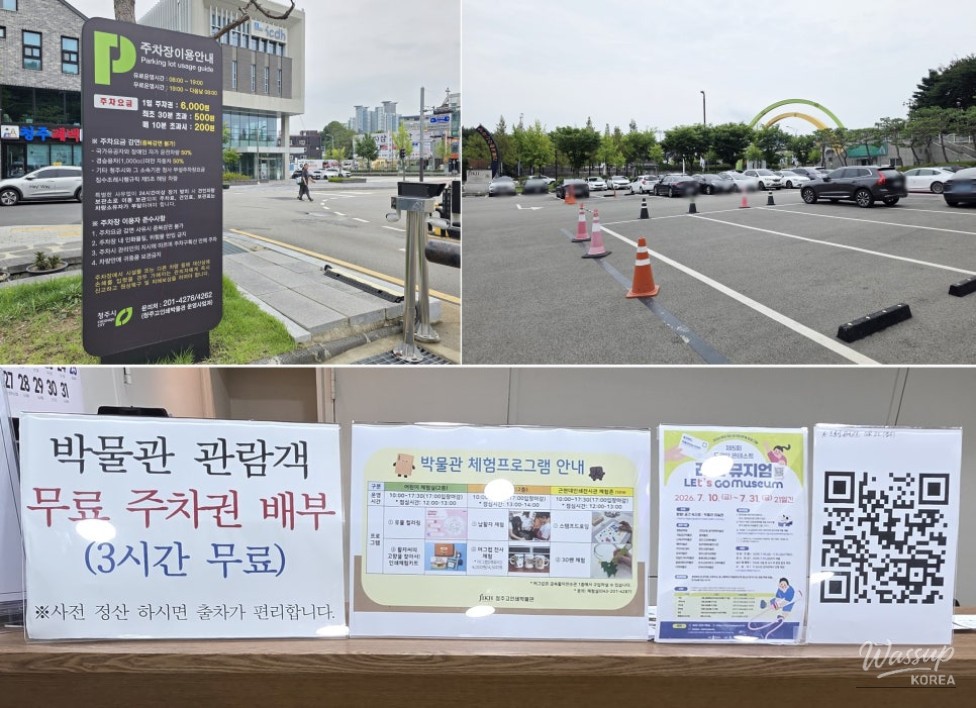
Free admission / Free parking for 3 hours
Paid parking: 08:00 - 19:00
Free parking hours: 19:00 - 08:00 the next day
1-day parking pass: 6,000 won, 500 won for the first 30 minutes over, 200 won for every 10 minutes thereafter
The area around the Cheongju Early Printing Museum features various facilities, including the Cheongju Heungdeoksa Site, Modern Printing Exhibition Hall, and Metal Type Training Center.
Heungdeoksa is where 'Jikji' was published, which is why the museum was established here (March 1992).
On the ground in front of the sculpture commemorating 'Jikji', the phrase 'Baekun Master’s Direct Transmission of the Buddha's Heart' is inscribed in Chinese characters,
and the arrangement of pots on the stairs in front of the museum also resembles the letters of 'Jikji'.
On the left and right walls of the museum entrance, there are inscriptions with the same content, with the left side showing the typeface version and the right side displaying the printed version.
The Cheongju Early Printing Museum is impressive with its detailed representation of the Jikji character.
Exhibitions and Experience Programs at the Early Printing Museum
Start your visit from the first exhibition hall while admiring the large Jikji sculpture.
There is also a digital heritage experience hall, where the significance of 'Baekun Master’s Direct Transmission of the Buddha's Heart' is briefly explained on the walls.
'Jikji' is a shorthand term for 'Baekun Master’s Direct Transmission of the Buddha's Heart'.
Its meaning is as follows:
“Master Baekun extracted important parts to convey that when one directly faces their mind through meditation, they realize that their true nature is that of the Buddha.”
The digital heritage experience hall includes a hologram theater, virtual reality printing house, and Jikji media art village.
The Birth and Journey of Jikji
Jikji is the oldest known metal type book that has been discovered and still exists today.
While the Gutenberg Bible is known as the oldest metal type book, the discovery of 'Jikji' (published in 1377), which predates it by 78 years, has changed historical records.
Dr. Byung-Seon Park was the one who discovered 'Jikji' at the National Library of France.
Dr. Park (1933–2011) worked at the National Library of France from 1967, researching 'Jikji' stored in the Eastern Library, and played a significant role in returning 297 volumes of the Oegyujang-gak records to Korea in 2011.
His research established 'Jikji' as the oldest metal type book.
Dr. Park received recognition for his contributions, receiving various awards including the Order of Cultural Merit in 1999, the National Medal of Merit in 2007, and the Moran Medal in 2011.
In June 2001, 'Jikji' was recommended for UNESCO World Documentary Heritage registration at the 5th UNESCO International Advisory Committee held in Cheongju, and the decision was finalized on September 4.
In response, Cheongju City started the 'Jikji Festival' from September 4 to 7, 2003, which has continued as the 'Jikji Cultural Festival'.
In 2004, UNESCO established the Jikji Prize with the support of the Korean government, awarding it to institutions on September 4 every two years, with the Czech National Library being the first recipient in 2005. By 2024, a total of 10 institutions, including the National Library of Indonesia, will have received the Jikji Prize.
This year marks another award year; which institution will take home the honor?
The history of printing technology in Korea, from woodblock printing to metal type, is also showcased, and on the second floor, you can see illustrations of the printing house.
The printing house, established in 1403, oversaw the casting and printing of metal types during the Joseon Dynasty for over 500 years until the early 1900s.
In the third exhibition hall, you can also see printing cultures from other countries.
You can register on-site for free printing experiences, making the Cheongju Early Printing Museum a great place to visit with children on a hot summer day.
The development of printing technology aligns with the current evolution of the internet in terms of sharing information.
It would be a good opportunity to discuss the meaning of 'democratization of information' with your children.
There is also a monument (erected in 1990) outdoors, commemorating the location of Heungdeoksa.
Heungdeoksa published 'Baekun Master’s Direct Transmission of the Buddha's Heart' in metal type in 1377, but its exact location was unknown until excavations by Cheongju University Museum in 1985 revealed it.
In the parking lot, there is information that the Jikji Cultural Festival will be held here from September 4.
Visitors arriving by car should remember to collect their 3-hour free parking ticket from the museum!


Source :https://blog.naver.com/cbkb21/224378720295
No comments yet.


