Exploring Gongju Fortress: A Journey Through Time



Gongju, the city where the spirit of Baekje remains most vividly alive, is home to the historical sites of Baekje scattered across Gongju, Buyeo, and Iksan.
These sites were designated as UNESCO World Heritage Sites in 2015 under the name 'Baekje Historic Areas'.
The Baekje Historic Areas encompass cultural heritage including fortresses, temples, tombs, and palace ruins from the late Baekje period, particularly in the regions of Ungjin (Gongju) and Sabi (Buyeo).
These sites serve as significant evidence of how Baekje transmitted the culture and technology it adopted through exchanges with China back to Japan and other parts of East Asia.
The reason for its recognition as a World Heritage Site lies not only in its antiquity but also in the relatively intact traces of cultural exchange and the formation of East Asian civilization.
Among these sites, Gongseong Fortress, located in Gongju, represents a royal palace from the Ungjin period when Baekje served as its capital and is one of the core heritage sites of the Baekje Historic Areas.
Gongju feels like a history book, with various spaces throughout the city that evoke the past.
Gongseong Fortress is the place where one can closely encounter traces of the Ungjin period, the capital of Baekje.
Walking along the fortress walls, I captured the scenery of the Geumgang River and the city of Gongju through photographs.
It was striking to see history seamlessly integrated into the present landscape rather than merely being confined to books or exhibitions.
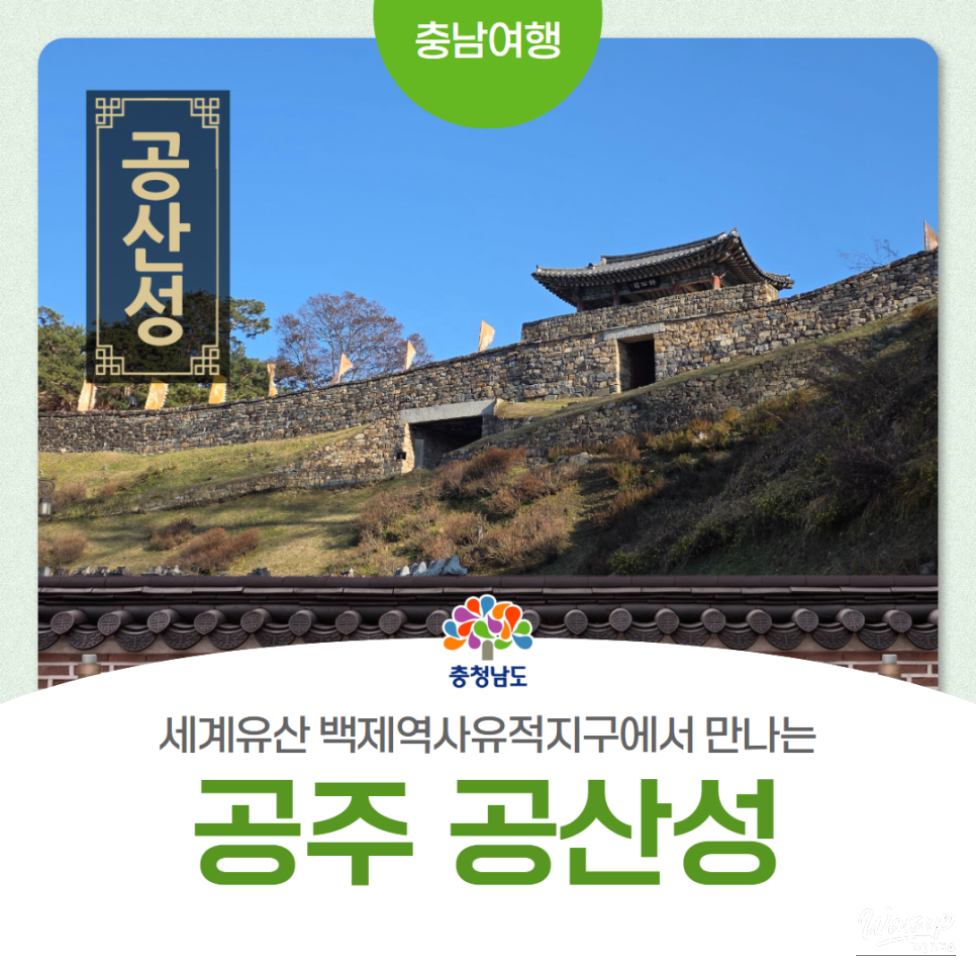
Gongseong Fortress, which was used as the Ungjin Castle during the Baekje period, is situated on a ridge 110 meters above sea level along the Geumgang River.
Its structure is characterized as a mountain fortress built using the natural terrain, with valleys nestled within.
As I entered the fortress, the gently winding walls and mild mountain paths caught my attention, evoking a sense of leisurely strolling rather than climbing a high mountain.
Looking back along the path, I could see the Geumgang River flowing and the city of Gongju spread out before me.
It was a moment where understanding why a royal fortress was established here became intuitive just by observing the terrain.
The fortress walls bear traces of continuous use and restoration from the Baekje period through Goryeo and Joseon.
During the Baekje period, it was known as Ungjinseong, in the Goryeo period as Gongjusanseong, and in the Joseon period as Gongseong, adapting its appearance to the needs of each era.
Examining the stones reveals overlapping construction methods from different periods.
Although it is a single fortress, it feels like a space layered with the passage of time from various eras.
Walking along the walls of the fortress, I felt as if I were not just viewing a historical site but walking through the timeline of the city.
Below my feet was present-day Gongju, while beneath me lay the intertwined histories of Baekje, Goryeo, and Joseon.
Pausing atop the fortress walls to gaze at the Geumgang River became a memory that lingered the longest.
The slowly flowing river and the cityscape beyond created a scene where the past and present seamlessly overlapped.
As I took photographs, I noticed the curves of the fortress walls mirrored the flow of the river.
Despite being a man-made structure, it harmonized beautifully with the surrounding landscape.
Another characteristic of Gongseong Fortress is the remnants of defensive structures scattered throughout.
The watchtowers, gates, and hidden passages were meticulously designed to thwart enemy invasions.
What now feels like a leisurely walking path was once the frontline of a nation’s defense.
As I circled the walls, the scenery continuously changed, yet the overall atmosphere remained calm and serene.
Being a tourist site yet distanced from the city’s noise naturally slowed my pace.
As I walked and took pictures, I could sense that this place had been significant for a long time without needing special explanations.
Each stone and wall seemed to hold the time people had built up over the years.
Rather than grand architectural structures, Gongseong Fortress felt like a space that tells stories through its landscape and structure.
Although there are no towering buildings, the view from the fortress walls is wide and profound.
As I slowly descended, I realized this place is not just a historical site but still part of people’s daily lives.
People walking, travelers taking photos, and those resting momentarily all blended together naturally.
This place felt more suited for a slow walk to appreciate the scenery than a quick visit.
Gongseong Fortress felt more like a 'place to walk' than merely a 'place to see'.
Amidst the landscape where the traces of Ungjin, the capital of Baekje, and present-day Gongju coexist, Gongseong Fortress felt like a space connecting the past and present.
Even if I return one day, I believe it will remain etched in my memory in a different light depending on the season and time.
Gongju Gongseong: Location: 53-51 Geumseong-dong, Gongju, Chungcheongnam-do. Operating Hours: Summer 9:00 AM - 6:00 PM / Winter 9:00 AM - 5:00 PM. Admission: Adults 3,000 KRW / Youth and Military 2,000 KRW / Children 1,000 KRW. Group discounts available for 20 or more. Parking: Free at Gongseong parking lot. Transportation: Gongju Comprehensive Terminal → City Bus 101, 125.

Source :https://blog.naver.com/sinmunman/224164568281
No comments yet.