A Special Time to Learn Sign Language and Everyday Communication
- Original source
- blog.naver.com



[Reporter: Yoon Jae-yeol]
A special time to learn sign language and everyday communication
It has become common to see sign language interpreters on television screens. During news broadcasts or public policy announcements, there are people moving their hands next to the hosts to convey messages. Until now, this scene was often overlooked. However, for some, it is a crucial moment to connect with the world and society. For those who cannot hear, the movements of their fingertips are not mere gestures but a precious language for understanding and communicating with the world.
The Gyeonggi Provincial Library is conducting basic education in Korean sign language.
A door to communication opened by sign language, the first step to understanding differences
The Gyeonggi Provincial Library has organized a program to understand people who communicate with the world in different ways. The first class was held on November 11 under the name "Sparkling Sound of Applause" on the library's fourth floor. The program consists of four sessions where participants learn Korean sign language and Deaf culture, including expressions used in daily life and sign language. It was designed to provide opportunities for learning sign language, understanding the language and culture of the Deaf, and respecting differences.
The class began with the instructor asking if anyone had encountered a person with hearing impairment. Only two participants raised their hands, stating that their relationships were distant. This indicated that most participants had no opportunity to share sign language in their daily lives. Nonetheless, they expressed curiosity and a desire to learn.
Choi Yu-ri from Suji District, Yongin, shared, "I read the book 'Sparkling Sound of Applause' by director Lee Gil-bora. This director is a hearing child of Deaf parents, known as a CODA (Children of Deaf Adults). Reading this autobiographical essay sparked my interest in sign language, and I wanted to learn more."
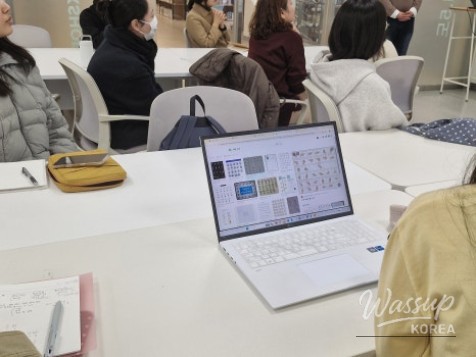
The atmosphere in the classroom was lively as learners and the instructor collaborated energetically.
Realizing new meanings of communication while learning the language of the Deaf
The lecture was conducted in a unique way. Instructor Jang Se-il, who is Deaf, led the class directly. Occasionally, communication was not smooth, but assistant instructor Kim Deok-won stepped in to help. When the main instructor expressed something in sign language, the assistant instructor conveyed it to the students.
The difference between 'Deaf' and 'hearing impaired' was explained first. The term 'hearing impaired' is commonly used, often in legal and administrative contexts. However, if we base it on language identity, we refer to them as Deaf. The Deaf community can be understood as a minority group that uses sign language as their primary means of communication.
Participants actively engaged with curiosity and a sense of necessity.
During the class, I felt my heart move. Even when referring to the same person, the expression changes depending on the perspective. By broadening our viewpoint beyond the majority's standards to consider others' perspectives, new insights emerged that I had not previously considered.
When learning finger spelling, the classroom buzzed with energy. Participants expressed Korean consonants and vowels with their fingers, observing each other's hand movements. Although some struggled to form the shapes correctly, laughter erupted as they confirmed their expressions. It was fascinating to realize that they were now expressing the Korean language, which they usually vocalized, through their hands.
Students actively participated in practicing expressing their names in sign language. When introducing themselves, they said, "Hello, I am" and then expressed their names with their fingers. Other students attentively watched the gestures and guessed the names. This process of introducing themselves without voice was a unique experience for everyone, highlighting the warmth of understanding and sharing feelings without spoken words.
Instructor Jang noted, "The theoretical lecture on Deaf culture might seem boring to students, but understanding their lives, culture, and communication methods is essential for true communication. The participants' active engagement made the time fly by. The joy of learning was shared between students and the instructor."
Kim Nam-hee, a program officer, mentioned that they are running a series of lectures and reading discussions called "Questions of the Times, Reading the World," focusing on various societal issues. This time, the topic of disabilities was chosen, allowing the general public to learn about Korean sign language and Deaf culture.
This education went beyond simply learning sign language expressions. It made me realize who the focus is on in expressions related to the Deaf and hearing impaired and from whose perspective we view the world. I learned that communication methods we take for granted may not be obvious to others. Ultimately, differences are not something strange or uncomfortable but values to be acknowledged and respected. I am looking forward to the remaining sessions.
Images:




Source :https://blog.naver.com/gyeonggi_gov/224479301018
More from Place



No comments yet.