A Journey to Muju in Autumn: Exploring the Royal Emissary Trail



Autumn has arrived, making it the perfect time for a trip to Muju.
As autumn approaches, the trees are gradually changing their colors. Fall has also arrived at Deogyusan Mountain, a great place to see the autumn foliage. You can hike up Deogyusan Mountain or take the gondola to the summit. If you prefer a more leisurely experience, you can enjoy a relaxing trek along the Royal Emissary Trail (Eosagil) while embracing nature.
While autumn is a great season for hiking, the Royal Emissary Trail is recommended for those who find mountain climbing challenging. Let me introduce you to the Royal Emissary Trail I visited on an autumn day.
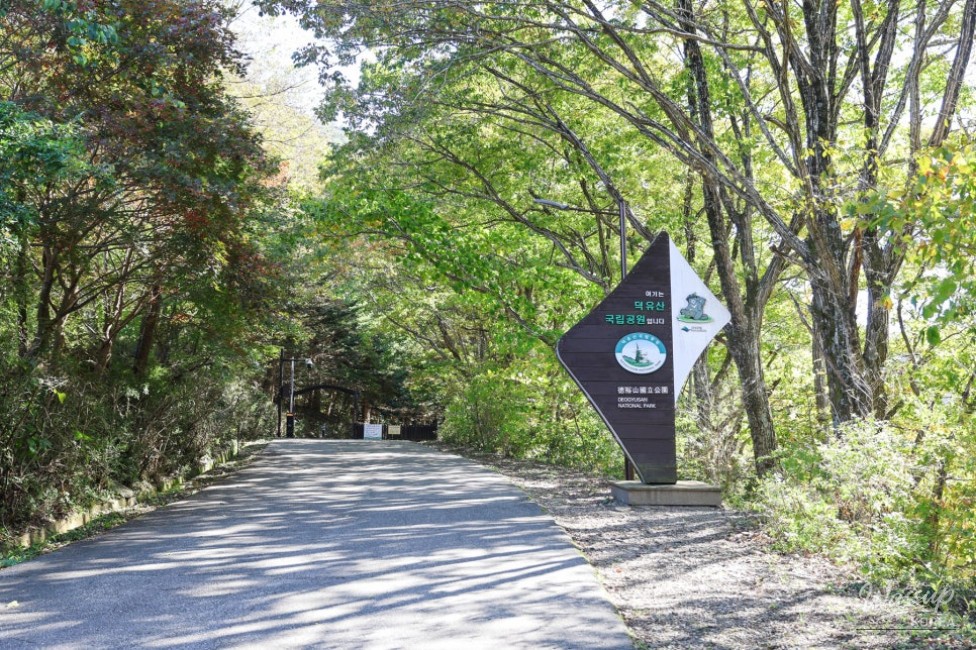
After parking in the Muju Gucheondong parking lot and passing the restaurants along the valley, you will find a sign indicating Deogyusan National Park.
After walking a short distance, you will cross a bridge and encounter the Exploration Information Center. The road up to this point is paved, but the Royal Emissary Trail begins after passing the Exploration Information Center.
This is the entrance to the Gucheondong Royal Emissary Trail.
There is a map of the Deogyusan hiking trails along with the Royal Emissary Trail. The Royal Emissary Trail extends to Baengnyeonsa Temple, totaling 4.9 km, and you can walk along the Gucheondong Valley while admiring the famous sights. Considering the walk from the parking lot, it is about 6 km to Baengnyeonsa Temple.
* Gucheondong: Derived from Gucheondun, meaning a place where 9,000 monks practiced asceticism, mentioned in the travelogue "Deogyusan Hyangjeokbonggi" in the mid-Joseon period.
* Royal Emissary Trail: Named after the story of Royal Emissary Park Mun-su in the late Joseon Dynasty, who punished those who abused their power in Gucheondong and upheld the principles of humanity for the people.
Royal Emissary Trail Section 1: Forest Trail
This is the first section of the Gucheondong Royal Emissary Trail, where you can explore the forest with a light heart, as if taking a stroll. You can feel the joy of an outing as you walk along the valley with the wind blowing from the forest and clear water flowing. From March to August, you can also see wildflowers such as Eranthis stellata, Windflower, azaleas, Rodgersia podophylla, Hydrangea serrata, and Aconitum.
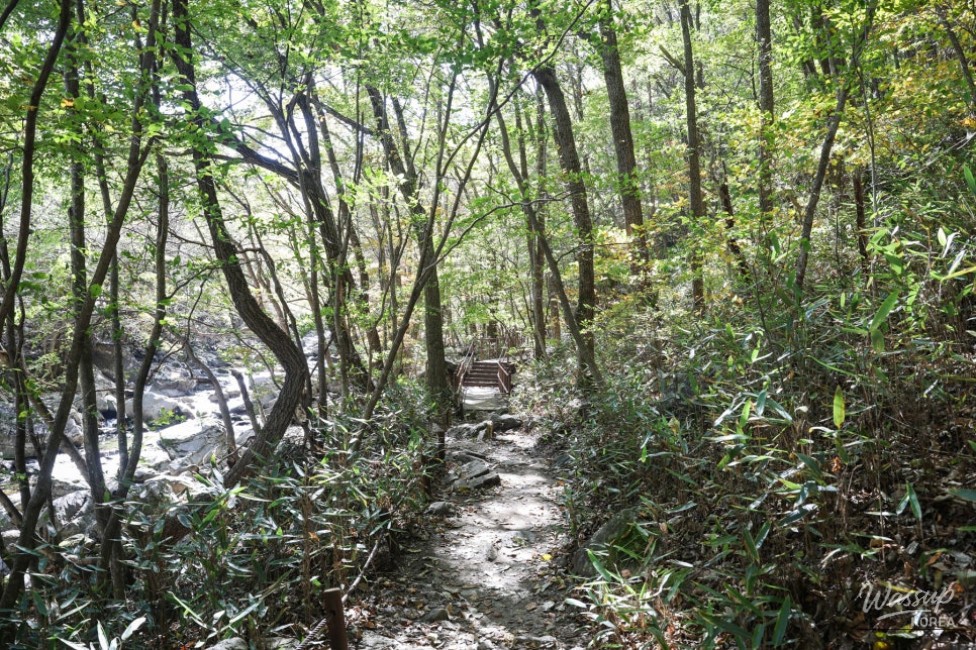
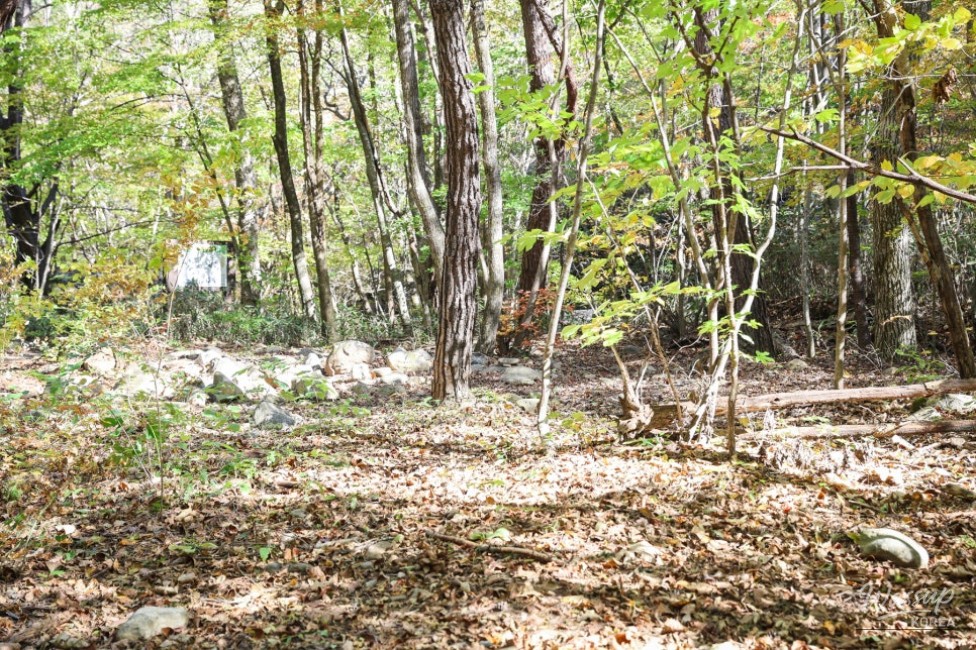
Walking on a dirt path after walking on a paved road makes my feet feel comfortable. Walking along the forest with lush trees, the sound of water flowing into the valley sounds like a song.
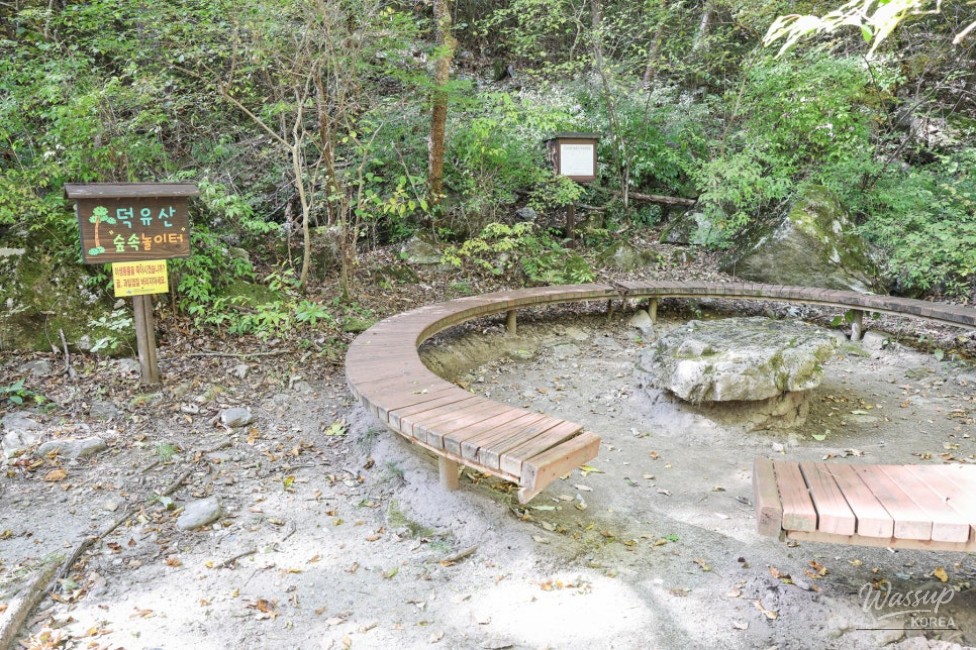
As you walk, you will pass the Deogyusan Forest Playground and the Gold-lined Barbel Ecology Playground, which are used when conducting the Deogyusan nature interpretation program. Reservations can be made through the National Park Service reservation integration system, and you can understand nature and enjoy special games with a commentator.
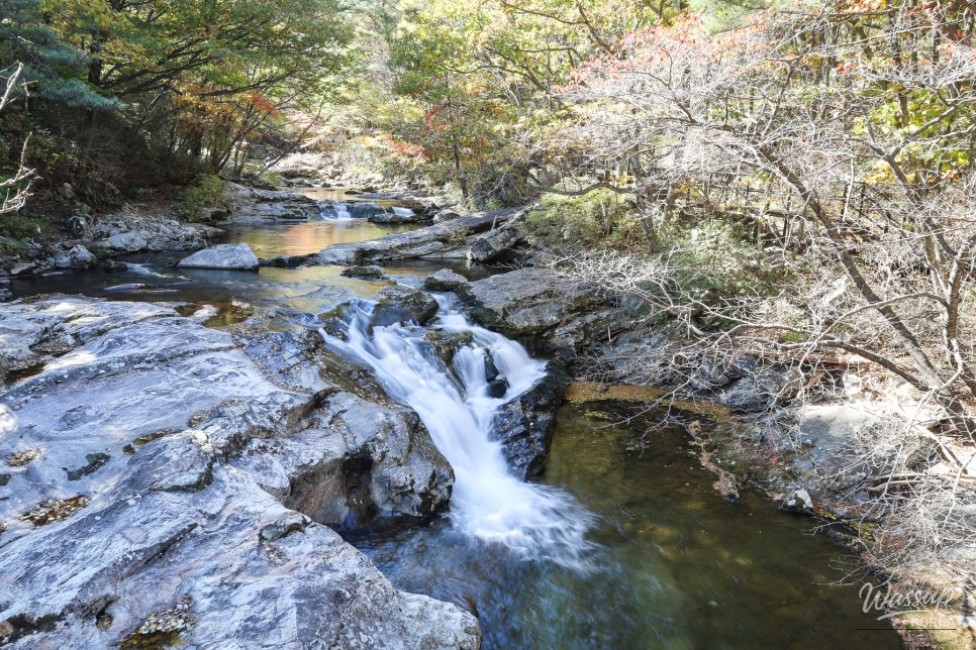
Streams of water flow between the layers of stacked rocks.
The forest with lush trees was healing itself, and the road was comfortable with no steep slopes.
The maple trees have begun to turn red little by little.
Royal Emissary Trail Section 2: Integrity Trail
The second section, the Integrity Trail, is derived from the path taken by Royal Emissary Park Mun-su, who examined the pain of the unfairly accused people and punished the exploitation and tyranny of corrupt people. You can walk while listening to the cool sound of water and the sound of the wind told by nature, and here you can see Inwoldam, Sajadam, Cheongnyudong, Bipadam, Dayeondae, and Guwoldam.
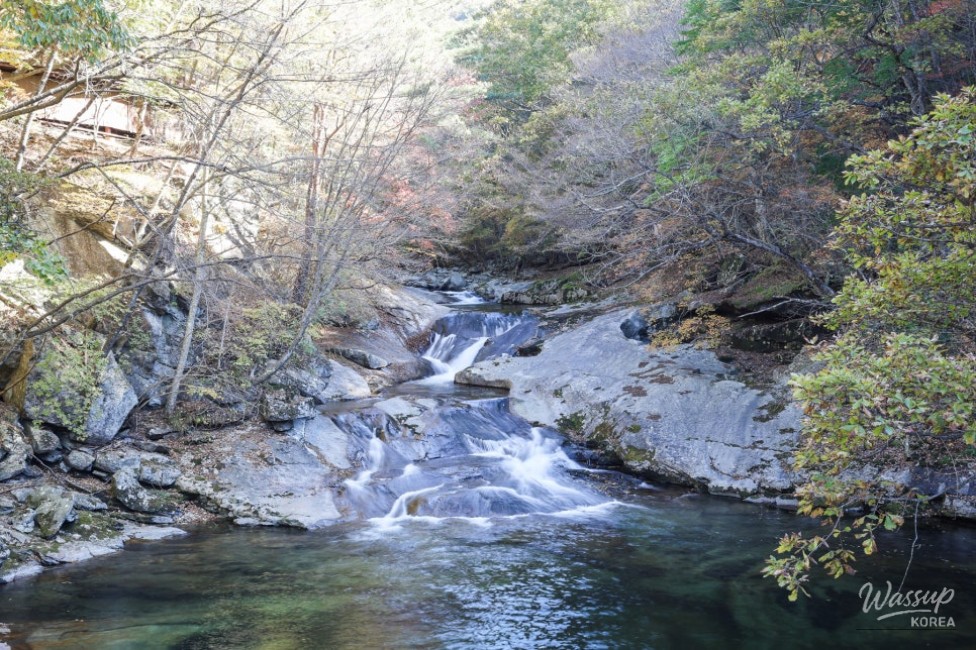
The clear valley kept catching my eye, and the cool pouring water was full of refreshment.
This place passing through the rocks is the Gate of Wish Fulfillment, and there is a story passed down. In the old days, a happily married couple lived in the village, but the husband had to leave on a long journey due to war.
After that, the wife prayed every day at the Tower of Wishes for her husband's safe return, and thanks to her sincerity, her husband was able to return safely. It is said that if you pass through this gate and make a wish at the Tower of Wishes, your wish will come true.
There is also a story passed down about the Gate of Wisdom, where a large rock seems to be split. In the old days, there was a nasty goblin living there who blocked the road with stones and only opened the road if he received grain, money, etc. from everyone who passed by.
After much deliberation, the villagers came up with a trick and told the goblin, who usually liked to show off his strength, to split the stone. That's how the big rock was divided into two, and the story is that it came to be called the Gate of Wisdom.
Bipadam is the 19th of the 33 scenic spots of Muju Gucheondong Valley. Bipadam is a wide pool where water flowing over a large rock forms several waterfalls, and the pool of waterfalls pouring down through several streams resembles the shape of a pipa, hence the name Bipadam.
It contains the legend that the seven fairies of the sky came down on clouds, bathed, and then sat on a large rock and enjoyed playing the pipa.
As you walk, you can also see stone towers built by stacking small stones in various places.
Royal Emissary Trail Section 3: Healing Trail
The third section, the Healing Trail, starts from Guwoldam. You can feel the sunlight pouring through the dense trees and hear the refreshing valley sounds. It is a place that shows the energy of new life in spring, the comfort of lush greenery in summer, the abundant energy of fruit in autumn, and the beautiful scenery of a valley covered with white snow in winter. Here you can see Guwoldam, Geumpotan, Hotanam, Cheongnyugye, and Ansimdae.
Guwoldam means a pool where nine moonlights shine, and it is where two streams of water flowing from Gucheondong Valley and Wolumnyeong meet. You can see the two streams merging when you go up on the bridge, but I was disappointed that the two streams were not fully captured in the photo.
As I went up, the autumn foliage turned redder. It wasn't a steep road, so I didn't feel the altitude difference, but as I went up, autumn became deeper.
Fallen leaves and ginkgo leaves were scattered on the floor. Many people came and went on this road and were crushed under their feet, and it felt like another year was passing by.
The autumn leaves glistening in the warm autumn sunlight made my heart feel soft.
Gucheondong Valley is famous for its clear water. The calm valley water was so transparent that I could see the fish moving, and the blue sky was reflected on the water.
As you walk, you can also see the Iron Production Site, where traces related to the operation of the ironworks in the past remain. Iron production sites are concentrated in the Muju Gucheon Valley and Wolumnyeong Valley, and although it is difficult for the general public to see, it is an important site where you can understand the iron production and ironware process of our ancestors.
This section is so beautiful with the red autumn foliage. I continued to admire as I walked along the valley road, and I was so happy at this time.
Royal Emissary Trail Section 4: Sky Trail
The last section of the Royal Emissary Trail, the fourth section, leads from Ansimdae to Baengnyeonsa Temple. Ansimdae is named because Kim Si-seup, one of the six loyal subjects of the Joseon Dynasty, stopped here for a while to rest and relax while wandering around to avoid being chased by government troops.
Before climbing Hyangjeokbong Peak, it is a place to catch your breath before the steep uphill climb, and you can see Ansimdae, Sinyangdam, Myeonggyeongdam, Gucheonpokpo Falls, Baengnyeondam, Yeonhwapok Falls, and Isokdae.
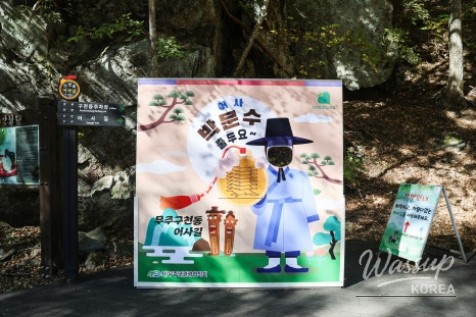
There is a story about Ansimdae and a photo zone where you can become Park Mun-su. Ansimdae serves as a shelter and ford for people traveling between Gucheondong and Baengnyeonsa Temple, and is a place where everyone can relax and rest.
Myeonggyeongdam is the 27th of the 33 scenic spots of Muju Gucheondong Valley. Myeonggyeongdam is named because the water is so clear that it reflects like winter, and it is a place to look at yourself in the clear water before going to Baengnyeonsa Temple and purify your mind and body stained by the secular world.
Mushrooms grew abundantly on the dead tree, creating a special landscape.
Green moss grows on the trees, and fern plants also grow, making the walk enjoyable as you observe nature.
As you walk, you will soon arrive at Baengnyeonsa Temple.
During the reign of King Sinmun of Silla, Zen Master Baengnyeon left the secular world and practiced asceticism here. A white lotus bloomed, and it was considered a good omen, so he built a temple called Baengnyeonam. As time passed, as many as 9,000 monks gathered at the temple and it became Baengnyeonsa Temple. Taekwondo, a martial art for national defense, was practiced in Muju Gucheondong, a battlefield where Silla and Baekje fought for territory from the Three Kingdoms period.
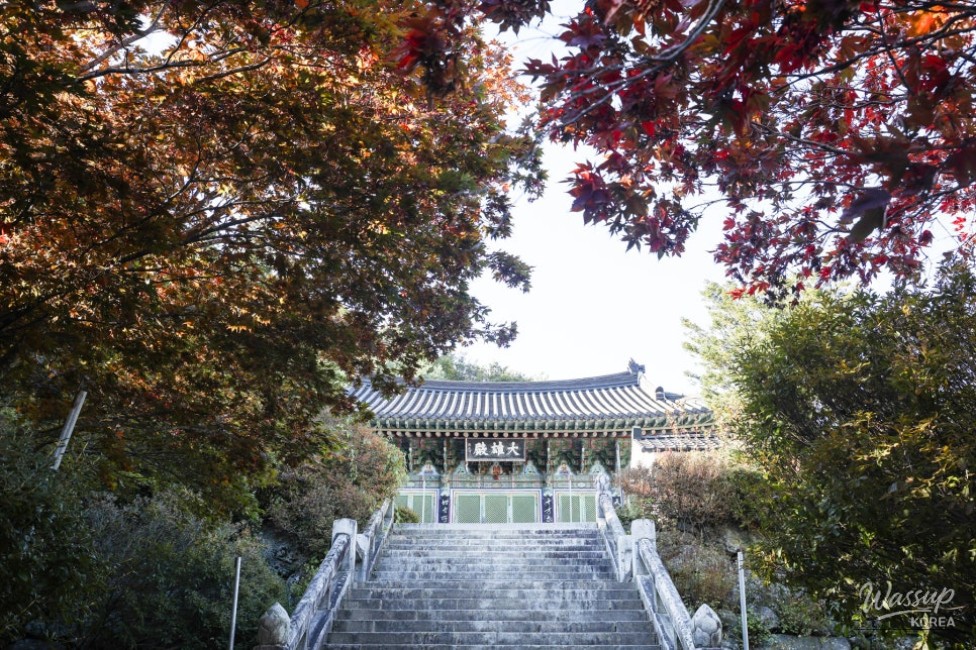
Baengnyeonsa Temple has halls including Daeungjeon Hall, Myeongbujeon Hall, Samseonggak Hall, Josildang Hall, and Yosachae Hall. And below the stairs of Daeungjeon Hall is a stupa enshrining the relics of Jeonggwandang Kwak Il-seon, a monk who devoted extraordinary efforts to the revival of the stagnant Joseon Buddhism and the spread of Buddhism.
The Gucheondong Royal Emissary Trail, walking with nature, was healing itself. The lush trees made my breathing comfortable, and the clear water sound that accompanied me throughout the walk purified my mind. The Gucheondong Royal Emissary Trail is changing into more colorful clothes as autumn arrives. Enjoy autumn here.
Article, Photo = Hwang Eun-mi, Reporter















Source :https://blog.naver.com/jbgokr/224086713996
No comments yet.