Exploring Hyangcheonsa Temple in Geumosan, Yesan



Hyangcheonsa Temple, located in Geumosan, Yesan, South Korea, is a serene destination that offers easy access without the need for strenuous hiking.
Just below the Iljumun Gate, there is a free parking area for visitors.
As you pass through the Iljumun Gate and ascend slightly, you will find a rock inscribed with the temple's history. This stone tablet was erected by the head monk Beopjeong on the celebration of Buddha's birthday in 2553.
Interestingly, Beopjeong is not the same monk known for the book 'Muso-yu.' The Beopjeong of Hyangcheonsa Temple uses the characters '法定' in Chinese, while the author of 'Muso-yu' is written as '法頂.'
Continuing past the Hyangseollu Pavilion, you enter the temple grounds. In front of the pavilion, there is a monument commemorating the restoration of Hyangcheonsa.
To the left of this monument, you can see a unique dragon statue coiled like a pillar.
Next to the stairs below the pavilion, there is also a stone tablet inscribed with 'The Flame of Peace,' which was brought from Lumbini, the birthplace of Buddha, in 2016, symbolizing the hope for unification between North and South Korea.
Ascending a few more steps from the pavilion leads you to the spacious courtyard where the main hall, Geungnakjeon, stands prominently.
Adjacent to Geungnakjeon is a stone pillar that was once used to hang the Buddha's ceremonial cloth.
The origins of Hyangcheonsa Temple trace back to the Baekje period during the reign of King Uija. The monk Uigak, while in Japan, is said to have created 3,053 Buddha statues and completed a triad statue using sandalwood, which was later brought to the coastal area of Yesan.
The 16 Arhats are enshrined next to Geungnakjeon.
There is a nine-story stone pagoda nearby, which was reconstructed from stones that had fallen over the years, symbolizing resilience.
According to legends, a pair of golden crows once flew to a fragrant spring at the foot of the mountain, leading to the naming of the temple as 'Hyangcheonsa,' meaning 'Fragrant Spring Temple.'
As you continue your visit, you will find a stream flowing down from the mountain, with a locked area believed to be the site of the fragrant spring. Unfortunately, the spring has nearly dried up over the years.
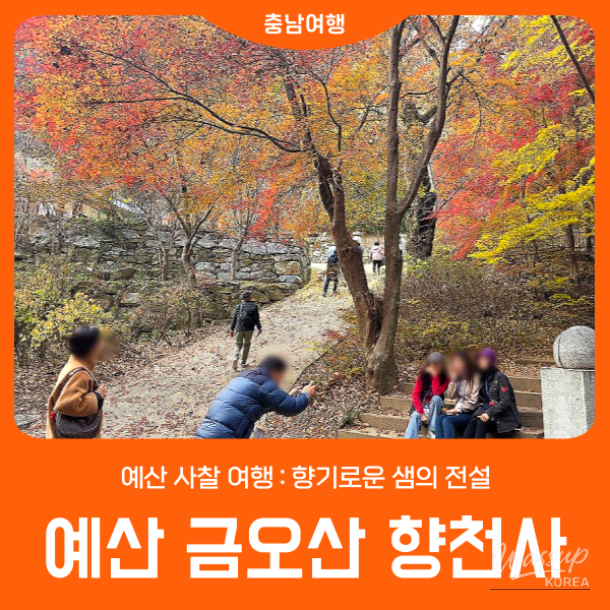
Despite being late November, the vibrant autumn colors are still on display at Hyangcheonsa Temple, with red and yellow leaves creating a stunning backdrop.
Just a short walk further leads you to the Cheonbuljeon Hall, which has gained popularity recently.
Cheonbuljeon houses 1,515 of the 3,053 statues carved by Uigak from jade, making it a significant site.
Nearby, the Cheonbul Seonwon is home to a monk known as 'Yunsunapja,' who is said to be dedicated to spiritual practice.
Visitors often share that the statues in Cheonbuljeon are said to resemble the faces of future brides and grooms, adding a whimsical touch to the experience.
As you explore the temple, don't miss the beautiful Ginkgo trees surrounding the stupa, which are over 200 years old and continue to thrive.
Finally, the Hyangcheong Tea House located above the Hyangseollu Pavilion offers a perfect spot to enjoy a cup of tea while taking in the autumn scenery.
Hyangcheonsa Temple is a place where history, tranquility, and natural beauty come together, making it a must-visit destination in Yesan.


No comments yet.