Discovering Jincheon Hyanggyo: A Journey Through History and Culture


Hello neighbors! Today, I'd like to introduce you to a beautiful historical and cultural heritage site located in Jincheon-gun, Chungcheongbuk-do: Jincheon Hyanggyo.
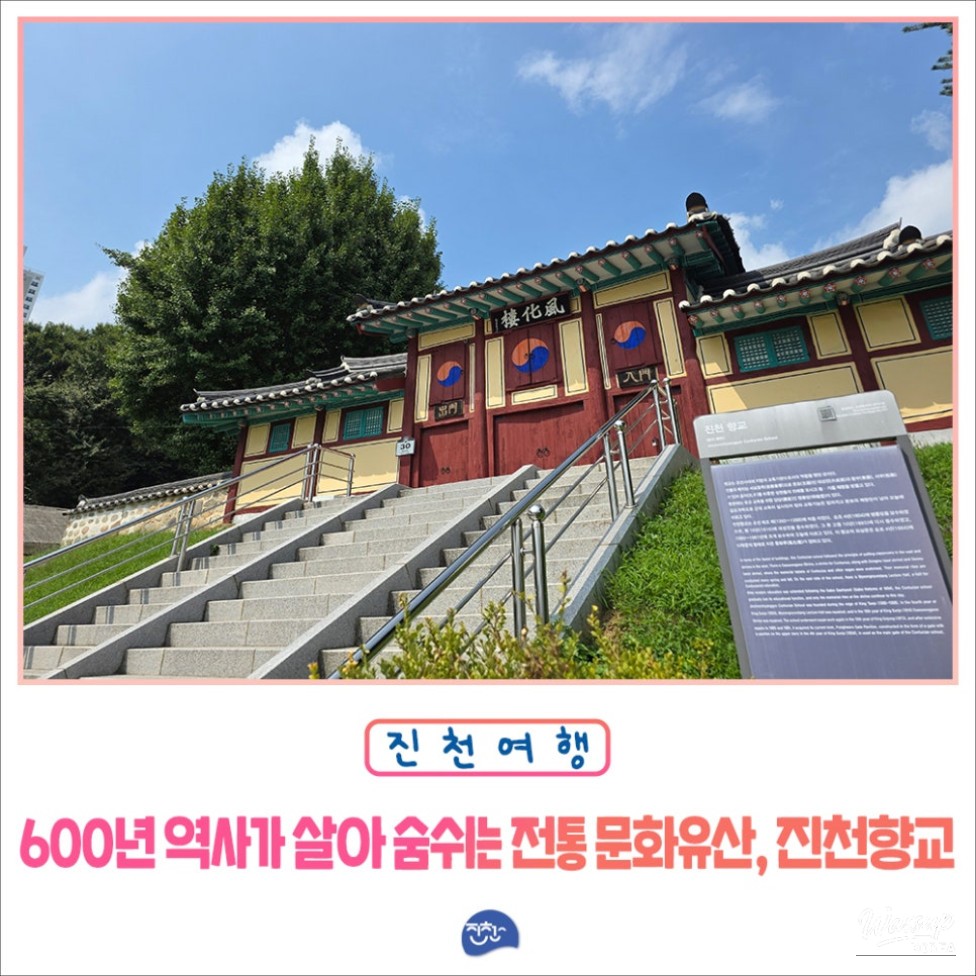
Jincheon Hyanggyo
Address: 30, Munhwa 5-gil, Jincheon-eup, Jincheon-gun, Chungcheongbuk-do
Inquiries: 043-539-3624 (Culture and Tourism Division, Cultural Facilities Team)
Admission: Free
Parking: Available
If you're looking for places to visit in Jincheon, Chungcheongbuk-do, Jincheon Hyanggyo is a must-see. Located at 30, Munhwa 5-gil, Jincheon-eup, Jincheon-gun, this precious cultural heritage of Jincheon has a long history of over 600 years, dating back to the Joseon Dynasty.
Jincheon Hyanggyo is a historic educational institution established between 1392 and 1398 during the reign of King Taejo of the Joseon Dynasty. Hyanggyo were educational institutions built by the state to honor great Confucian scholars and to educate and enlighten the local people in Confucianism. Jincheon Hyanggyo was also built for this noble purpose.
In 1804, during the 4th year of King Sunjo's reign, Myeongnyundang Hall, the East and West Dormitories were repaired, and Punghwaru Pavilion was newly built. In 1816, Daeseongjeon Shrine was renovated. After several repairs, it has reached its current form. Renovations also took place in 1851, 1873, 1935, 1942, 1959, 1966, 1967, and 1972, allowing this Jincheon tourist destination to boast its magnificence to this day.
Currently, Daeseongjeon Shrine, Dongmu, Seomu, Myeongnyundang Hall, Punghwaru Pavilion, and other auxiliary buildings are well preserved at Jincheon Hyanggyo. Each building has its own unique function and meaning, making it a great place to visit in Jincheon.
Daeseongjeon Shrine is a sacred space where the memorial tablets of Confucius and other sages are enshrined and ancestral rites are performed. Dongmu and Seomu together form the ritual space, and the Seokjeon Daeje (Confucian Rite) is held here twice a year in spring and autumn.
Myeongnyundang Hall was a lecture hall where students studied, and a learning space was created around this building. During the Joseon Dynasty, many Confucian students learned Confucianism and cultivated their character here.
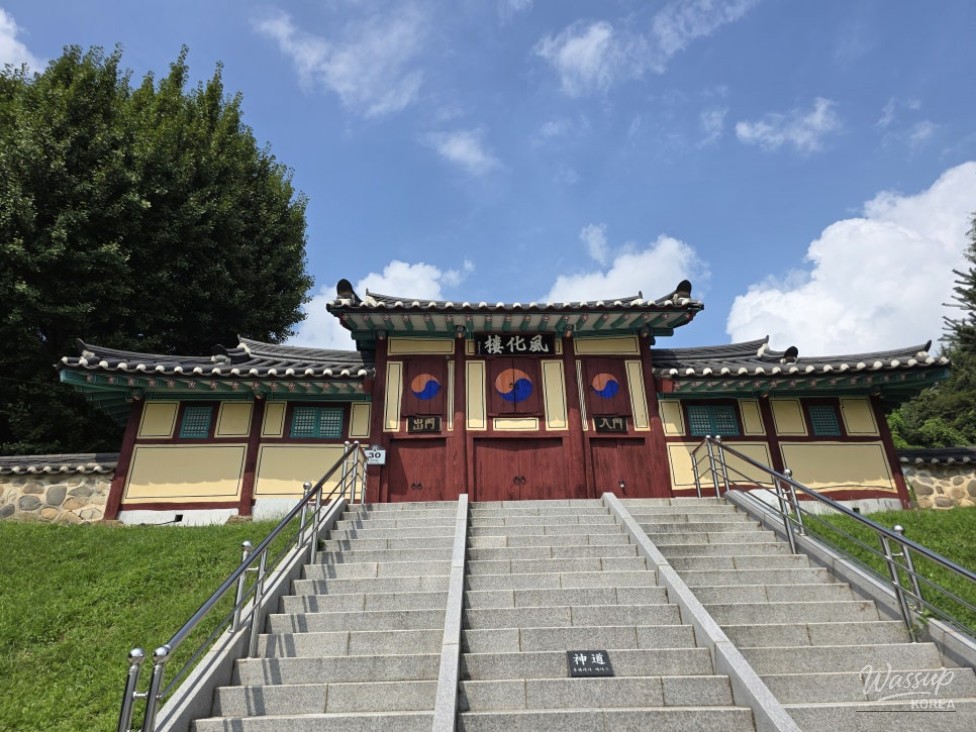
Punghwaru Pavilion is a unique structure that served as a resting place for students and also functioned as a gate tower. In particular, this building is a three-gate that corresponds to the outer three gates built in 1804 by Choi Heup, a local figure, at his own expense, and boasts a size of 6 kan in the front and 2 kan on the sides.
During the Joseon Dynasty, land, books, and servants were provided by the state to teach students, but since 1894, after the Gabo Reform, its educational function has disappeared, and now only ancestral rites are performed twice a year in spring and autumn. Despite these changes, Jincheon Hyanggyo still retains the value of our traditional culture and adds to its significance as a precious cultural heritage of Jincheon.
When you visit Jincheon Hyanggyo, you can also see the Gongdeokbi (Stele of Meritorious Deeds) and the Jonseongbi of Jincheon Hyanggyo at the entrance. Here, where tradition is alive, it is good to appreciate the beauty of the tranquil traditional houses, and thanks to the environment harmonizing with nature, it is a perfect Jincheon travel destination for healing.
Although you may not be able to see the inside, you can have a satisfying experience just by appreciating the Hyanggyo building itself. It is also a very good place to visit with children for a historical trip, and it is a place with high educational value where you can naturally learn about our traditional culture and the history of education.
Jincheon Hyanggyo is not just a tourist attraction, but a valuable space where you can experience the essence of Confucian culture and a living witness to the history of education in Korea. Looking at these buildings that have been in place for over 600 years, you can feel a strange emotion as if you are traveling through time.
As we enter modern society and lose the old, Jincheon Hyanggyo is conveying the teachings of our culture and Confucianism through various programs, which shows its value as a cultural heritage that is not just a relic of the past, but still alive today.
There are various other places to visit in Jincheon besides Jincheon Hyanggyo. There are various historical and cultural attractions such as the Jincheon Bell Museum, Nongdari Bridge, Botapsa Temple, and Baeti Shrine, making it perfect for a day trip. If you are planning a cultural heritage tour course centered around Jincheon Hyanggyo, we recommend that you visit it in conjunction with other historical sites in the surrounding area. This way, you will be able to understand the overall context of Jincheon's cultural heritage and have a richer travel experience.
So, I introduced you to the beautiful travel destination of Jincheon, Chungcheongbuk-do, Jincheon Hyanggyo. How was it?
I hope you will feel the wisdom and passion for education of our ancestors in this place where 600 years of history and tradition are alive. If you want to take a break from your busy daily life and find peace of mind in a tranquil atmosphere, I highly recommend a trip to Jincheon Hyanggyo.



Source :https://blog.naver.com/jincheongun/224032459124
No comments yet.