The Evolution of Navigation: From Directions to Comprehensive Mobility Platforms



The domestic map application market is rapidly advancing.
Navigation systems, which once simply provided the shortest route to a destination, are now transforming into comprehensive platforms that connect lane selection, spatial recognition, and post-travel behaviors.
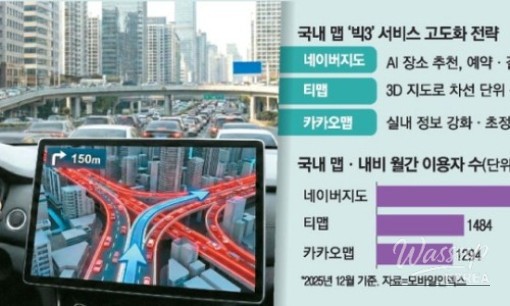
The so-called 'Big Three' map services – T-map, Naver Maps, and Kakao Maps – are leveraging artificial intelligence (AI) and ultra-precise data technologies to increase user engagement and secure dominance in everyday mobility.
T-map Mobility is set to introduce a **'Full 3D Navigation'** system this second half of the year, moving beyond the existing 2D framework. This feature will accurately represent not only building heights but also road elevations and intersection structures, aiding intuitive decision-making even in complex urban driving scenarios.
Notably, T-map will provide lane-specific traffic information, analyzing real-time congestion levels to guide drivers toward less congested lanes. This design aims to help first-time drivers navigate without deviating from their routes, marking a shift towards a data-driven navigation system that assists real driving decisions.
Naver Maps is focusing on expanding its mapping services into a local lifestyle platform. A prime example is the indoor AR navigation implemented in places like COEX. This feature visually guides users through large facilities using smartphone cameras, significantly reducing the inconvenience of navigating in areas with weak GPS signals.
Additionally, Naver Maps has integrated functionalities that allow users to reserve and pay for restaurants, cafes, hospitals, accommodation, performances, and leisure activities all within the app. This seamless flow from mobility to exploration, reservation, and payment minimizes user churn.
Kakao Maps emphasizes accuracy during transit, utilizing GNSS-based ultra-precise technology to track bus locations within 10 centimeters and provide subway locations and arrival times down to the second. Recently, the interactive AI recommendation service **'KanaNa in Kakao Maps'** has been rapidly growing. When users request locations in natural language, the AI analyzes reviews, features, and contexts to suggest tailored spots. Within just six months of its launch, it has surpassed 1 million monthly active users, showcasing the potential for a shift from a search-centric map to an interactive map experience.
While the strategies of these three services differ, their common goal is clear: to transform map applications into platforms that encompass users' mobility before, during, and after travel. By integrating precise navigation, real-time situational awareness, reservations, payments, and AI recommendations, map applications are establishing themselves as hubs for everyday mobility rather than mere navigation tools.
In the future, competition may hinge less on who finds the most accurate route and more on who can retain user engagement for longer periods.
Source :https://blog.naver.com/oiiiii542/224159945408
No comments yet.