Oh Se-chang: In the Land of Mugunghwa – An Exhibition at the Gyeonggi Provincial Museum



By Yoon Jae-yeol, Reporter
Gyeonggi Provincial Museum
《Oh Se-chang: In the Land of Mugunghwa》 Exhibition
To commemorate the 80th anniversary of Korea's liberation, the Gyeonggi Provincial Museum (Director Lee Dong-guk) is hosting 《Oh Se-chang: In the Land of Mugunghwa》 from November 27, 2025, to March 8, 2026.
Oh Se-chang was a modern intellectual, journalist, independence activist, and calligrapher who systemized the roots of Korean culture.
As the culminating exhibition for the 80th anniversary of liberation, it newly illuminates his spirit of preserving culture and art amidst the turbulent history of the modern era.
Artifacts gleaming in the darkness quietly speak to visitors. ⓒ Yoon Jae-yeol, Reporter
The first thing you encounter upon entering the exhibition hall is the March 1st Independence Declaration.
Oh Se-chang's name is clearly visible among the 33 national representatives.
He was arrested by Japanese police at this time, imprisoned, and sentenced to three years.
As an intellectual during the Japanese colonial period, he participated in the independence movement and could not avoid the waves of oppression.
Afterward, Oh Se-chang devoted himself solely to the independence movement of protecting Korean culture.
Jeong Yun-hoe, Senior Curator at the Gyeonggi Provincial Museum, who planned the exhibition, said, "Oh Se-chang's collection and recording were themselves an independence movement."
She added that this exhibition is “a place to confirm how Korean culture has been preserved and passed down.”
《Geunyeok Seohwajing》: A book proving Korean calligraphers and painters ⓒ Yoon Jae-yeol, Reporter
Reading the Era of Modern Transition Through His Father
The exhibition is composed of four themes, structured like a journey following his life.
✔️Part 1:
‘Enlightenment and Independence – The Era of Yeokmae and Wichang’ follows the history of records preserved by father and son.
His father, Oh Gyeong-seok, was a translator from the late Joseon Dynasty and a thinker of the enlightenment. He visited China 13 times throughout his life.
He introduced the knowledge he gained at this time to Korea, influencing the formation of enlightenment ideas.
He collected Qing Dynasty bronze inscriptions and calligraphy, and this legacy was passed down to his son, Oh Se-chang.
Oh Se-chang naturally read the era of modern transition and recorded cultural language through his father.
His father was a teacher who refined his life and spirit.
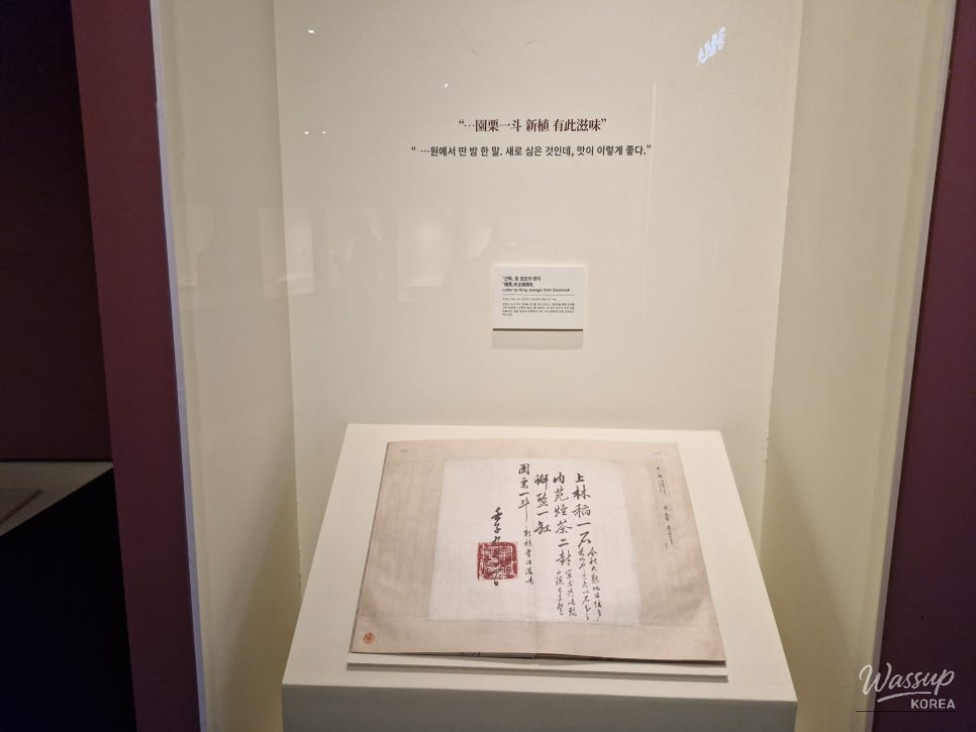
Jeongjo's letter from 《Geunmuk》 ⓒ Yoon Jae-yeol, Reporter
✔️Part 2:
‘Meaning Engraved in Form – Exploration of Bronze Inscriptions and Seal Engraving Art’ allows you to hear the sound of ink conveyed on faded paper.
Bronze inscriptions and seal engraving are fields that Oh Se-chang explored throughout his life.
Through ancient bronze inscriptions engraved on stone, he sought to read the minds of ancient people and find the origin of how to write letters.
Seal engraving is a seal.
This is a process of exploring the formation of letters.
Oh Se-chang's research on bronze inscriptions and seal engraving activities was a breath of life to protect the turbulent modern era and a way to sublimate national art.
In the exhibition hall, a rubbing of Hwangchoryeongbi among the Jinheung Great King Inspection Stele stands proudly, boasting a distant time.
You can also see what Chusa Kim Jeong-hee wrote, following the bronze mirror script of the Han Dynasty, which Oh Se-chang copied again.
Kim Jeong-hee and Oh Se-chang's affection for calligraphy and discerning eye stand out.
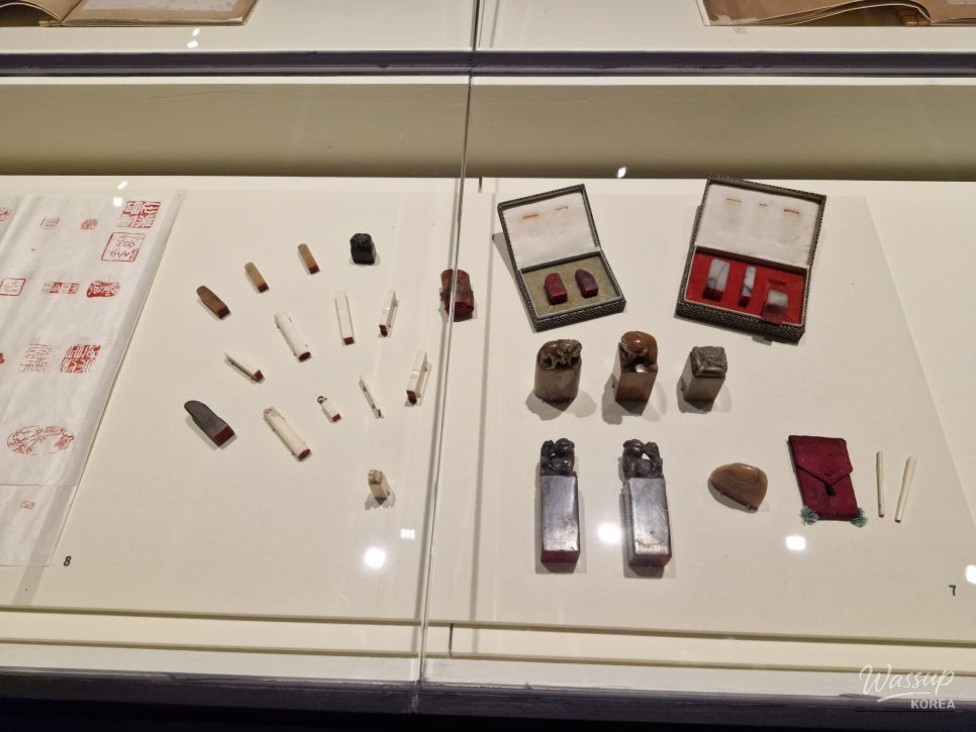
Oh Se-chang studied seal engraving and directly produced seals from a young age due to his father's influence.
You can also see pictographic seals that are rare these days.
Oh Gyeong-seok's letter, the one on the right sent to his son from Beijing ⓒ Yoon Jae-yeol, Reporter
✔️Part 3:
It is classified under the title ‘The Road of Collection – Towards Cultural Independence.’
Here,
you will encounter the passion of an intellectual who wanted to protect culture.
Oh Se-chang collected and organized old writings and paintings.
Thanks to his efforts, Korean culture continued proudly even in the history of the Japanese colonial period
and has grown into a solid culture today.
His collection was not a simple hobby but an effort to protect cultural independence.
That's why the ink on the writings and paintings has faded, but you can still feel a warm body temperature.
The frame on the right is a couplet written by Oh Se-chang to Kim Eui-han ⓒ Yoon Jae-yeol, Reporter
Teaching Collection and Appreciation Activities to Jeon Hyeong-pil
The writings ‘Bohwagak’ and ‘Okjeongyeonjae’
make you feel the breath of an era.
‘Bohwagak’ is the name of the signboard
and Korea's first private art museum.
‘Okjeongyeonjae’ was hung in Kansong Jeon Hyeong-pil's study.
The two artifacts
symbolically show the relationship between Oh Se-chang and Jeon Hyeong-pil.
Oh Se-chang taught Jeon Hyeong-pil collection and appreciation activities.
Han Jeong-gyu, a docent at the Gyeonggi Provincial Museum,
says, “Oh Se-chang’s achievements in collecting and researching Korean culture are outstanding, but raising Kansong Jeon Hyeong-pil is also
a touching achievement.”
Writing that Oh Se-chang wrote to Kansong Jeon Hyeong-pil ⓒ Yoon Jae-yeol, Reporter
Oh Se-chang compiled books such as 《Geunmuk》, 《Geunyeok Seohwi》,
《Geunyeok Hwahwi》, 《Geunyeok Seokmuk》,
and 《Geunyeok Seohwajing》.
In the exhibition hall, Jeongjo's letter from 《Geunmuk》,
Yun Du-seo's painting from 《Geunyeok Hwahwi》,
and Shin Saimdang's painting are on display,
showing a dignity that cannot be easily approached.
The fact that you can see a legacy with such elegant grace
was ultimately possible thanks to Oh Se-chang's efforts.
There is also the joy of seeing books divided among several institutions all at once here.
A folding screen decorated with Oh Se-chang's writing and Kim Eun-ho's painting ⓒ Yoon Jae-yeol, Reporter
In books that collect Korean writings and paintings, all
‘Geun (槿-mugunghwa)’ and ‘Geunyeok (槿域-land of mugunghwa)’
were placed at the beginning.
The explanation is that this contains the desire for Korean culture to continue.
The exhibition title is also taken from here.
In an instant, Oh Se-chang's dazzling spirit enters your whole body.
During the Japanese colonial period,
his belief that ‘mugunghwa is the heart of our land’
must have blossomed in the hearts of the Korean people.
Oh Se-chang's seal. He made the seal himself. ⓒ Yoon Jae-yeol, Reporter
A Legacy Containing the Wounds and Hopes of the Era is the Root of ‘K-Culture’
✔️Part 4:
‘Enduring the Era with a Brush –
Oh Se-chang's Writing and Contemporary Art’
faces Oh Se-chang as an artist.
Through his exploration of old calligraphy,
he established his own style.
This means that he protected tradition and created a new world of art.
Portrait of his father Oh Gyeong-seok ⓒ Yoon Jae-yeol, Reporter
In the exhibition hall, works containing exchanges with contemporary artists await.
There is a couplet written by Oh Se-chang to Kim Eui-han, an independent meritorious person.
Kim Eui-han is the son of independence activist Kim Ga-jin.
It can be seen that they have continued their relationship for generations.
There is also a ‘two-panel folding screen’ decorated with Oh Se-chang's writing and Lee Dang Kim Eun-ho's painting,
which is the first time it has been revealed.
The overall space of the exhibition hall is dark.
Visitors walking through the dark space
feel like they have been invited to a time in the past.
Artifacts that contain just the right amount of light in the darkness
slowly draw visitors into the present.
It is the moment when you meet Oh Se-chang's beliefs that did not fade even in the era of chaos.
Oh Gyeong-seok and Oh Se-chang are pioneers who strived to protect the autonomy of Korean culture.
It is a record of not losing hope in the wounds of the era.
That legacy connects history and has become a proud culture.
And today, it is shining again as the root of the rich ‘K-Culture.’
Oh Se-chang's legacy is a record that connects Korean culture and history. ⓒ Yoon Jae-yeol, Reporter
《Oh Se-chang: In the Land of Mugunghwa》
Period
2025. 11. 27. (Thu) ~ 2026. 3. 8. (Sun) / Closed every Monday
Location
Gyeonggi Provincial Museum Special Exhibition Room
Hosted by
Gyeonggi Cultural Foundation, Gyeonggi Provincial Museum
Exhibition Artifacts
Approximately 90 writings and calligraphy by Kang Gam-chan, Kim Jeong-hee, Shin Saimdang, Jeong Yak-yong, Han Seok-bong, etc., from 『Geunmuk』, 『Geunyeok Seohwi』, 『Geunyeok Hwahwi』, etc., collected and compiled by Oh Se-chang









Source :https://blog.naver.com/gyeonggi_gov/224095475913
No comments yet.