Healing Agriculture at Green Star Farm in Ulsan



Green Star Farm in Buk-gu, operated by healing agriculture specialists
I never expected to encounter passion fruit in Ulsan.
At first, I doubted my eyes.
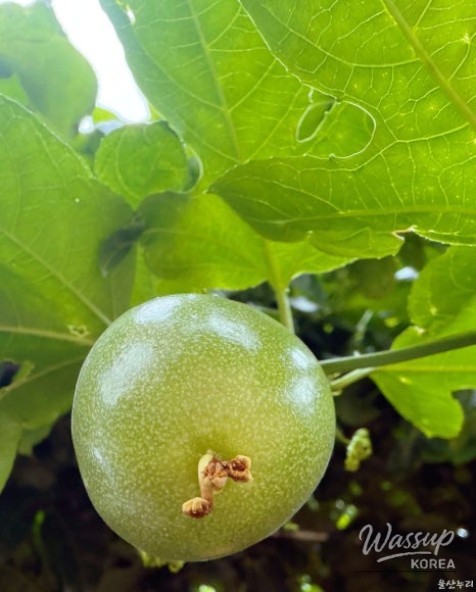
Passion fruit, which I thought only grew in tropical regions, was hanging in abundance under the summer sun. And not in a supermarket display, but on a farm.
Visiting Green Star Farm, which was selected for a social entrepreneurship incubation program this year, I was greeted by unexpected scenery.
"Do you know passion fruit?"
Most people respond with, "You mean the fruit called passion fruit?" That's right. The fruit we commonly refer to as passion fruit is called 백향과 (baekhyanggwa) in Korean, which literally means 'a fruit with a hundred fragrances.'
Upon entering the greenhouse at Green Star Farm, my eyes were captivated by the luscious passion fruits hanging among the green vines. It was astonishing to think that tropical fruits, which seemed only to be found in Southeast Asia just a few years ago, were ripening under the sky of Ulsan.
But there was something else that surprised me that day.
Do you know about a herb that is sweeter than sugar?
"Try this stevia leaf," said CEO Park Chae-yeon, handing me a small leaf.
In an instant, my eyes widened.
"Wait, is this sugar?" I exclaimed without thinking.
Stevia, which has recently gained fame as stevia cherry tomatoes, is originally a herb. However, the sweetness created by this tiny leaf was beyond imagination. It filled my mouth with an intense sweetness, as if I had poured a whole bag of sugar into it. At Green Star Farm, such surprises become part of everyday life.
As I strolled through the farm, the scent of herbs wafted through the air. Over 50 types of herbs, including rosemary, lavender, geranium, and stevia, grow alongside more than 100 types of plants, such as passion fruit, cucumbers, tomatoes, corn, and sweet potatoes, creating different seasonal landscapes.
This place feels like a small botanical garden, but it is more than just an experiential farm.
Children are laughing, and seniors are engaging with the plants, sharing stories. This is a space where nature heals people.
The couple running Green Star Farm, Lee Seung-yoon and Park Chae-yeon, are parents of four children. They excel not only in parenting but also in their farming endeavors.
They personally pollinate each passion fruit and care for the hearts of people with developmental disabilities, seniors, and children. For them, farming is not merely about cultivating crops; it's about nurturing and growing people.
“Healing agriculture is not just about growing crops; it’s about caring for people,” said CEO Park Chae-yeon, a statement that lingered in my mind.
It’s remarkable that CEO Park is a former naval and marine design engineer, and her husband, CEO Lee, also worked as a ship supervisor. What led them to leave stable jobs for farming?
“I wanted a life where I could work without worrying while raising my children.” After resigning, she became involved in social economy and operated programs for children with developmental disabilities, completely changing her life’s direction.
“Spending time with children with developmental disabilities taught me so much more,” she said. This experience led to the creation of Green Star Farm.
The most significant difference between Green Star Farm and typical experiential farms is the focus on 'healing.' This place is not just about providing fun experiences. They operate specialized programs that help with physical, cognitive, and emotional recovery for individuals with developmental disabilities, seniors with mild dementia, teens with borderline intelligence, and children from multicultural families.
CEO Park holds over 30 professional qualifications, including social worker, healing agriculture specialist, urban agriculture manager, organic farming technician, and child psychology counselor. Notably, the healing agriculture certification is a national qualification that requires specialized training and examination.
“Healing doesn’t happen just once. True change begins after at least eight repetitions.” In fact, many families with developmental disabilities have been visiting the farm for years.
One caregiver said, “Problematic behaviors that were evident at home hardly appear at the farm.”
The simplest experiences are the favorites among children: pulling radishes, picking corn, and harvesting sweet potatoes. They learn a sense of achievement and responsibility through the processes of planting, watering, and harvesting.
Seniors immerse themselves in the aroma of herbs, recalling forgotten memories as they smell, touch the plants, and sift through the soil. Watching them, I realize that healing might not be something extraordinary but rather the time spent in nature itself.
Another highlight of Green Star Farm is its glass greenhouse, established over 40 years ago, making it the first of its kind in Ulsan. Now equipped with heating and cooling systems, it allows for year-round healing programs.
No matter the season, whether it’s a scorching summer, a snowy winter, or a rainy day, you can always connect with nature.
As I left the farm, I glanced back once more. The passion fruits were ripening, the stevia was sweet, and the herb scents were fresh.
Above all, it was a farm that prioritized people.
“Healing agriculture is not about farming; it’s about restoring people. Nature has the power to heal,” said the farm owner.
Perhaps that’s why, as I walked out of Green Star Farm, I felt a little lighter in my heart.
This summer, how about heading to a healing farm instead of a resort? The aroma of passion fruit, the sweetness of stevia, and the comfort of greenery await you.




Source :https://blog.naver.com/ulsan_nuri/224331452307
No comments yet.