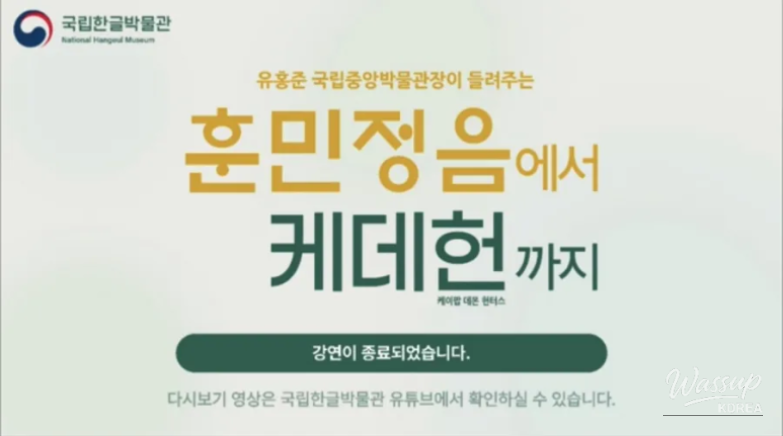
From Hunminjeongeum to K-Demon Hunters: A Lecture on the Evolution of Korean Writing Through Literature


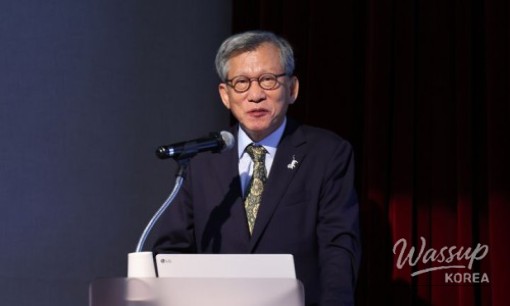
A lecture by Yu Hong-jun, Director of the National Museum of Korea, covered the historical journey from the creation of Hangul to the formation of modern Korean literature and the identity of its writers. He shared his past concerns about his identity as a writer and once presented his writing secrets in the form of 15 principles.
Yu Hong-jun's 15 Principles of Writing
1. Master the Subject: Good writing is achieved when the content can be conveyed through the title alone.
2. Content Should Be Substantial and Information Accurate: The life of writing lies in its content.
3. Have a Clear Structure: Introductions and conclusions breathe life into the text.
4. Adjust the Rhythm to the Length of the Text: Sentences that are too short feel disjointed, while those too long are difficult to follow.
5. Envision the Potential Reader: Write while considering who will be reading your work.
6. Write in One Sitting: Plan in advance, and once you start writing, finish it in one go.
7. Adhere to Grammar, but Infuse Flavor with Conversational Style: Elegantly utilize the language of the time.
8. Don't Forget the Pleasure of Reading Between the Lines: Use metaphors and symbols to encourage readers to contemplate.
9. Don't Try to Teach, Appeal Humbly: Be humble before the reader.
10. There is No Better Training Than Reading: Copying good writing is very helpful.
11. Absolutely Avoid Taboos: Avoid pretentious writing, clichés, and unnecessary conjunctions.
12. Revise the Completed Manuscript from the Reader's Perspective: Add the final touches while feeling the rhythm.
13. Have Others Read Your Work: It is better to rewrite after undergoing objective verification and criticism.
14. Harmonize Popularity and Professionalism: If professionalism is lacking, the quality of the writing diminishes.
15. Bring Out the Rhythm of Writing Suitable for Your Age: The writer's age is reflected in the text.
Standardization of Hangul and Spacing
The Gabo Reform of 1894 was a significant turning point that mandated the use of Hangul in official government documents. One of the decisive moments in the development of Hangul was the introduction of word spacing.
Particularly touching is the contribution of foreign missionaries to the development of Hangul. The first recorded instance of spacing was attempted by Scottish missionary John Ross in 1877 in a textbook for foreigners. It is remarkable that foreigners recognized and put into practice the necessity of spacing, which even Koreans at the time had not fully systematized.
Later, American missionary Homer Hulbert recognized its importance and, together with Seo Jae-pil and Ju Si-gyeong, fully introduced spacing in the The Independent, which was first published in 1896, laying the foundation for its popularization. It is truly moving that these foreign missionaries dedicated themselves not only to religious purposes but also to the genuine development of the Korean language. Their achievement is made even more meaningful by the fact that they recognized the value of the language, the core of a nation's identity and culture, and contributed to its development.
The Korean linguist Ju Si-gyeong systematically formalized this academically, completing the theoretical foundation for the spacing we use today. Without their efforts, it would have taken much longer for us to write Korean sentences that are as easy to read and understand as they are now.
Hangul and the Dawn of Modern Literature
The establishment of a standardized writing system was intrinsically linked to the development of national literature.
The Struggle to Preserve Hangul
A significant event was the 'Malmoi' operation in 1933, which collected Korean words nationwide to compile the first unified Hangul orthography dictionary. This movement faced intense suppression by the Japanese colonial government, culminating in the Korean Language Society Incident in 1942, when scholars were imprisoned and valuable linguistic materials were confiscated. The publication of the Great Korean Dictionary after liberation was a monumental achievement in the history of Hangul.
Pioneers and Controversies
The growth of newspapers and novels had a significant impact on refining the language. The lecture addressed the complex legacy of literary pioneers such as Choi Nam-seon (Yukdang) and Lee Kwang-soo (Chunwon). While their contributions to Korean studies by Choi Nam-seon or early modern literature such as Lee Kwang-soo's novel The Heartless are significant, their subsequent pro-Japanese activities remain a point of historical controversy.
Reflection of Reality
Professor Yu pointed out that Lee Kwang-soo's The Heartless, while excellent in storytelling and description, overlooked the harsh realities of the colonial era, contrasting it with Yeom Sang-seop's Before the Typhoon. Before the Typhoon is highly regarded for its candid depiction of the suffering and despair of Koreans under colonial rule.
Hangul Matures in Literature
In the early 20th century, Hangul developed into a sophisticated literary medium that captured the spirit of the Korean people.
Literary Masterpieces
The lecture highlighted Kim So-wol's poetic achievements, whose works were deeply connected to traditional Korean folk song melodies. It also emphasized the tremendous social impact of Hong Myeong-hee's (Byeokcho) historical novel Lim Kkeok-jeong. This novel is regarded as a masterpiece that vividly portrays the life and aesthetics of the time, along with efforts to preserve disappearing indigenous languages and customs.
The Era of Literature
The literary magazine Literature, edited by novelist Lee Tae-jun from 1939 to 1941, is considered a cornerstone of Korean modern literature. It was through Literature that the prominent 'Green Deer School' poets (Park Mok-wol, Cho Ji-hoon, Park Doo-jin) officially debuted. The literary value of this magazine is further enhanced by its resistance to the forced closure by the Japanese colonial government.
The Rise of Modernist Poetry
Chung Ji-yong's poetry marked a major turning point by introducing a sophisticated modernist aesthetic to Korean poetry. His poem Glass Window 1 is famous for its outstanding expression of parental grief through refined and restrained imagery. In the 1930s and 40s, unique poets such as Lee Yong-ak and Baek Seok emerged, capturing the sorrow of diaspora and the pain of division with lyrical depth.
Post-Liberation Hangul Literature
The liberation in 1945 unleashed new literary energy and renewed awareness of the nation's linguistic heritage.
The Treasure of Hunminjeongeum
One of the important events after liberation was the publication of a reprint of the Hunminjeongeum Haeryebon (Explanations and Examples of the Correct Sounds for the Instruction of the People). This original commentary on Hangul, which scholars had so yearned for, was preserved during the colonial period and finally made public.
The Emergence of Engaged Poetry
While essay literature flourished after liberation, poetry in the 1960s and 70s began to directly address social and political realities. The works of poets such as Shin Dong-yeop and Kim Soo-young played an important role in this change.
The Voice of the People
The 1970s brought about a powerful wave of realist literature. The lecture emphasized Kim Ji-ha's significant literary influence, who was at the center of the democracy movement. Park No-hae, who wrote works based on his experiences as a factory worker, was also praised as a true 'labor poet', giving a genuine voice to the struggles of the working class. The poetry of this era, including that of Kim Soo-young, is characterized by a powerful combination of resistance and condensed emotional expression.
No comments yet.