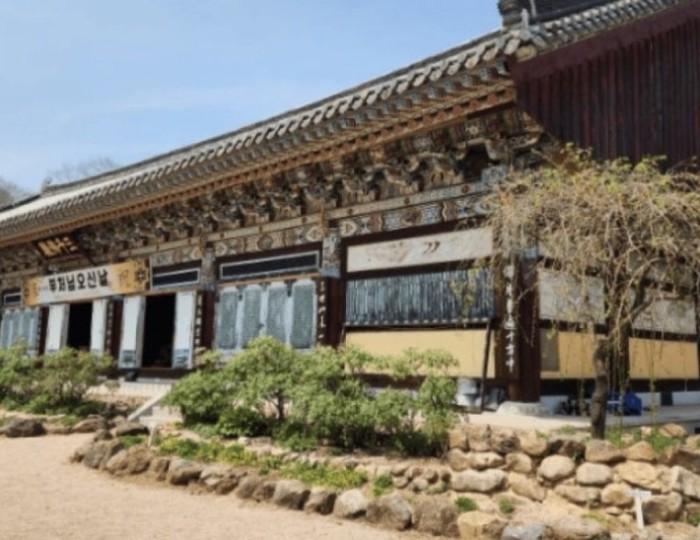
Exploring Shinsan Village in Ham-an



By Choi Hong-dae, 14th SNS Reporter
Shinsan Village
- Address: Hwaesan-ri, Chilsseo-myeon, Ham-an-gun, Gyeongsangnam-do
Upon closer inspection, place names often carry traces of time that remain in those locations. Chilsseo-myeon in Ham-an-gun is one such area. Its name means 'west of Chilwon.' When the former Chilwon-hyeon was restructured into smaller administrative units, the western part became known as Chilsseo. The name Chilwon itself includes the character for lacquer tree (漆), which signifies a field where lacquer trees used to grow. It's endearing to think that a place's name can originate from a plant.
As you enter Chilsseo-myeon, you will find Shinsan-ri. A small stone marker stands at the village entrance, next to a sculpture of two children looking up with their hands clasped together, while jars are neatly lined up at their feet. This picturesque scene reveals details that a city might lack. The way a rural village introduces itself and where a child's gaze is directed reflects the village's sentiment.
Shinsan Village is renowned for its murals. As you walk deeper into the village, you'll find murals painted on every wall. There are benches under pink cherry blossoms, children catching crayfish in a stream, a mother holding a laundry stick, and a handcart transporting briquettes. Each painting captures a moment from the village's past.
Two large old zelkova trees stand on one side of the village, where villagers have gathered under their shade for many years. Every village has such trees, which outlive people and remember them. While village halls and schools may disappear, these trees remain steadfast. A single tree can play a surprisingly significant role in maintaining the essence of a village.
While there are stories about the roses of May, the roses of June are the most vibrant. Pink, white, and apricot-colored roses bloom simultaneously in one spot. This landscape is created only when someone looks after it daily. The village is cultivated not for display but for living.
Forgotten landscapes from the city come back to life on the village walls. While mural villages exist everywhere, the paintings in Shinsan Village are scenes drawn from the memories of those who lived here, not mere tourist decorations.
Walking through the alleys reveals that the village was not created merely for show. On the side of a wall, onions and garlic grow in rows, while a jar sits in one corner of a yard, next to blooming roses.
Between the murals, a yellow fence can be seen, adorned with images of girls jumping rope. Five girls stand in line, jumping together, and if one falls out, the line breaks. This simple illustration encapsulates the essence of community—tasks that cannot be accomplished alone come together in a rural village, distinguishing it from the city.
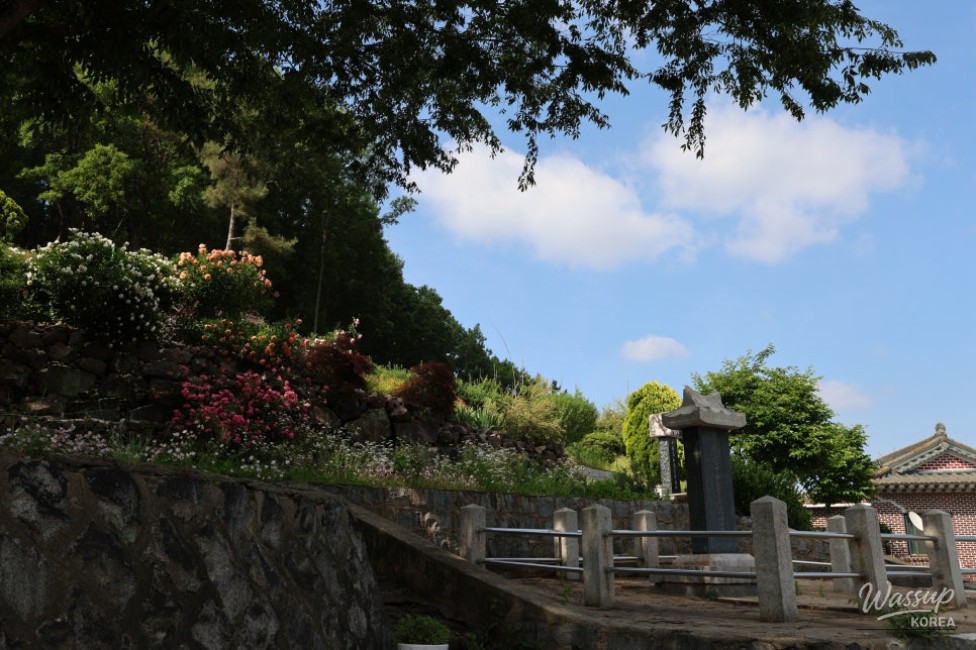
On the way out of Shinsan Village, I encountered the Obigak Pavilion. It is located not far from the village, at the foot of a mountain. A small pavilion stands against a backdrop of lush greenery, built in 1905 during the Gwangmu era to honor the filial piety of Jo Jong-young (1712-1786). He was the tenth descendant of the loyalist scholar Jo Gye, showcasing the depth of a family’s legacy through one person’s devotion.
Though small, Obigak is ornate. Its colors are vivid, and the decorations of turtles and lotus flowers are intricately carved. The roof, larger than the main structure, is supported by separate pillars at each corner. There was a time when filial piety had to be expressed in such a grand manner. This is not to say that era was good or bad, but it reflects how individual ethics were recorded in the name of the community.
While we cannot bring back that same sense of filial piety today, the fact that people once tried to remember a person's devotion to their parents still holds significance. The effort to remember is an ethic of the community itself, and what is remembered reflects what society values.
Walking through Shinsan Village in Ham-an-gun and passing by Obigak naturally illustrates how a region preserves its time. The child in the mural grows up to become an adult, who then becomes a parent, and another generation remembers that parent, erecting a pavilion along the way. This is how a village is built over time, much like the trees, pavilions, and murals within Shinsan Village. Everything coexists here, resembling one another, creating a delightful experience for travelers.


Source :https://blog.naver.com/arahaman/224306867449
No comments yet.