Discovering the Unique Shindo Monument of Lady Hong of the Namyang Hong Clan in Yangju



Hello everyone!
We are the Yangju City SNS Supporters.
Today, we're excited to introduce a remarkable cultural heritage site.
Traditionally, Shindo monuments were erected in front of men's tombs.
However, in a unique case, one was also erected for a woman's tomb.
We're visiting the tomb of Lady Hong of the Namyang Hong clan and its Shindo monument.
Shall we go together?
The tomb of Lady Hong of the Namyang Hong clan, which features Korea's only Shindo monument dedicated to a woman, is located at 54-1 Yongam-ri, Eunhyeon-myeon, Yangju-si.
Lady Hong of the Namyang Hong clan was the mother of Queen Sohye (Queen Insu) and the wife of Han Hwak of the Cheongju Han clan.
Her tomb is located in the Cheongju Han clan's cemetery in Eunhyeon-myeon.
Her husband, Han Hwak, is buried in Neungnae-ri, Joan-myeon, Namyangju-si, with the couple having separate tombs far apart.
It is said that the separate tombs for the couple follow the traditions of the Cheongju Han clan at the time.
They are said to have sought auspicious sites, resulting in individual tombs for each person.
In particular, the location of Lady Hong's tomb is known as a place where a 'noble woman will emerge'.
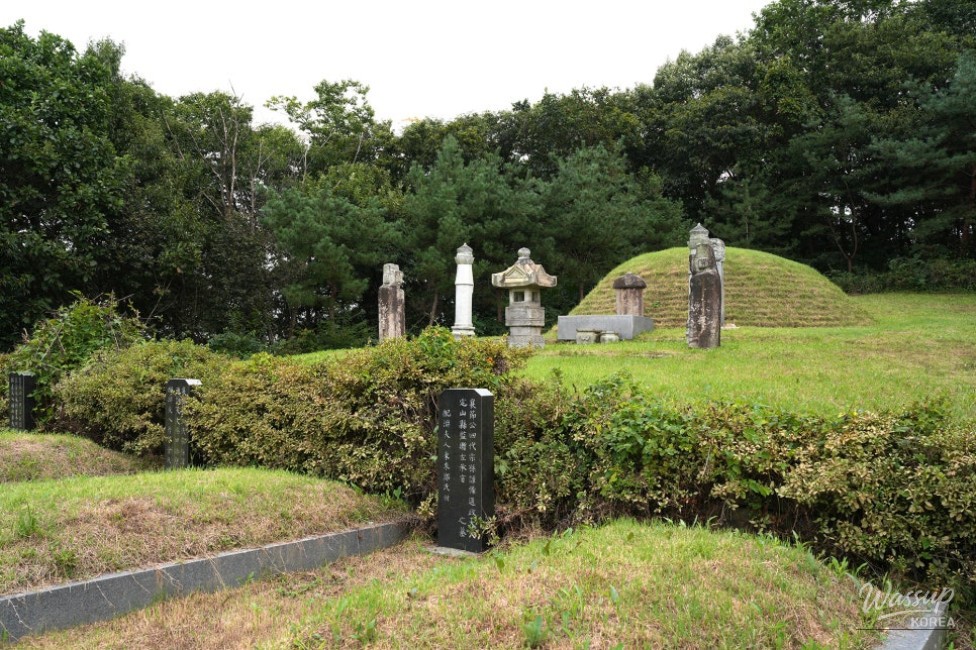
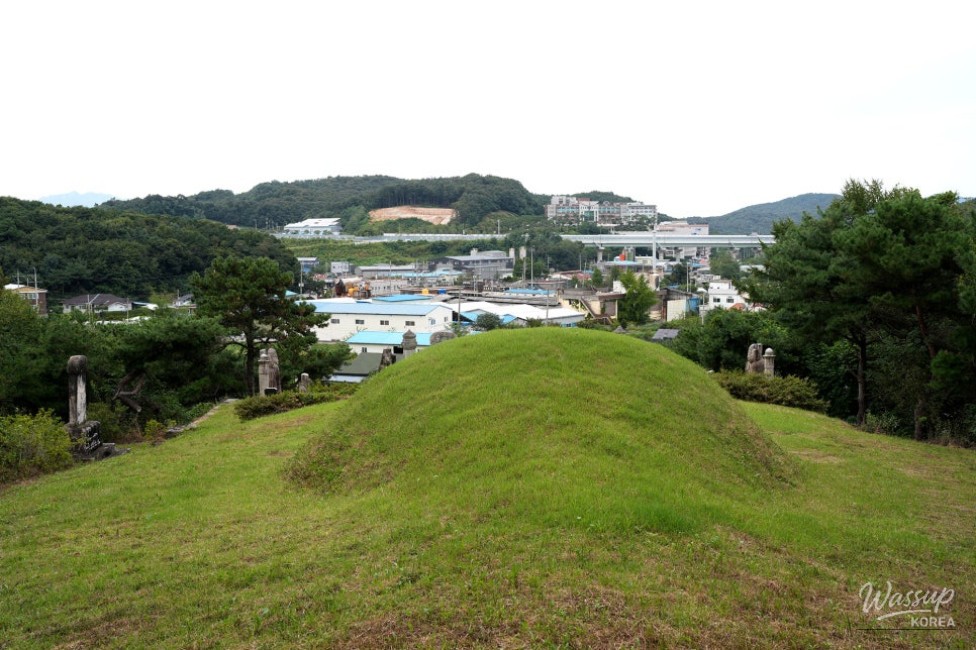
As you ascend the stairs to reach the tomb, you can see a huge Shindo monument standing tall right next to it.
The stone used for this Shindo monument is said to have been bestowed by the Ming Emperor.
It is said that an elephant transported the stone from Ming China, but unfortunately, the elephant did not adapt to the conditions in Joseon and died soon after.
Descendants are said to have created a tomb next to Lady Hong's tomb for the elephant, but it no longer exists.
The Shindo monument was erected with text composed and calligraphed by Daejehak (Great Scholar) Im Sa-hong.
The Shindo monument of Lady Hong of the Namyang Hong clan, the mother of Queen Insu, was erected by Queen Insu herself in the 3rd year of King Yeonsan's reign after the death of King Seongjong.
Below the tomb of Lady Hong of the Namyang Hong clan, tombs of descendants of the Yangjeolgong branch of the Cheongju Han clan are located.
It is a unique case where the tomb was created in Yangju following the grandmother, rather than in Namyangju, where the grandfather Han Hwak's tomb is located.
Lady Hong of the Namyang Hong clan (1403~1450) was the daughter of Hong Yeo-bang, the Minister of Personnel.
She married Han Hwak of the Cheongju Han clan, who was a diplomat during the reign of King Taejong, and had 3 sons and 6 daughters.
Among them, the sixth daughter was Queen Sohye (1437~1504), the wife of Crown Prince Uigyeong (posthumously known as King Deokjong) and the mother of King Seongjong, also known as Queen Insu.
The tomb of Lady Hong of the Namyang Hong clan is a single burial in a single mound, equipped with stone objects such as a tombstone, civil officials, a Jangmyeong lantern, and Mangjuseok pillars.
The tombstone is a lotus leaf-shaped stele with the inscription 'Jeonggyeongbuin Namyang Hongssi' (Lady Hong of the Namyang Hong clan, First Rank Royal Consort) inscribed on the front.
Next to it, a newly erected tombstone stands together.
Perhaps it was thanks to finding an auspicious site and building the tomb about 100 li (approximately 40 kilometers) away from her husband's tomb that Lady Hong's grandson ascended to the throne as King Seongjong, the 9th monarch of the Joseon Dynasty.
Meanwhile, it is said that a separate shrine (Byeolmyo) of Lady Hong of the Namyang Hong clan is located on the hill facing the hill where the tomb and Shindo monument of Lady Hong of the Namyang Hong clan are located.
Later, Queen Insu educated women, especially concubines and women in the royal court, with Confucian virtues and compiled Naehun, a guide to cultivating virtue.
The Shindo monument of Lady Hong of the Namyang Hong clan is historically significant as the only Shindo monument bestowed upon a woman in Korea.
There is also an interesting tale about the elephant that transported the Shindo monument's stone, which would make for a vivid history lesson if told to children.







Source :https://blog.naver.com/yangju619/224076453657
No comments yet.