Art Enriches Everyday Life: 'Sengseng Hwahwa: Hwadu' Exhibition at Suwon Art Space Gwanggyo


[By Ahn Sun-young, Reporter]
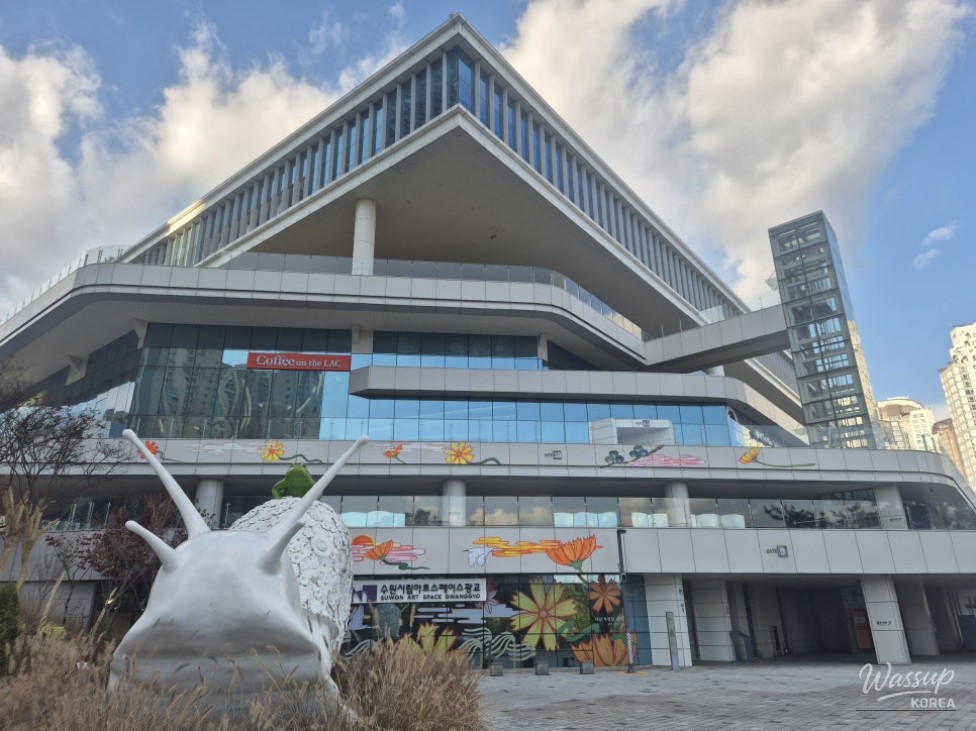
Suwon Art Space Gwanggyo, located within the Suwon Convention Center in Gwanggyo Lake Park. ⓒ Ahn Sun-young, Reporter
Art has permeated closer to our daily lives.
Exhibitions where you can encounter new perspectives and senses in the heart of the city without special preparation are ongoing.
The trend of steadily supporting artists' creative activities through local competitions and support, and returning the results to the citizens, is also taking root.
Gyeonggi Province has been supporting visual arts creation for a long time,
continuously providing a platform for artists to share their new works.
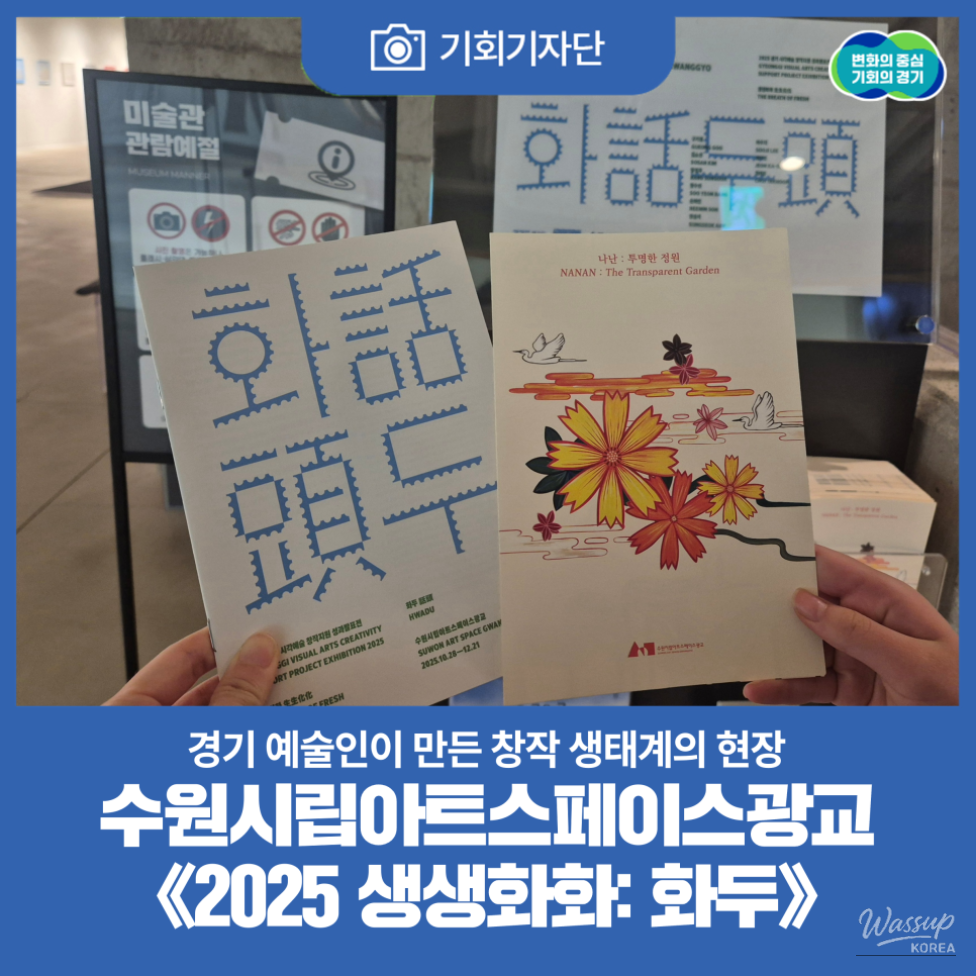
《2025 Sengseng Hwahwa: Hwadu》 Exhibition
Suwon Art Space Gwanggyo, located on the first basement floor of the Suwon Convention Center, has been hosting the 《2025 Sengseng Hwahwa: Hwadu》 exhibition since last month.
This exhibition, jointly prepared by the Gyeonggi Cultural Foundation and Suwon Art Space Gwanggyo,
is even more meaningful as it is the '2025 Gyeonggi Visual Arts Creation Support Achievement Exhibition'.
Nine artists selected through the support project are showcasing 15 new works, including sculptures, installations, and paintings,
demonstrating the diverse trends of contemporary art.
I'll share a vivid review of my art experience with my family last weekend!
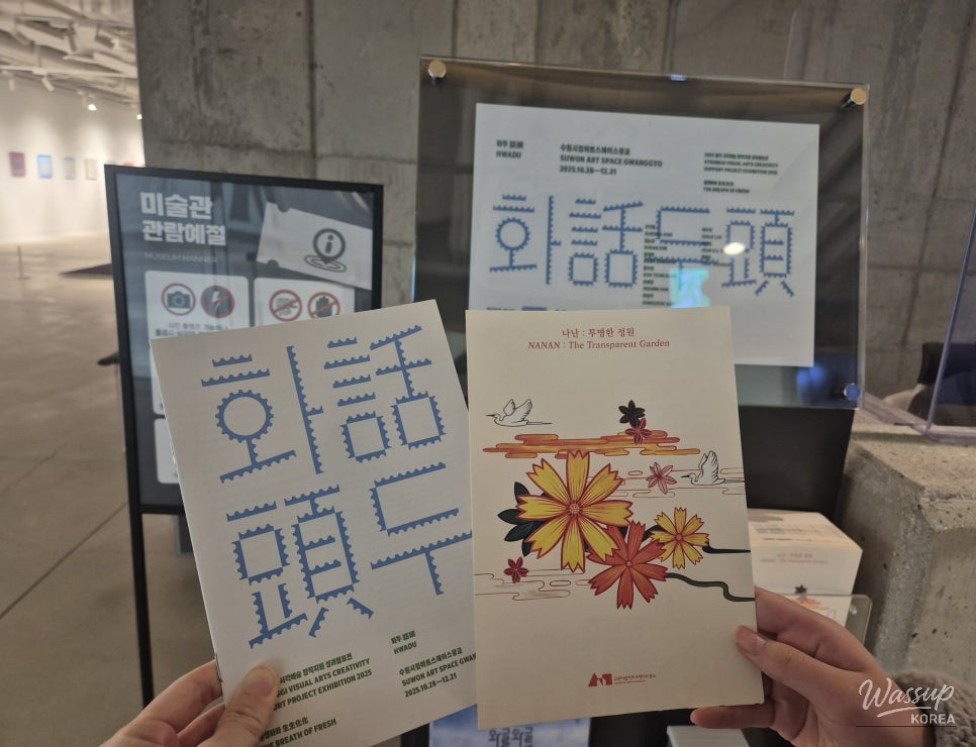
Gyeonggi Visual Arts Creation Support, Achievements Encountered at the Exhibition Hall ⓒ Ahn Sun-young, Reporter
'Sengseng Hwahwa 生生化化' is an exhibition showcasing the results of the visual arts support program that the Gyeonggi Cultural Foundation has been running since 2013.
Every year, artists selected through open calls create new works,
and these are introduced to the citizens in art museums throughout Gyeonggi Province.
In simple terms, it is a place where you can see 'which artists Gyeonggi Province supported,
and what kind of works resulted from it' all in one place.
The 'Hwadu (話頭)' in the title of the 2025 exhibition refers to the question that artists grapple with when starting their work,
that is, 'the starting point of the work'.
The exhibition is structured to show what form the questions that the artists held
took in the works, and through what methods and devices they were expressed.
How did they solve the 'device' Hwadu?
If you read the exhibition guide received at the entrance,
the word 'device' appears repeatedly.
The device referred to here does not only indicate machines or tools.
It is a broad concept that includes social systems and structures, our perspective on the world,
and even the framework of our senses.
You will encounter how the nine artists faced and interpreted this device in their own ways, one by one.
Following the viewing route, one by one!
It was a special experience to follow the Hwadu thrown by each person.
✔️Hwadu 1. The Form that Supports the Invisible | Choi Tae-hoon
The first viewing starts with
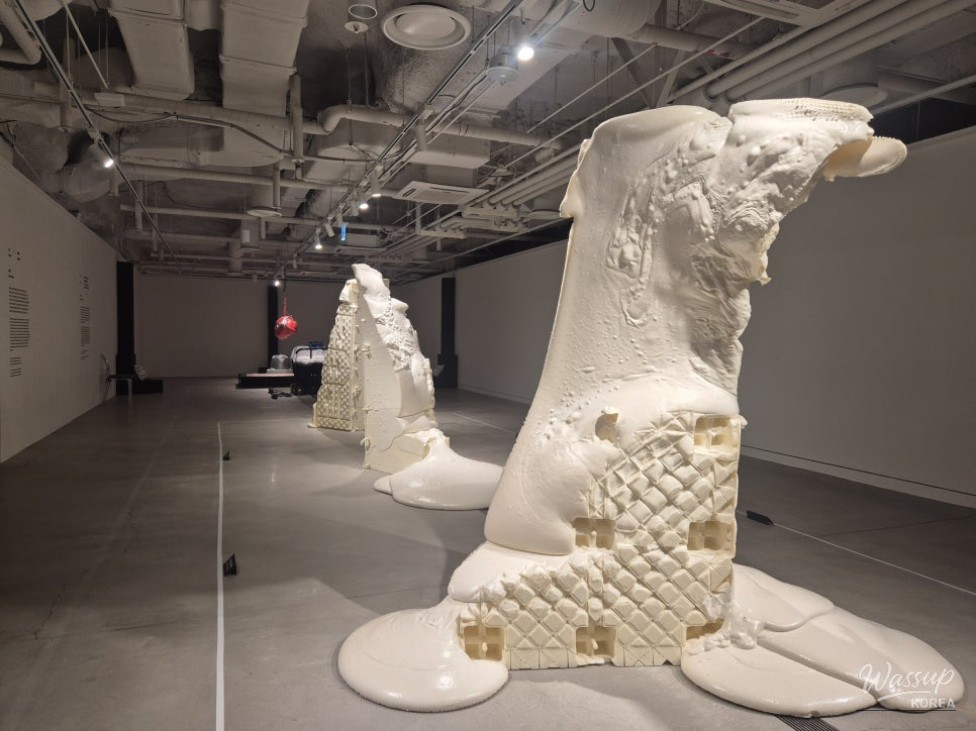
Choi Tae-hoon's 〈Supporting Body〉.
The artist has been continuing a series of re-examining furniture recommended by the IKEA website algorithm as 'sculptural language'.
In this work as well, objects that have quietly played their roles behind the scenes, such as tables, ladders, and handcarts,
meet with expanded urethane and are reconfigured into a sculpture.
The scene where the device that supported the result comes to the center of the work is impressive.
Work made of expanded urethane, Choi Tae-hoon 〈Local Autonomy〉 ⓒ Ahn Sun-young, Reporter
The form created by leaning and overlapping each other is solid but also somewhat unstable, reminiscent of the invisible hands that support the other side of creation.
Standing in front of the work side by side with my child,
"What is this material?",
"What shape do you see?"
As we talked,
at some point, the question arose, "What is supporting what?"
✔️Hwadu 2. A Scene Revealing the Device of Emotion | Ahn Seong-seok
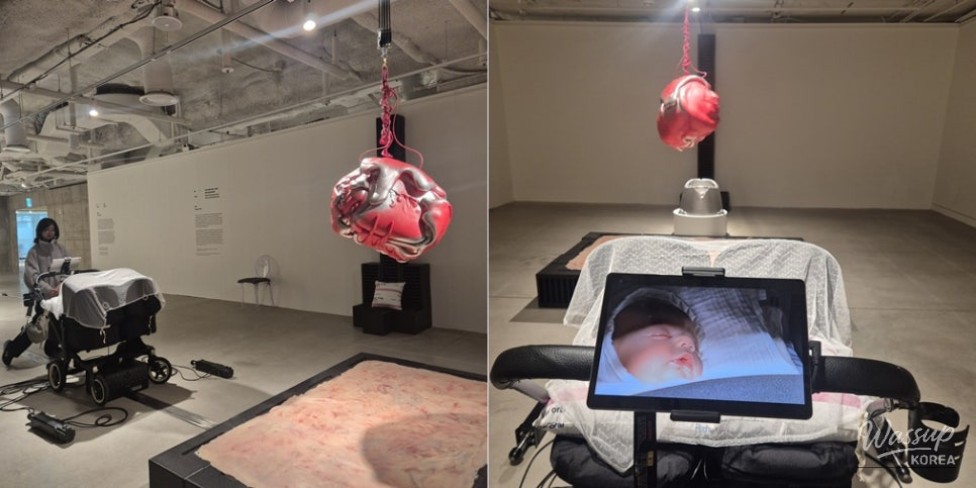
Ahn Seong-seok presents
an installation work combining motion simulators, videos, and sounds.
The title is 〈We Abandon the Future and Fill the Space with Pessimism and Cynicism〉.
Standing in front of the work, the movement of the screen, the shaking of the machine,
and the sound filling the space come all at once,
and the various layers of emotions that an individual experiences when facing reality slowly begin to emerge.
Ahn Seong-seok's work that unravels autobiographical experiences through photos, videos, and graphics ⓒ Ahn Sun-young, Reporter
I felt that one side of my heart was shaking little by little while watching through the motion simulator.
I also realized that what moves the huge social structure
is ultimately the emotions and choices of one person.
This work, encountered in the early part of the exhibition,
was a scene that clearly showed that this exhibition is not just a place for visual pleasure.
✔️Hwadu 3. Between Process and Result, Traces of Connection | Lee Su-ji
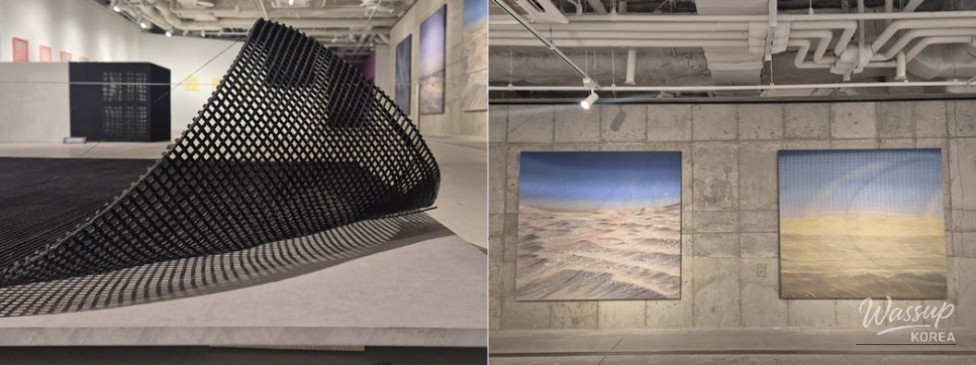
Lee Su-ji's work
focuses more on the process of 'how it was made' than on the completed result.
It was arranged like clues leading from 〈Wide Thing〉 to 〈Similar Thing〉 in the center of the exhibition hall.
Standing in front of the work, the thought comes to mind, 'What steps did this form go through to get here?'
Rather than directly showing the scene where the work is made,
the artist leaves traces and fragments so that viewers can imagine for themselves.
It's an open method.
Walking slowly between the two works,
I felt like an invisible line was drawn in the exhibition hall.
(Left) Lee Su-ji 〈Wide Thing〉, (Right) Bang Su-yeon 〈Sand Road〉 ⓒ Ahn Sun-young, Reporter
✔️Hwadu 4. Walking Along an Invisible Landscape | Bang Su-yeon
Bang Su-yeon's 〈Sand Road〉 and 〈Ghost Curve〉 are works that unravel the landscapes encountered in the desert and sand mountains into abstract patterns.
Following the lines, planes, and traces of light stacked on the screen, even though I am not actually looking at the actual landscape,
the air and temperature of that place are subtly conveyed.
These are the results of an attempt to translate invisible elements such as wind, fog, vibration, and sound into paintings.
Stopping in front of the work for a moment,
the time of the place where the artist stood and my present quietly overlap.
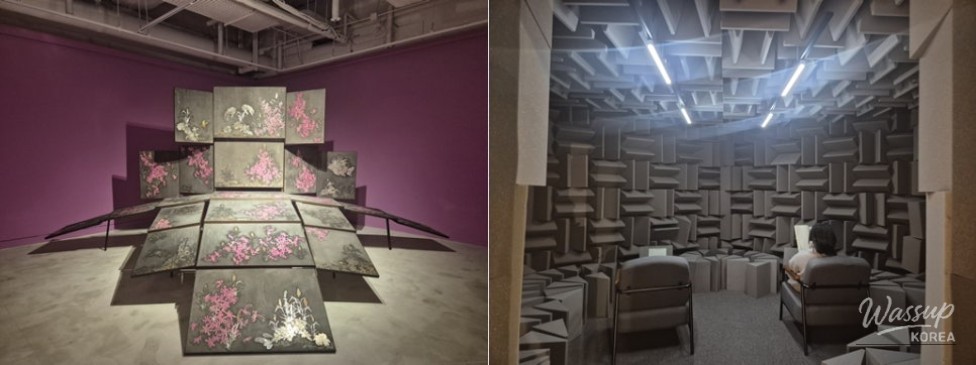
✔️Hwadu 5. A Screen Where Nature and Technology are Intertwined | Kim So-san
Kim So-san's 〈Flowers Stained with Machines〉
started from observing the flowers and weeds that bloomed around her in the spring when she started working.
After drawing the shape of the plant with etching and detailed painting,
she combined it with a three-dimensional structure and expanded it into an installation form.
The natural lines of flowers, leaves, and stems and the solid lines of materials such as metal and wood
are in contact with each other like a scene in one screen.
Looking at the landscape where nature and technology are permeated at the same time,
I am reminded of what the texture of the time we live in looks like.
(Left) Kim So-san 〈Flowers Stained with Machines〉, (Right) Bang Seong-wook 〈Labor Sense〉 ⓒ Ahn Sun-young, Reporter
✔️Hwadu 6. A Room Containing the Sense of Labor | Bang Seong-wook
Bang Seong-wook's 〈Labor Sense〉
is located in a space configured like a 'room'.
When you enter the anechoic chamber surrounded by sound-absorbing materials,
the sounds from outside slowly disappear,
and only your own breathing and footsteps
begin to be heard clearly.
The artist started from the scenery of the work site that he remembered with his mother sharpening needles
and has been shaping the tension and weight of labor.
The writings about labor that you encounter in the space
make you recall the moments of labor that we have too easily overlooked.
While reading the text in the room, a heavy lingering feeling remains on one side of my heart.
✔️Hwadu 7. A Sculpture Imagining the Change of Life | Son Hee-min
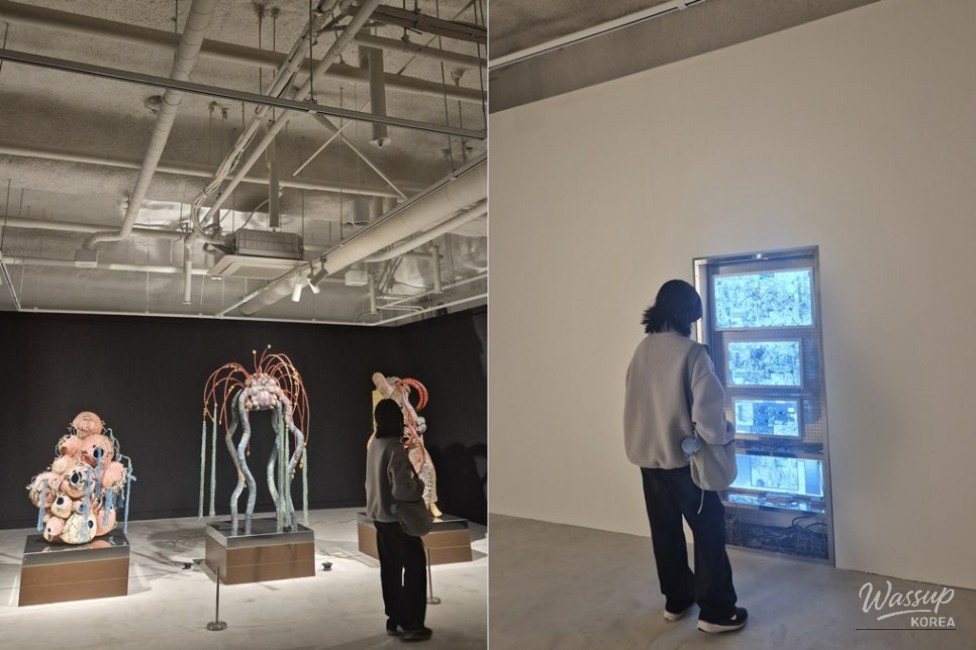
Son Hee-min's 〈Mixed Scenario〉
is a work that unravels the various stages that life has gone through, such as cell division, symbiosis, reproduction, and evolution.
The sculpture with different materials hanging and overlapping
was a structure that allowed you to look inside and look outside at the same time.
While looking at the work, the shape and movement of life,
and the possibility of change come to mind, but that flow is ultimately an endless evolutionary process leading to death!
At this point, it seems that the word 'device' is connected to a biological system.
(Left) Son Hee-min 〈Mixed Scenario〉, (Right) Gu Gi-jeong 〈Clear View Mechanism〉 ⓒ Ahn Sun-young, Reporter
✔️Hwadu 8. Visual Perception System and Mechanical Device | Gu Gi-jeong
Gu Gi-jeong's 〈Clear View Mechanism〉
has LED substrate devices, wires, photographic images,
and 3D rendering images stacked in layers.
Looking at one screen in multiple layers,
what is real and what is reproduction,
and you will ask yourself when the boundary becomes blurred.
How digital devices affect our gaze,
and what medium is hidden between what is visible and what is invisible.
You will think about it.
✔️Hwadu 9. A Gaze Reflecting the Cracks in the Social Structure | Jeon Ga-bin
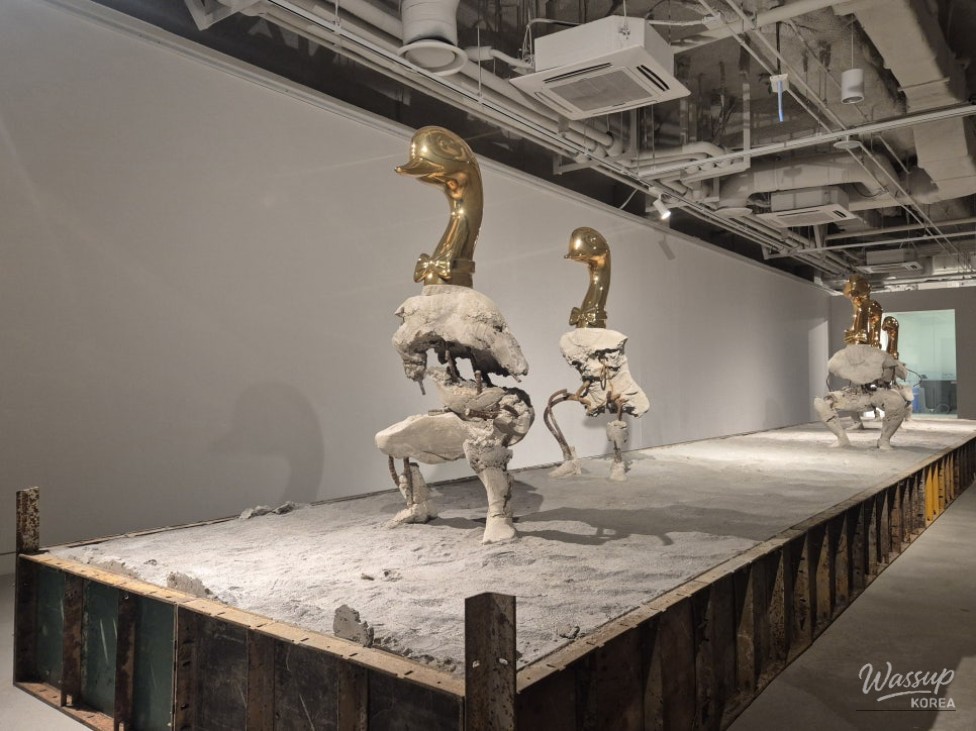
The last corner is Jeon Ga-bin's
〈So That We Can Be Us〉 is located.
The texture of cement and rebar, cracks and rust left on the surface is like a memory that has been accumulated in one place for a long time.
It came to me.
They are materials that can be commonly seen at construction sites,
but in a social structure that is 'barely withstanding the tipping point',
it is connected to beings that are easily pushed out.
Several works I encountered while looking around the exhibition
overlapped at once at this point,
and the question quietly remained, "What devices are needed for us to be us?"
Jeon Ga-bin's 〈So That We Can Be Us〉, which reveals the self-destructive growth of modern cities ⓒ Ahn Sun-young, Reporter
Although they had different materials and forms,
the viewing route was smoothly connected like a sentence.
While watching one artist's work
and moving to the next space,
I feel like the scene I just saw is slowly being organized in my head.
It is a space to see works,
but also a space to come up with questions!
Rather than having long conversations about the work while viewing it with my child, I thought it would be more appropriate to quietly bring out the impressions that each person had in mind.
When the support project leads to an exhibition
《2025 Sengseng Hwahwa: Hwadu》
not only shows the work of individual artists,
but also shows how Gyeonggi Province's visual arts support policy is operating.
It is also a place where you can see it with your own eyes.
The process of selecting artists through open calls, providing necessary support in the process of creating works,
sharing discussions about the work through criticism workshops, and finally, publicly displaying the results to the public through exhibitions
forms a structure.
I also heard that a criticism workshop was held on November 1 (Sat) with 5 critics,
9 participating artists, and project managers.
It was a place to review the entire process from the beginning of the support project to the exhibition,
and to check the virtuous cycle structure of creation, criticism, and exhibition!
I am thinking again through this exhibition that the word support does not stop at administrative terms,
but is actually a bridge connecting the work of artists and the experiences of citizens.
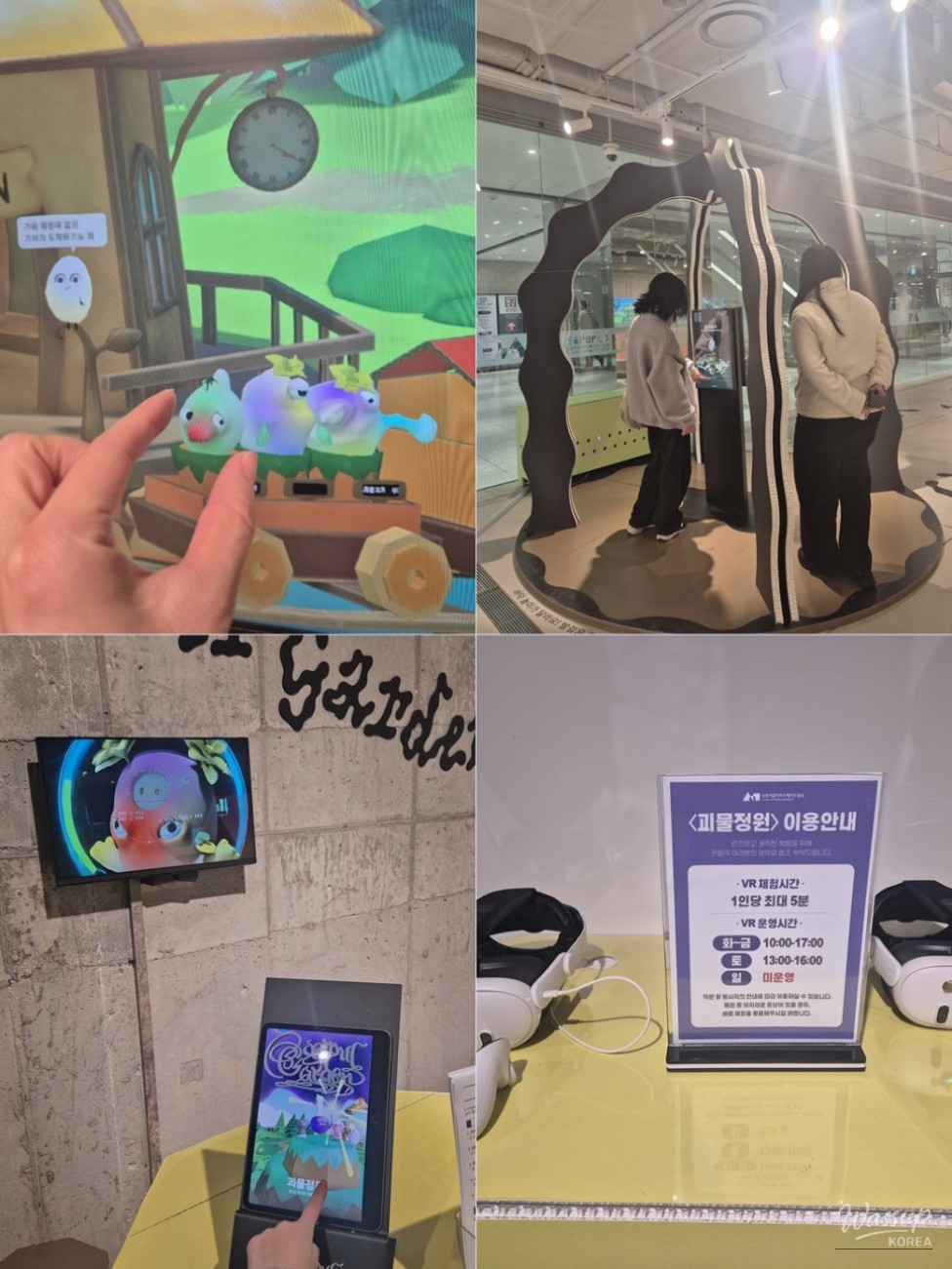
Another experience to complete the exhibition, 〈Monster Garden〉 experience space ⓒ Ahn Sun-young, Reporter
When visiting the exhibition hall with the whole family,
I also pay attention to the experience corner.
The experience space 〈Monster Garden〉 felt like a place to directly experience the concept of 'device' covered in the exhibition.
Through the AI program,
by creating your own plant monster,
the shape and personality change slightly depending on the questions that appear on the screen.
My child was curious about what form the clues he chose would be completed in and looked at it for a long time,
and the production of the completed image moving and settling in the digital garden was also interesting.
It was also connected to the content of the exhibition in that the viewer's choice became a 'device' and created a new life form.
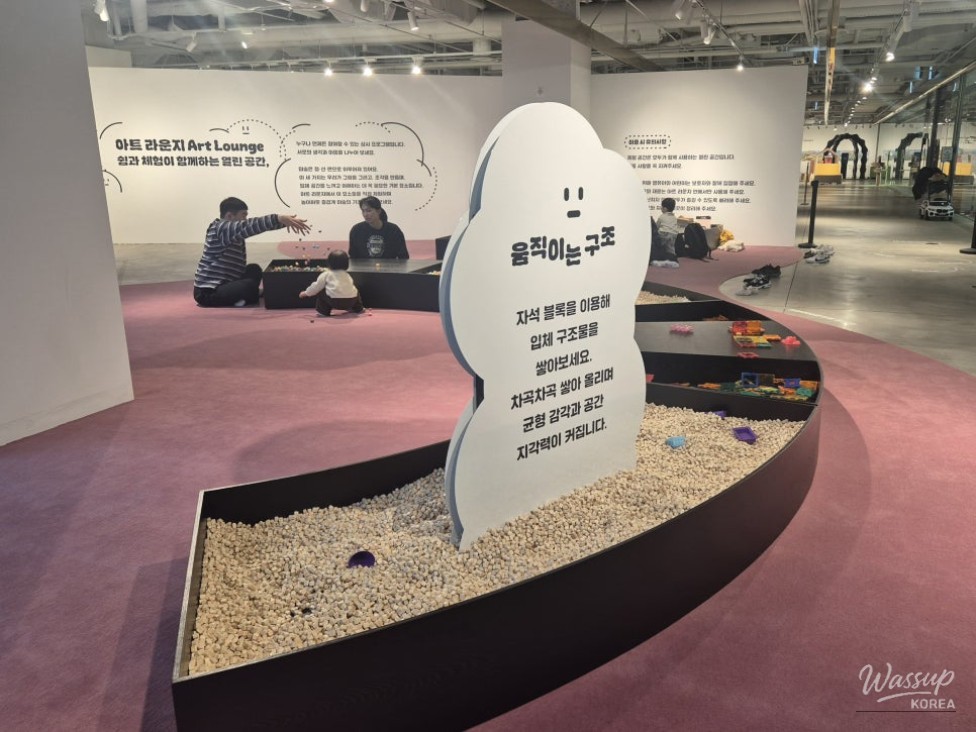
〈Art Lounge〉 where you can directly experience the points, lines, and planes of art ⓒ Ahn Sun-young, Reporter
The open space 〈Art Lounge〉, which combines rest and experience, also added to the enjoyment of the exhibition.
While doing simple hand play and sharing stories about the works that left a lasting impression, the appreciation continued once more.
《2025 Sengseng Hwahwa: Hwadu》, which is open until December 21 (Sun),
is an exhibition that I would like to recommend to those who felt unfamiliar with modern art.
A place to show the questions posed by contemporary art in connection with the locality of Gyeonggi Province!
In the deepening autumn, why not stop by Suwon Art Space Gwanggyo and think about the Hwadu posed by the artists together?
Suwon Art Space Gwanggyo Information
• Address: B1, Suwon Convention Center, 140, Gwanggyojungang-ro, Yeongtong-gu, Suwon-si, Gyeonggi-do
• Exhibition Name: 2025 Gyeonggi Visual Arts Creation Support Achievement Exhibition 《Sengseng Hwahwa: Hwadu》
• Dates: October 28 (Tue) ~ December 21 (Sun), 2025
• Hours: 10:00 AM ~ 6:00 PM / Closed every Monday
• Admission: Free
• Inquiries: 031-5191-4104
• Homepage: suma.suwon.go.kr







Source :https://blog.naver.com/gyeonggi_gov/224086470549
No comments yet.