Rediscovering Tradition: 5 Traditional Korean Games to Enjoy During Chuseok


Chuseok, also known as Hangawi, is a major Korean holiday celebrated as a harvest festival and a time to honor ancestors. During this period, families gather to share food and enjoy various traditional folk games, strengthening their sense of community. However, with increasing urbanization and individualism, the significance of these traditional games is gradually fading. Nevertheless, folk games offer more than just entertainment; they hold important values such as enhancing cooperation, preserving traditional culture, and fostering intergenerational communication.
In fact, according to a survey by the Rural Development Administration, 78% of adolescents who have experienced folk games responded that their “bond with family has strengthened,” highlighting the significant emotional effects.
This article introduces five representative folk games that are enjoyable during Chuseok, along with the hidden stories they hold.
Chuseok's Top 5 Traditional Folk Games
1. Yut Nori: Rolling the Dice of Destiny
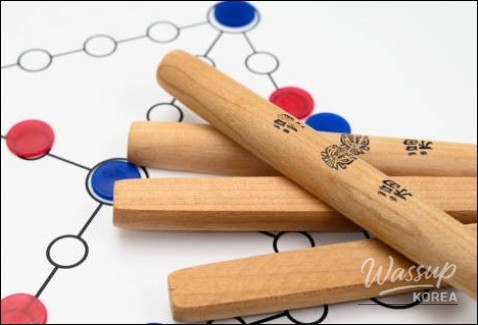
Yut Nori is a board game where players move their pieces according to the shapes (Do, Gae, Geol, Yut, Mo) that result from throwing four Yut sticks. Dating back to the Three Kingdoms period, this game was originally used as a divination tool before gradually transforming into entertainment. Interestingly, some interpretations suggest that the movement of pieces on the Yut board symbolizes the seasonal changes of an agrarian society.
Recently, digital Yut Nori apps and events featuring popular characters have emerged, making it more familiar to the MZ generation (Millennials and Generation Z). For example, the National Folk Museum of Korea operates a virtual Yut Nori experience center using VR technology.
2. Ganggangsullae: Women's Power Blooming in a Circle
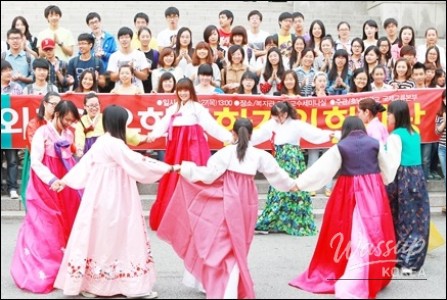
One theory suggests that Ganggangsullae originated during the Imjin War when Admiral Yi Sun-sin gathered women to dance in a circle to deceive the Japanese army. Later, it became established as a group dance performed by women to pray for a bountiful harvest and well-being. This dance has garnered global attention, having been inscribed on the UNESCO Intangible Cultural Heritage list.
Large-scale Ganggangsullae festivals are held annually in Jindo, South Jeolla Province, and Tongyeong, South Gyeongsang Province, where participants hold hands and sing, sharing their energy with each other. This is not just a simple dance but a cultural heritage symbolizing community resilience.
3. Jegichagi: The Aesthetic of Balance Blooming from the Toe
Jegi is a game that involves kicking a shuttlecock made by connecting paper feathers with coins or metal pieces. Although it may seem simple, it actually requires accuracy of the foot, a sense of body rhythm, and concentration, making it a highly challenging skill. It is also sold as a popular sporting good overseas, called 'Korean Hacky Sack.'
Notably, a startup in New York has even developed a Jegi that connects to a smartwatch to measure exercise. In this way, traditional games are opening up new possibilities by combining with modern technology.
4. Tuho: The Tension Between Arrow and Jar
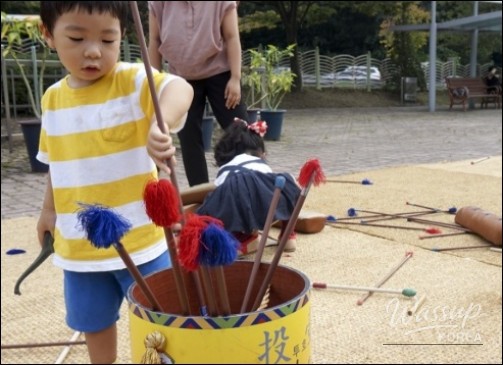
Tuho was a game enjoyed in the royal court, where long sticks (arrows) are thrown into a distant jar. During the Joseon Dynasty, it was a competition between the king and his officials at royal banquets, but it gradually spread to the common people, becoming accessible to everyone.
Recently, it has been used as a team-building activity in corporate workshops. For example, Samsung Electronics reportedly incorporates Tuho into its new employee training programs to test collaboration skills. The charm of Tuho lies in the strategic thinking hidden within its simple rules. The process of calculating the wind direction or the angle of the arm to increase the score is similar to contemplating life's choices.
5. Neolttwigi: Leaping Towards the Sky
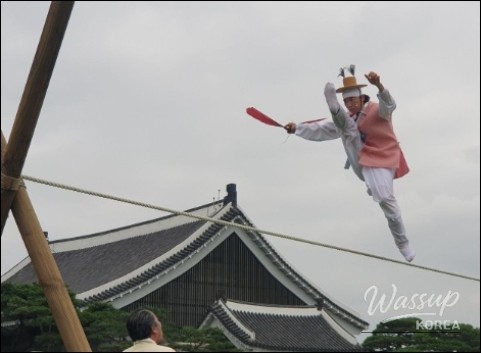
Neolttwigi, or Korean plank jumping, was the only game enjoyed by both men and women together. The late Joseon Dynasty scholar Yi Ik recorded that “Neolttwigi was a means for women to circumvent restrictions on going out.” Scientifically, the principle of elastic energy accumulating and increasing the height as two people take turns jumping is at play.
In South Jeolla Province, festivals are held where entire villages participate using large planks, and in Pyeongchang, Gangwon Province, Neolttwigi has been included as an event in international folk game competitions.
Rediscovering Folk Games in Modern Society
Folk games are now evolving beyond tradition into new cultural content. For example, a cafe in Seoul has opened a 'Yut Nori Cafe' where people can enjoy the game while drinking beverages.
Furthermore, they are gaining popularity as creative experiential activities in educational settings. An elementary school in Gyeonggi Province has received great responses for conducting classes where students make their own Jegis and modify the rules of the game. In this way, folk games are serving as a bridge connecting the sensibilities of the digital generation with the wisdom of tradition.
Create Memories with Games This Chuseok
Chuseok is a perfect opportunity to revive traditions that have been forgotten in our busy lives. Share laughter by throwing Yut sticks instead of using smartphones, and relieve stress by jumping high on a Neolttwigi board. If it is difficult to experience them directly, it is also a good idea to search for 'Folk Game Experience Videos' on YouTube. Check the websites of the National Museum of Korea or local cultural foundations for special Chuseok program schedules.
Why not take this holiday to rediscover the wisdom of our ancestors and the preciousness of family through folk games? If you listen to the stories hidden within the games, you may find that time flies by.
No comments yet.