The Scholar Who Completed Chusa Script
799-2 Yonggung-ri, Sinam-myeon, Yesan-gun, Chungcheongnam-do



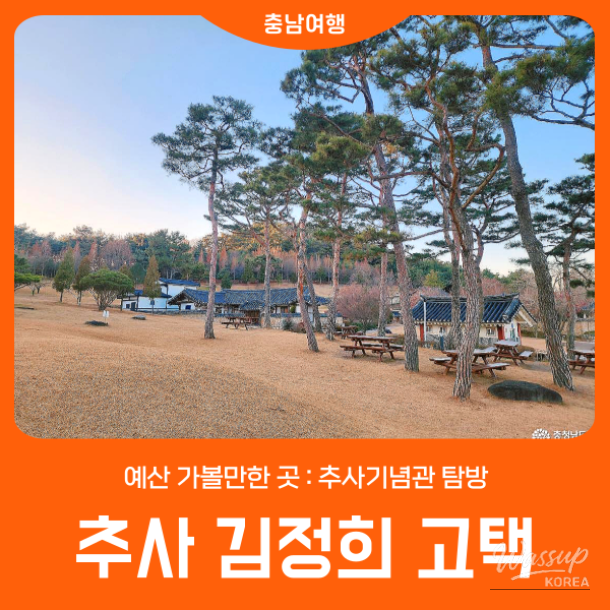
The historic home of Chusa Kim Jeong-hee in Yesan is not a crowded tourist attraction, but a quiet space where the life of a great Joseon scholar can be felt through architecture and atmosphere.
Walking through the house, memorial hall, and shrine offers a tangible connection to Chusa’s scholarship, calligraphy, and philosophy, allowing visitors to reflect in a calm and meaningful environment.
Visiting the Home of Chusa Kim Jeong-hee
The historic home of Chusa Kim Jeong-hee is located in Yonggung-ri, Sinam-myeon, Yesan-gun, Chungcheongnam-do. Visiting this site made it possible to encounter a historical figure once known only through books and writings in a real, physical space.
Rather than feeling like a typical sightseeing destination, the area is quiet and contemplative, making it well suited for slow exploration and reflection.
Chusa Kim Jeong-hee and His Legacy
Chusa Kim Jeong-hee lived from 1786 to 1856 and was one of the most influential scholars, calligraphers, and epigraphers of the late Joseon period. Born in Yesan, he emphasized empirical and critical approaches to learning.
He completed the unique calligraphic style known as Chusa Script. His representative work, Sehando, reflects both his integrity and philosophical depth during his period of exile, revealing a pursuit of new expression rooted firmly in tradition.

Overview of the Historic Site
Adjacent to the house is the Chusa Memorial Hall, where visitors can learn about his life and artistic achievements before or after touring the residence. The site also includes Chusa’s tomb, located near the house where he was born and lived.
According to information provided at the entrance, Chusa’s great-grandfather received the house as a royal gift after becoming the son-in-law of King Yeongjo. The original residence consisted of fifty-three rooms, with construction costs shared by fifty-three counties of Chungcheong-do.
Only part of the original structure has been restored. Today, the house is designated as Cultural Heritage No. 43 of Chungcheongnam-do and recognized as the third scenic site of Yesan.
Gatehouse and Guesthouse Spaces
Passing through the gatehouse feels like stepping into a different era. The space immediately beyond is the guesthouse, once used for welcoming visitors, reading, and quiet contemplation.
The interior has been recreated with objects from over a century ago. Imagining Kim Jeong-hee studying and reflecting in this space creates a strong sense of connection to his everyday scholarly life.

In front of the guesthouse stands a stone-column sundial crafted by Kim Jeong-hee himself. The inscription Seoknyeon, meaning Stone Year, was carved in Chusa Script by his son, Kim Sang-woo.
Main House and Shrine
The main house sits next to the guesthouse and follows a square-shaped layout, including living quarters, guest rooms, a kitchen, and an inner courtyard. The interior has been simply restored using period-appropriate furnishings.
Inside the kitchen area, a display of photographs showing the house across four seasons leaves a lasting impression and inspires a desire to revisit at different times of the year.
Behind the main house is Yeongdang, a shrine established by Chusa’s son after his passing. The plaque inside, written in Chusa Script by his lifelong friend Kwon Don-in, and the portrait painted by his disciple Lee Han-cheol further deepen the historical significance of the site.
A Place for Quiet Reflection
The historic home of Chusa Kim Jeong-hee is less about spectacle and more about atmosphere. Walking through the spaces he once occupied brings his name and legacy closer, transforming abstract history into lived experience.
For travelers exploring Chungcheongnam-do, this site offers a meaningful stop where scholarship, art, and quiet contemplation naturally come together.
No comments yet.