Exploring Victory Park: A Glimpse into the History of Dangjin



When thinking of Dangjin, many people may only consider Myeoncheon Fortress, but there was also Dangjin Fortress.
The site of the old Dangjin Fortress in the city center has returned to the citizens this year.
Welcome to Victory Park in Seungri-dong, Dangjin. Let’s enjoy a winter stroll in this historical park.
Dangjin Fortress was built in 1440 during the 22nd year of King Sejong's reign as Pyeongsan Fortress.
Utilizing the low hilly terrain, it is recorded in the New Illustrated Book of Geography that the fortress had a circumference of 1,954 feet and a height of 8 feet, with two wells present.
Later records in the Annals of King Munjong noted a circumference of 2,809 feet and a height of 9 feet, with three wells and three gates, indicating that the fortress grew in size over a short period.
However, it fell into disrepair, leaving only faint traces behind, and after decades of ups and downs, it became a historical park.
Victory Park is accessible from three paths leading in different directions. One route connects to Dangjin Cathedral and the village hall of Eunnae 8-dong, leading to a residential area.
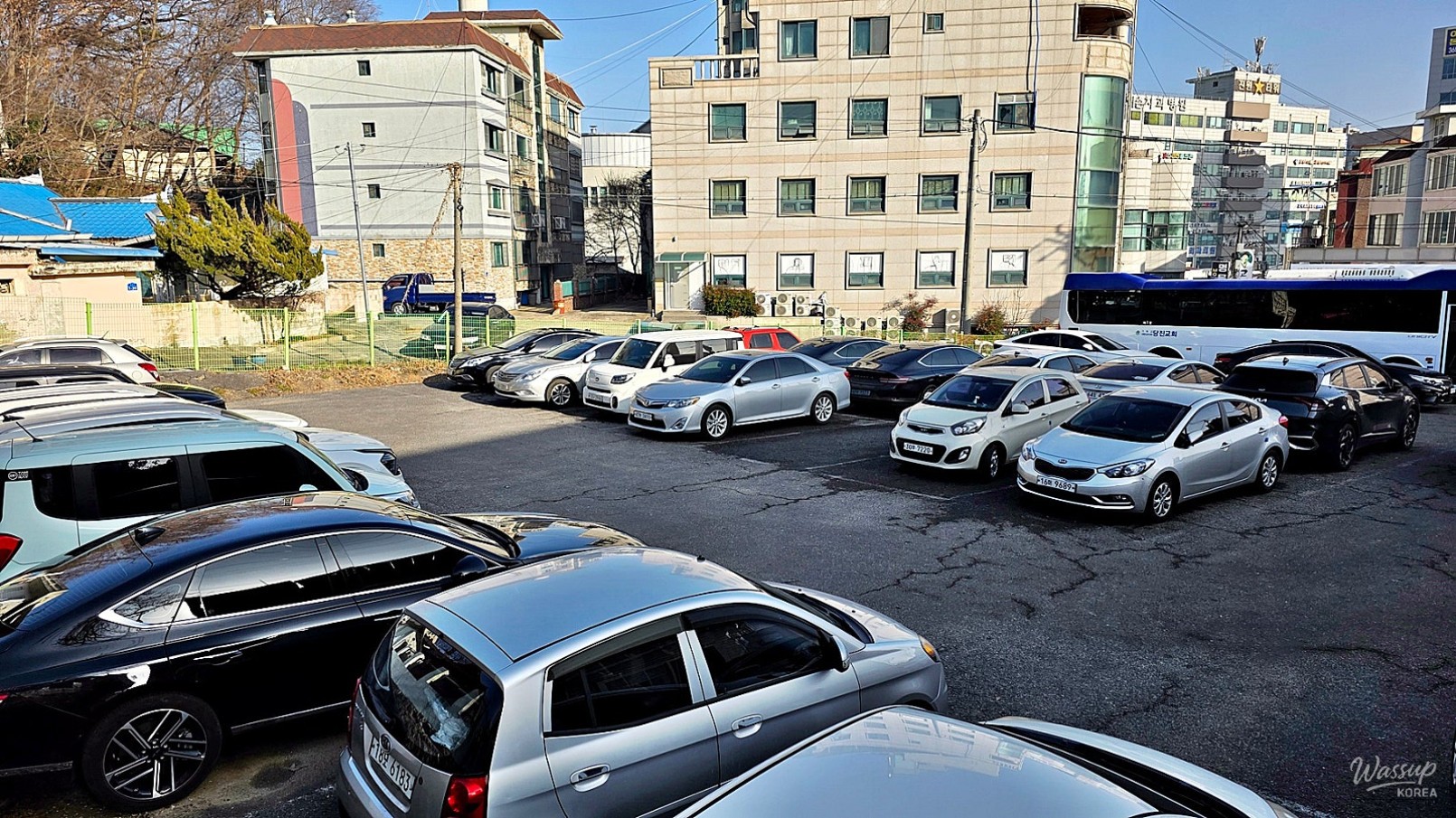
Entering Victory Park via navigation leads to Dangjin Cathedral, where you find a parking lot for the church and a daycare center, and a gentle uphill path that connects to the park.
As you ascend the hill, a wide hilly landscape unfolds.
The park's pathway winds along the hillside, zigzagging up to the summit.
This layout encourages visitors to linger longer.
The route back to Dangjin Cathedral and the village hall is downhill, with a long ridge guiding you to the northwest, north gate, and northeast.
However, the old traces are not clearly visible to the naked eye.
From the upper pavilion, you can enjoy a panoramic view of the Dangjin cityscape.
Amidst the expansive scenery, you can take a leisurely stroll while reflecting on history.
The old site of Dangjin Fortress has undergone many twists and turns before returning to the citizens.
In 1968, it was designated as park land, and at one point, plans were made to construct apartments there.
With the resolution of long-standing issues, the area has transformed into a historical park that preserves the old fortress and connects the past to the present.
From the center of Victory Park, you can overlook the city center of Dangjin.
Paths leading down from the park connect to main and minor roads, with large apartment complexes beyond.
At the end of the park, the village hall of Eunnae 8-dong serves as a landmark connecting to Victory Park.
During my hour-long walk, I encountered a few visitors in the park.
From above, the park reveals a monochrome winter landscape, with only clusters of bamboo providing a touch of green.
As spring arrives and nature awakens, the scenery will surely be even more beautiful.
The trail along the hillside continues from the summit, with pavilions installed at various points.
The walking paths are wide, paved with blocks and asphalt between the ridges and grassy fields.
Additionally, security cameras and streetlights are installed at various heights, ensuring safety for evening strolls.
The signage of Victory Park also lights up the darkness.
As I walked slowly, I reached the northeastern pavilion, arriving at the east entrance.
This area is a residential neighborhood with a one-lane road and apartment complexes.
The historical park at the site of the old Dangjin Fortress is well-connected with multiple entrances and has an accessible, gently sloped walking path that is also suitable for exercise.
While strolling through Victory Park, I encountered a bird from the heron family.
I searched for its name and found it referred to as a Red-shouldered Hawk, though I am not entirely sure.
Personally, I was delighted to observe this majestic bird that I spotted near the old fortress.
Now newly opened, Victory Park reminds us of the existence of Dangjin Fortress in the city center.
It has become a historical park that symbolizes a place for remembering history, and I hope it will establish itself as a historical site in Dangjin, following Myeoncheon Fortress.



Source :https://blog.naver.com/dangjin2030/224176988044
No comments yet.