Exploring the Beauty of Goeunsan: A Winter Trek to Ssangok Waterfall


[ Goeunsan Travel ]
Must-Visit Places in Goeunsan
Winter Trekking Course at Ssangok Valley and Ssangok Waterfall
On a snowy day, the lush forests and valleys of Goeunsan became even more beautiful. Here, I share the dazzling scenery of Ssangok Valley enjoyed during a light trek.
As you drive towards Yeonpung in Goeunsan, you will pass through Misun Tree Village in Chilseong-myeon, where the signpost for Ssangok Valley appears. This location is one of the eight scenic spots of Goeunsan, renowned for its beauty in all four seasons. Historically referred to as Ssanggye, it has been loved by many literary figures such as Toegye Yi Hwang and Songgang Jeong Cheol during the Joseon Dynasty. It is said that someone named nine scenic spots as Ssangokgu-gok, which stretches 10.5 km from Ssangok Village to Jejusuri Pass. This long course can be enjoyed in various ways, including scenic drives, mountain trekking connecting all nine spots, or light trekking at select locations.
Among these, I recommend the barrier-free trail to Ssangok Waterfall, which anyone can enjoy. It is a 1.5 km round trip, taking about an hour, where you can encounter the stunning landscapes of Ssangok Valley.
The beauty of Ssangok Valley unfolds from the very beginning. In summer, it is a popular spot for water activities, and in autumn, the vibrant fall foliage is spectacular. After following the signpost through the evergreen pine areas, a white snowy mountain appears before you.
Surrounded by the majestic peaks of Bobaesan, Gunjasan, and Bihak-san, Ssangok Valley features a one-lane road alongside cliffs and ancient pines. On the way to Ssangok Waterfall, you will pass through the second scenic spot, Sogeumgang, along with the Sogeumgang Rest Area, and the third scenic spot, Byeongam. Sogeumgang is considered one of the most beautiful spots among the Ssangok scenic spots.
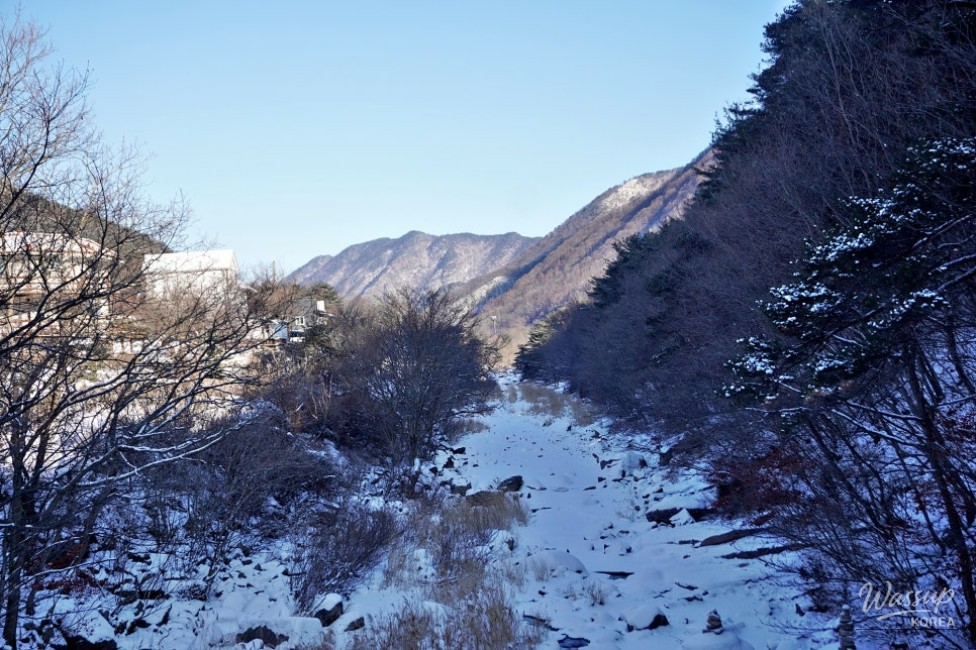
Below Sogeumgang Rest Area, the valley flows beneath towering cliffs. The valley, once a summer water play area, now disappears into the snow, creating a breathtaking view between the cliffs and ancient pines. The combination of the white snow and dark green pines creates a fantastic landscape. Even a single part of this scene is mystical, and the panoramic view of the connected peaks is equally mesmerizing. In that moment, I felt as if I had become a fairy lost in the beauty of Sogeumgang.
About a five-minute distance from the entrance of Ssangok Village, you will find a camping area, accommodations, and a cluster of restaurants. This is the entrance to Byeongam, the third scenic spot of Ssangok. The trail leading to the summit of Chilbongsan was bustling with visitors from summer to autumn. In winter, it becomes somewhat quiet, but you can still see people climbing the mountain with crampons here and there.
After passing through an archway, the deck path begins, leading over the valley to the hiking trail. Bare trees and pines create a stunning landscape on either side. The snow that had melted along the roadside now sinks to your ankles as you enter the mountain path. Depending on the sunlight, the scenery changes dramatically. It is a winter mountain that does not permit beginners.
Continuing on, you will arrive at Ssangok Rest Area, where the barrier-free trail to Ssangok Waterfall is located. The Ssangok scenic spots extend from Tteokbawi to Munsuam, Ssangbyeok, Yongso, Ssangok Waterfall, and Seonnyeotang. Among these, Ssangok Waterfall is the seventh scenic spot. The wide parking lot at Ssangok Rest Area offers a beautiful view of the snow-covered surrounding ridges.
In the fourth week of January, a strong cold wave coincided with the coldest part of winter, bringing snowfall that made Goeunsan's winter incredibly beautiful. The valley and forest transformed into a fairy-tale world. The trail from Ssangok Rest Area to Ssangok Waterfall is a light trek that takes about an hour round trip, starting on a deck path and connecting to a gentle mountain trail.
As you pass the entrance with facilities such as corporate training centers, guesthouses and pensions welcome hikers along the mountain path. Behind you, the snowy mountains and clusters of pines create a boundary between near and far landscapes, while the forest path ahead is wide, perfect for enjoying the winter woods while chatting with friends.
As you walk along the snowy path, the types of trees frequently change, and the scenery transforms. The freshness of the pine forest, the mysterious beauty of silver winter trees, and the deep brown winter woods intersect, making it feel as if a witch from a fairy tale might suddenly appear.
After about 20 minutes of walking, you will reach Ssangok Waterfall. A deck path has been constructed below the mountain path, ensuring good accessibility. Beautiful snow rests on the twisted tree trunks and pine needles, blending with the crispy brown leaves and green pine needles. The valley, which once flowed with clear water, is now frozen and covered with a white blanket of snow.
The view from the deck overlooks Ssangok Waterfall, which shyly reveals itself. The sound of water flowing through small ice walls and the songs of birds create a beautiful atmosphere. The waterfall amidst the tranquil winter forest felt like a delightful winter experience.
The building under construction above the forest path leading from Ssangok Waterfall has been completed. Currently, it stands empty, but it is expected to welcome visitors on warmer spring days. On a snowy day, the path leading to Ssangok Waterfall in Ssangok Valley showcased beautiful winter scenery between the towering cliffs and dense forests. Even after the snow melts, the valley surroundings are likely to remain frozen, continuing the winter charm. I highly recommend the light winter trek to Ssangok Waterfall, where the valley and forest harmonize beautifully.



Source :https://blog.naver.com/goesan-gun/224161201384
No comments yet.