Cultural Journey at Arario Gallery in Cheonan


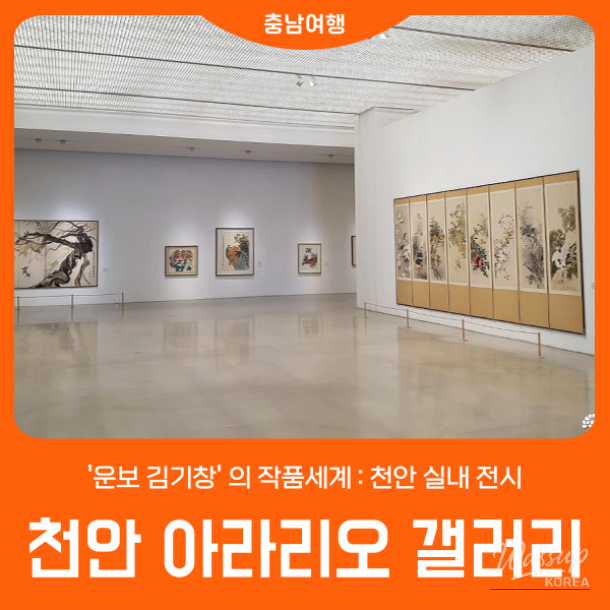
Arario Gallery Cultural Journey
97-3 Sinbu-dong, Dongnam-gu, Cheonan, Chungcheongnam-do
Cheonan is home to various art museums and galleries that are perfect for enjoying cultural activities.
Among them, the Cheonan Arario Gallery is conveniently located near the terminal and department stores, making it easily accessible. I recently embarked on a cultural journey to the Arario Gallery.
The exterior of the Cheonan Arario Gallery is quite impressive. Currently, it features an exhibition of the works of Kim Ki-chang, known as Unbo, and the entire facade feels like a piece of art.
Parking is available at the Shinsegae Department Store in Cheonan-Asan, and the admission fee is 3,000 won for adults. Unlike most art galleries, which are usually closed on Mondays, the Cheonan Arario Gallery closes once a month on a Monday that aligns with the Shinsegae Department Store's day off.
The exhibition introduces the world of Unbo Kim Ki-chang, a master of modern painting. Unbo lost his hearing at the age of eight due to a high fever caused by typhoid fever, which led him to develop a visual aesthetic from his experiences of silence.
This exhibition showcases works from the 1930s to the 1990s. Upon entering the exhibition hall, the first work you encounter is Mugunghwa Samcheolli Geumsugangsan.
Unbo, who showed artistic talent from a young age, began seriously painting at 17 after studying traditional landscape and figure painting. The following year, he won recognition at the Joseon Art Exhibition and continued to receive awards, including the Changdeokgung Palace Award.
The piece Night Owl displays a vibrant depiction and a sense of tension. In the first exhibition hall, you can appreciate various flower and bird paintings, where owls, hawks, and eagles create a strong impression.
One notable work from the 1950s is Wisteria and Sparrow, a collaborative piece created with his wife, Woo-hyang. After Woo-hyang painted the wisteria, Unbo added the sparrow and text, resulting in a unique four-panel folding screen.
The eight-panel bird-and-flower folding screen features various plants and birds, capturing the four seasons using ink and color on silk. A charming painting of a squirrel conveys a sense of liveliness, with its gestures and eyes appearing so vivid that one might want to pet it.
The work Military Horses, believed to be from the 1950s-60s, transforms emotions that could not be expressed due to hearing loss into visual art. The energetic depiction of horses and the tension conveyed through explosive brushwork are remarkable.
In the late 1950s, Unbo began exploring the possibilities of abstraction in Korean painting, and from the 1960s onward, he actively pursued abstraction. After the passing of his wife in 1976, he started creating the Foolish Landscape series, expressing the humor and simplicity of folk paintings, and in the 1980s, he produced the Teal Landscape series, characterized by deep blue tones.
You can view these works in the second exhibition hall. Pieces like Image of Late Autumn and Abstract are examples of Unbo's attempts at abstraction. As you slowly appreciate Unbo's works, you can sense his constant experimentation and diverse approaches.
Works like Chunhyangjeon and Chunhyangdo evoke the feeling of watching a play, with the dynamic gestures of the characters reminiscent of scenes from a novel, accurately capturing their movements with bold lines.
Unbo worked as a newspaper reporter in 1946 and served as the head of the art department at the National Folk Museum in 1927, which naturally led him to develop an interest in folk crafts and folk paintings. During the evacuation period from 1951 to 1953, he used rural landscapes and everyday life as subjects for his artwork or kept a painting diary.
Some works by Woo-hyang Park Rae-hyun, Unbo's wife and a renowned Eastern painter, are also displayed in the exhibition hall. Woo-hyang's piece Anxiety can be seen as a representative work from the time they sought to explore and realize a new form of Korean painting together.
This work reflects the influence of the informal art movement that was popular in the international art scene after World War II. In this piece, the subjectivity fades away, emphasizing abstraction with filled colors and blurring effects.
At the Arario Gallery, I encountered a variety of works by Kim Ki-chang and learned about Unbo's 70-year artistic journey. The collaborative works with his wife, Woo-hyang, held even more significance, providing a meaningful glimpse into the lives of both artists.
Cheonan Arario Gallery
Exhibition: Unbo Kim Ki-chang Exhibition until March 22, 2026
Address: 43 Mannam-ro, Dongnam-gu, Cheonan, Chungcheongnam-do
Opening Hours: 11:00 AM - 7:00 PM / Closed once a month on a Monday aligned with the Shinsegae Department Store's day off
Admission Fee: 3,000 won for adults
Reporting Date: December 1, 2025


No comments yet.