Experiencing the Charm of Seochon at the Seochon Brand Week


Seochon Brand Week is being held in Seochon, Jongno-gu, until Sunday, October 26, 2025. It had been a while since I last visited Seochon, a place I frequented even before it became popular.
The 2025 Seochon Brand Week features the participation of local cafes, bookstores, and galleries.
Seochon Brand Week is a festival that brings together various spaces in Seochon, including workshops, cafes, bookstores, galleries, and restaurants. It's a blend of diverse cultural and recreational activities, such as music appreciation, reading, exhibitions, and markets, even reading with drinks. There's so much going on that it can feel a bit overwhelming.
They were also offering a coupon event for those who spend over 10,000 KRW in Seochon and bring the receipt, but I skipped it as it seemed too complicated and I wasn't interested in the featured restaurants or cafes.
At the Honggeonik House, I participated in Capture Log.
Seochon refers to the village located west of Gyeongbokgung Palace. Administratively, it encompasses various neighborhoods such as Okin-dong, Nusang-dong, and Nuha-dong, spread out on both sides of Pilun-daero Road. You can think of it as the area near Baehwa Girls' High School.
During the Japanese colonial period, this area was also home to Byuksu Villa, a Western-style mansion owned by Yoon Deok-yeong, who was an even more fervent pro-Japanese figure than Lee Wan-yong. Now, no traces of it remain. Seochon has a fascinating network of narrow alleys and numerous houses built on the mountainside, making it a delightful neighborhood to explore. As you wander around, you'll encounter a unique blend of buildings from the 1950s and 60s, traditional Korean houses (Hanoks), and modern structures.
This unique atmosphere is drawing even more popularity than Bukchon Hanok Village. Perhaps that's why novelist Han Kang lives in this neighborhood. It truly is a place where you can fully experience the four seasons and feel a sense of tranquility. Although the number of visitors has increased, there are still many wonderfully charming spots.
Be sure to visit the Honggeonik House. The Seoul Metropolitan Government acquired the house of a wealthy merchant named Honggeonik and transformed it into a Hanok space for everyone to enjoy.
I happened to participate in the Capture Log event. They lend out Instax Mini 12 cameras to the first 30 people each day, which you must return within two hours. It comes with 10 shots, of which you submit 2 and can keep the remaining 8. You don't necessarily have to return the camera to Honggeonik House; you can also return it to Sangchunjae, located at the end of a Seochon tour.
You'll need a mobile ID or other form of identification to borrow the camera.
The Hanok appears to have been built during the Japanese colonial era. Hanoks with glass windows are mostly renovated or urban-style Hanoks, often built by the construction company of Jeong Se-kwon, the 'King of Korean Architecture.' Nevertheless, this one is quite large.
They've arranged books to encourage reading. With autumn being the season for reading, many local governments, especially Seoul, are promoting 'Reading Seoul.'
Honggeonik House also has an annex, which I imagine was once the sarangbang (guest room). It was probably a space where male guests would drink, read, converse, and smoke.
You can enter and sit in all the spaces. It's a great place to experience what a Hanok feels like.
In the backyard, camping chairs are provided for reading.
When you visit Honggeonik House, be sure to climb to the very top of the backyard. You'll get a full view of the entire house.
I've already taken three shots. It's my first time using an Instax camera. The button placement seemed odd, but I realized the basic Instax photo is a vertical shot, like a short-form video. You're supposed to hold it vertically, but I only took horizontal shots.
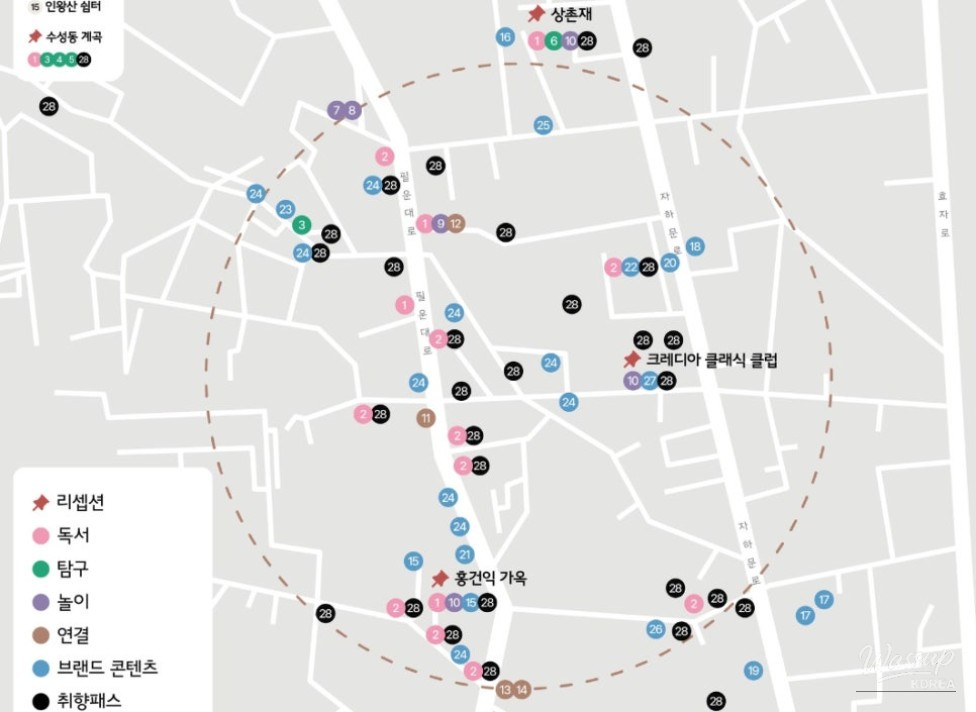
These are the locations of the Seochon Brand Week events. Some require reservations. There are many hands-on activities. It's a major festival in Seochon. Jongno-gu hosts many festivals in October.
I envy this area. Jongno-gu has so many of these spaces. Perhaps because it was once the capital of Joseon, it has a rich history and many stories.
This is Pilun-daero Road. Seochon's attractions are located on both sides of this road that cuts through the neighborhood.
There are many buildings with Hanok roofs that are rarely seen elsewhere.
Seochon Lounge is one of them. They're starting a new exhibition on October 23rd. The final preparations are underway.
This is one of Seochon's alleys. I saw that Hanok being built, and it turned out beautifully. The government provides significant subsidies for building Hanoks. While Hanoks may be less convenient for modern living, they have a courtyard, the charm of wood, and are simply beautiful to look at. The camping chair in the alley is memorable. A generation ago, there would have been a wooden platform there.
Even small spaces are decorated beautifully. This is just a roadside space, but it looks like a cafe garden.
This is where Suzy's hideout was in the movie 'Architecture 101.' Many great Korean films came out around the time 'Architecture 101' was released, but now... I'm not so sure.
Most of the houses in this area are Hanoks, and they are a mix of residential and commercial spaces.
Bukchon Hanok Village restricts access, only opening during the day and closing at night due to the influx of tourists. Seochon has no such restrictions. Since the no-traffic policy implemented in Bukchon Hanok Village, I no longer feel like visiting.
Jahamun-ro 7-gil and Pilun-daero are the main roads in Seochon. Jahamun-ro 7-gil has become a hot spot with many cafes and restaurants.
There's a large pavilion in the middle of Seochon, where many elderly people gather.
Next to it is Tongin Market, a traditional market famous for its oil tteokbokki (spicy rice cakes). It's located near the Blue House, so the president used to visit often.
I wondered what kind of building a two-story Hanok could be, but surprisingly, it's the 'Okin Childcare Harmony Center.' There's even a kids' cafe. Even public institutions in this neighborhood are in Hanoks. However, two-story Hanoks were rare in the Joseon era because of the ondol (underfloor heating) system. Ondol was widely used by commoners and was later adopted by the nobility for their tile-roofed houses. But ondol couldn't be installed on the second floor, so there were only one-story houses. China, with its warmer climate, could build two or three-story buildings without worrying about winter.
This is Pilun-daero Road. Every time I come here, I'm immersed in the scenery of the alleys on both sides of Pilun-daero. It's a really great neighborhood. Perhaps that's why so many writers and artists live in and come from Seochon. If only there weren't any apartments in sight, it wouldn't feel like Seoul at all. Because of the Blue House, high-rise apartments couldn't be built, which is why it became a tourist destination in Seoul.
There's a stone structure resembling Jizo Bodhisattva in front of a Hanok building.
At Sangchunjae, I participated in Open Bookshelf, Reading Village.
Seochon has a Hanok cultural space called Sangchunjae, where you can also experience Hanoks. This is a truly beautiful Hanok.
I returned the Instax camera and the two photos. The returned photos are displayed here.
Inside the Hanok, there was a photo exhibition showcasing the four seasons of Seochon. I've seen so many photos that I'm becoming less and less impressed, but I stopped for a moment. It was full of photos capturing Seochon's four seasons, including rainy and snowy days. Seochon during a downpour, and Seochon's autumn with its yellow ginkgo leaves.
These were truly wonderful photos that I hadn't seen in a long time. It's a blessing to have someone documenting the neighborhood like this.
Be sure to visit Sangchunjae.
The jars in the backyard are also very pretty.
At Open Bookshelf, Reading Village, if you read a book and submit a book review or a recommendation for someone else, you'll receive a souvenir. They also have an Instagram event.
I was immediately captivated by Han Kang's short story 'Paper Piano' from 'The Essentials.' When we were young, we played the piano with a paper piano printed with piano keys instead of a real piano. I remember playing one too, but I wasn't interested in the piano, so I took the easiest recorder exam.
I was very interested in sports. Han Kang writes that when she wanted to play the piano in elementary school, her mother couldn't afford piano lessons due to their family circumstances. But when she was in middle school, their financial situation improved, and her mother offered to send her to piano lessons. Han Kang wondered why her mother would suddenly offer piano lessons when she was supposed to be preparing for the middle school entrance exam.
But it seems her mother had seen her playing the paper piano. She felt it was something she hadn't been able to provide for her.
There's a time for everything you like. There's a reason why they say you shouldn't make your passion your profession. You never know when you might stop liking it.
You'll always be good at what you're good at. Han Kang writes in her short story about how her mother offered to send her to piano lessons when she was good at and enjoyed writing novels, poems, and essays.
Even now, countless parents across the country must feel a stab in their hearts when they can't give their children what they ask for because of their financial situation. I saw a good book for a while in a good space at an age when the things I want to do are gradually disappearing. The book 'The Essentials' is a good read because it contains a mix of the novel 'Greek Lesson', short stories, essays and poems.
By participating in the event and the Instagram event, I received a keyring and a fountain pen. It's a PREPPY Japanese fountain pen, and after using it now, wow~ the writing is really smooth. It costs over 3,000 KRW per pen, and it's amazing to see such a fountain pen. It's been almost 20 years since I last wrote anything, so I'm realizing how much writing instruments have evolved.
Nowadays, it's all about typing. That's why the warmth of handwriting, which reveals and contains personal individuality, has disappeared. I miss receiving handwritten letters.
The Seochon Brand Week, which runs until this Sunday, is a great event. Be sure to participate.
Start by visiting the Honggeonik House.

No comments yet.